组成图示
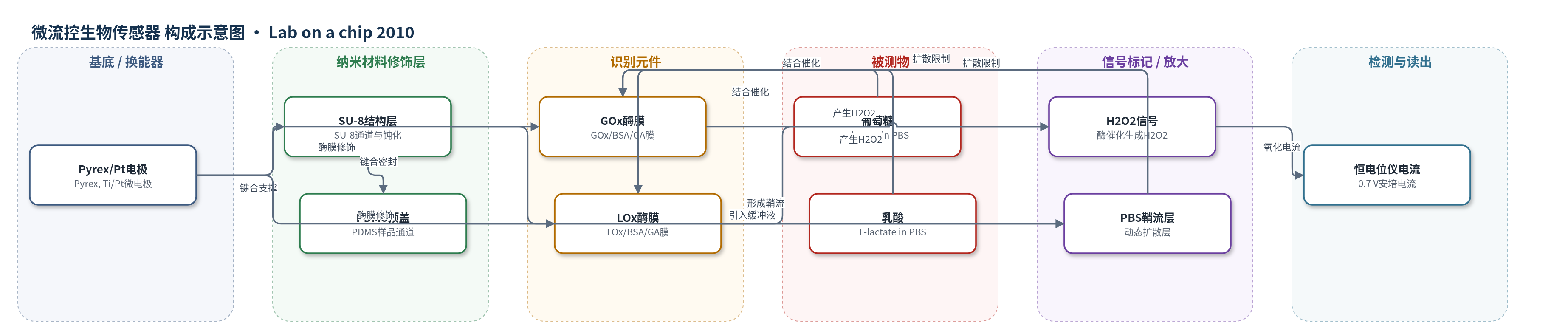
点击图片查看大图 · 依据论文自动绘制
传感器类型
微流控生物传感器
检测对象
葡萄糖(glucose)、L-乳酸(L-lactate/lactate);样品基质为PBS(磷酸盐缓冲液)配制溶液(文中未测真实样品)
检测原理
样品中葡萄糖或乳酸扩散穿过下方PBS鞘流层,到达Pt电极上的GOx或LOx酶膜。GOx催化葡萄糖氧化生成葡萄糖酸和H2O2,LOx催化L-乳酸氧化生成丙酮酸和H2O2。H2O2在Pt工作电极上于0.7 V发生氧化,产生与H2O2浓度成正比的安培电流。由于酶反应在高浓度下可能受氧限制,直接响应在约2 mM附近饱和;引入层流鞘流形成动态扩散层,使分析物需经扩散穿过缓冲液层,电极表面浓度按线性比例FLR降低,从而扩展线性范围并降低灵敏度。通过改变缓冲液流速可在线调节扩散层厚度、灵敏度和线性范围。平行电极与层流条件可减少相邻电极间化学串扰。
检测灵敏度
LOD: 0.2 mM;线性范围: 2 mM–15 mM(原文:increased from initially 2 mM up to 15 mM);灵敏度: 157 ± 28 nA/mM(glucose)、79 ± 12 nA/mM(lactate);表1: buffer 0 mL/min: glucose S 84.0 nA/mM, LR 1.5 mM; lactate S 32.2 nA/mM, LR 2 mM; buffer 30 mL/min: glucose S 40.0 nA/mM, LR 2.0 mM; lactate S 9.7 nA/mM, LR 4 mM; buffer 45 mL/min: lactate S 3.6 nA/mM, LR 8 mM; buffer 65 mL/min: glucose S 2.6 nA/mM, LR 15.0 mM; lactate S 1.1 nA/mM, LR 15 mM
效应效果
器件在15 mM葡萄糖下相邻乳酸电极无交叉信号,表明层流和电极腔可抑制化学串扰。酶膜沉积重现性好,葡萄糖灵敏度157±28 nA/mM(n=6)、乳酸79±12 nA/mM(n=5)。稳定性方面,前三周葡萄糖灵敏度下降7.4 nA mM-1 d-1,乳酸下降1.0 nA mM-1 d-1;乳酸膜因BSA含量较高更稳定。改变缓冲液流速后扩散层数秒内稳定,电流响应稳定且噪声不受影响。作者认为该一次性微流控芯片可低成本连续多分析物检测,并在线调节线性范围,适用于临床、运动代谢和发酵过程,但尚未用真实样品验证。
传感器的构成
- 基底/换能器电极:Pyrex玻璃基底,蒸镀20 nm Ti粘附层和130 nm Pt微电极,提供电化学换能与导电
- 中间结构层:SU-8光刻胶层,形成缓冲液通道、酶膜沉积通道和电极腔,并作为顶面钝化
- 顶盖/样品通道层:PDMS(Sylgard 184)复制模压层,形成样品通道、进出口和沉积区孔,与SU-8键合密封
- 识别/催化元件:葡萄糖氧化酶GOx或乳酸氧化酶LOx酶膜,分别催化葡萄糖或L-乳酸氧化生成H2O2
- 交联/稳定剂:牛血清白蛋白BSA与戊二醛GA共交联固定酶,Triton-X 100降低疏水性促进毛细填充
- 动态扩散层:PBS缓冲液层,从下方引入形成层流鞘流,作为可调节扩散限制层
- 外部控制/读出:PMMA支架、弹簧接触、多通道恒电位仪eDAQ和注射泵,施加0.7 V并采集电流
中文摘要
本文报道一种用于连续同时测量样品溶液中生物相关分析物的微流控生物传感器芯片的设计与制备。该传感器基于酶修饰电极对过氧化氢的安培检测。低集成、一次性芯片由PDMS和SU-8快速原型法制备。器件设计解决微流控生物传感器两大挑战:酶膜通过芯片外微流控沉积通道沉积在铂电极上,使膜沉积与芯片制造解耦,用户可决定何时及用何种混合物修饰电极;通过样品与缓冲液的层流鞘流形成动态扩散层,分析物须穿过缓冲液层才能到达电极上固定酶膜,通过改变两层流速控制扩散层厚度,从而调节传感器灵敏度和线性区域。缓冲液与样品流汇合点对形成层流鞘流至关重要。计算流体力学模拟考虑流体动力学和扩散,结果与葡萄糖和乳酸检测实验一致。葡萄糖传感器灵敏度157±28 nA/mM,乳酸79±12 nA/mM;线性响应范围可从初始2 mM提高到15 mM,检出限0.2 mM。
英文摘要
This article presents the design and fabrication of a microfluidic biosensor cartridge for the continuous and simultaneous measurement of biologically relevant analytes in a sample solution. The biosensor principle is based on the amperometric detection of hydrogen peroxide using enzyme-modified electrodes. The low-integrated and disposable cartridge is fabricated in PDMS and SU-8 by rapid prototyping. The device is designed in such a way that it addresses two major challenges of biosensors using microfluidics approaches. Firstly, the enzymatic membrane is deposited on top of the platinum electrodes via a microfluidic deposition channel from outside the cartridge. This decouples the membrane deposition from the cartridge fabrication and enables the user to decide when and with what mixture he wants to modify the electrode. Secondly, by using laminar sheath-flow of the sample and a buffer solution, a dynamic diffusion layer is created. The analyte has to diffuse through the buffer solution layer before it can reach the immobilized enzyme membrane on the electrode. Controlling of the thickness of the diffusion layer by variation of the flow-rate of the two layers enables the user to adjust the sensitivity and the linear region of the sensor. The point where the buffer and sample stream join proved critical in creating the laminar sheath-flow. Results of computational simulations considering fluid dynamics and diffusion are presented. The consistency of the device was investigated through detection of glucose and lactate and are in accordance with the CFD simulations. A sensitivity of 157+/-28 nA/mM for the glucose sensor and 79+/-12 nA/mM for the lactate sensor was obtained. The linear response range of these biosensors could be increased from initially 2 mM up to 15 mM with a limit of detection of 0.2 mM.