组成图示
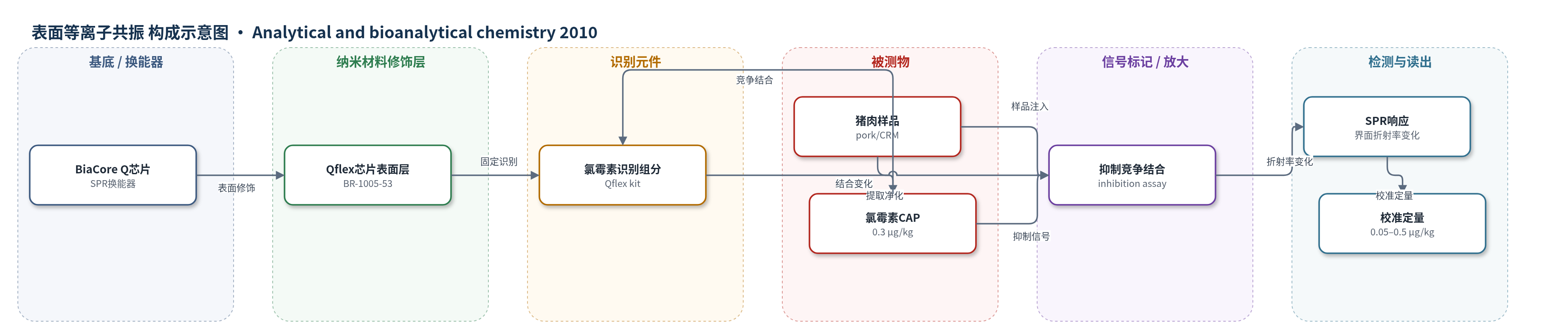
点击图片查看大图 · 依据论文自动绘制
传感器类型
表面等离子共振(SPR)生物传感器
检测对象
氯霉素(chloramphenicol, CAP);样品基质:猪肉肌肉、猪肉匀浆、冻干猪肉候选 CRM ERM-BB130
检测原理
猪肉样品经 70% methanol 提取和反相 SPE 净化后,提取液注入 BiaCore Q 表面等离子共振(SPR)系统。芯片表面由 Qflex Chloramphenicol kit 提供氯霉素识别组分,形成识别层。样品中的氯霉素(CAP)与识别层上的竞争物或标记物发生竞争性结合,使界面结合量发生变化。SPR 通过监测界面折射率变化产生响应;CAP 浓度越高,竞争越强,结合信号越低,呈抑制法响应。按 0.05–0.5 μg/kg 的校准曲线进行定量。原文未报告额外信号放大策略。
检测灵敏度
校准范围: 0.05–0.5 μg/kg(4 levels)
效应效果
该研究将候选 CRM ERM-BB130 与五种 ELISA 和一种修改版 BiaCore SPR 生物传感器进行比较。BiaCore 检测的校准范围为 0.05–0.5 μg/kg,样品 D 结果高于上限并记为 >0.5 μg/kg。其重复性 RSD 为:B 17.8%、C 9.0%、ERM-BB130 3.8%;回收率为 126±34%,结果经回收率校正。与 LC–MS/MS 和 GC–MS 相比,BiaCore 存在明显正偏差,分别为 118–133% 和 66–86%,但肉类样品与 CRM 之间相对偏差约 10%,表明可交换性可接受。作者认为 ERM-BB130 可作为该 SPR 筛查方法的质量控制样品,但试剂盒校准可能需检查以降低正偏差。
传感器的构成
- 换能器/仪器:BiaCore Q 系统(SPR 换能器,用于实时监测界面结合变化)
- 芯片表面层:Qflex Chloramphenicol kit BR-1005-53 芯片表面识别层(原文未给出具体材料)
- 识别元件:Qflex kit 中的氯霉素识别组分(抑制法,原文未给出抗体或配体名称)
- 样品前处理:70% methanol 提取与反相 SPE(从猪肉中提取并净化 CAP)
- 被测物:chloramphenicol (CAP)(猪肉肌肉或 CRM 中的目标残留)
- 信号读出:SPR 响应与校准曲线(0.05–0.5 μg/kg,4 levels)
中文摘要
氯霉素(CAP)因对食品动物产生不良健康效应,已在欧盟禁止用于食品生产动物。欧洲委员会联合研究中心参考物质与测量研究所(IRMM)正在开发猪肉中氯霉素认证参考物质(CRM)ERM-BB130,用于分析方法的验证和性能确认。该材料拟以液相色谱-串联质谱(LC–MS/MS)和气相色谱-质谱(GC–MS)方法认证,目标氯霉素水平约为最低要求性能限(MRPL)0.3 μg/kg。为证明该材料可作为筛查方法的质量控制工具,开展了可交换性研究,涉及五种商品化酶联免疫吸附测定(ELISA)试剂盒和一个生物传感器检测(BiaCore 试剂盒)。对含氯霉素浓度接近 MRPL 的冷冻研磨猪肉匀浆和候选 CRM(冻干粉末)分别用 LC–MS/MS、GC–MS 及六种筛查方法测定。成对方法比较表明,CRM 可成功用作六种筛查方法的质量控制样品。研究认为 ERM-BB130 与所研究检测体系具有足够可交换性,使用相关试剂盒的实验室可借此证明结果正确性;但各检测体系在偏差、重复性和方法拟合度方面存在差异。
英文摘要
Chloramphenicol (CAP), an effective antibiotic against many microorganisms, is meanwhile banned in the EU for treatment of food-producing animals due to adverse health effects. The Institute for Reference Materials and Measurements (IRMM) is currently developing a certified reference material (CRM) for CAP in pork, intended for validation and method performance verifications of analytical methods. The material will be certified using liquid chromatography-tandem mass spectrometry (LC-MS/MS) and gas chromatography-mass spectrometry (GC-MS) methods and has a target CAP level around the minimum required performance limit (MRPL) of 0.3 microg/kg. To prove that the material can be applied as a quality control tool for screening methods, a commutability study was conducted, involving five commercially available enzyme-linked immunosorbent assay kits and one biosensor assay (BiaCore kit). Meat homogenates (cryo-milled wet tissue) with CAP concentrations around the MRPL and the candidate CRM (lyophilised powder) were measured by LC-MS/MS and GC-MS as well as the six screening methods. Pairwise method comparisons of results obtained for the two sample types showed that the CRM can successfully be applied as quality control (QC) sample to all six screening methods. The study suggests that ERM-BB130 is sufficiently commutable with the investigated assays and that laboratories applying one of the investigated kits therefore benefit from using ERM-BB130 to demonstrate the correctness of their results. However, differences among the assays were observed, either in the abundance of bias between screening and confirmatory LC and GC methods, the repeatability of test results, or goodness of fit between the methods.