组成图示
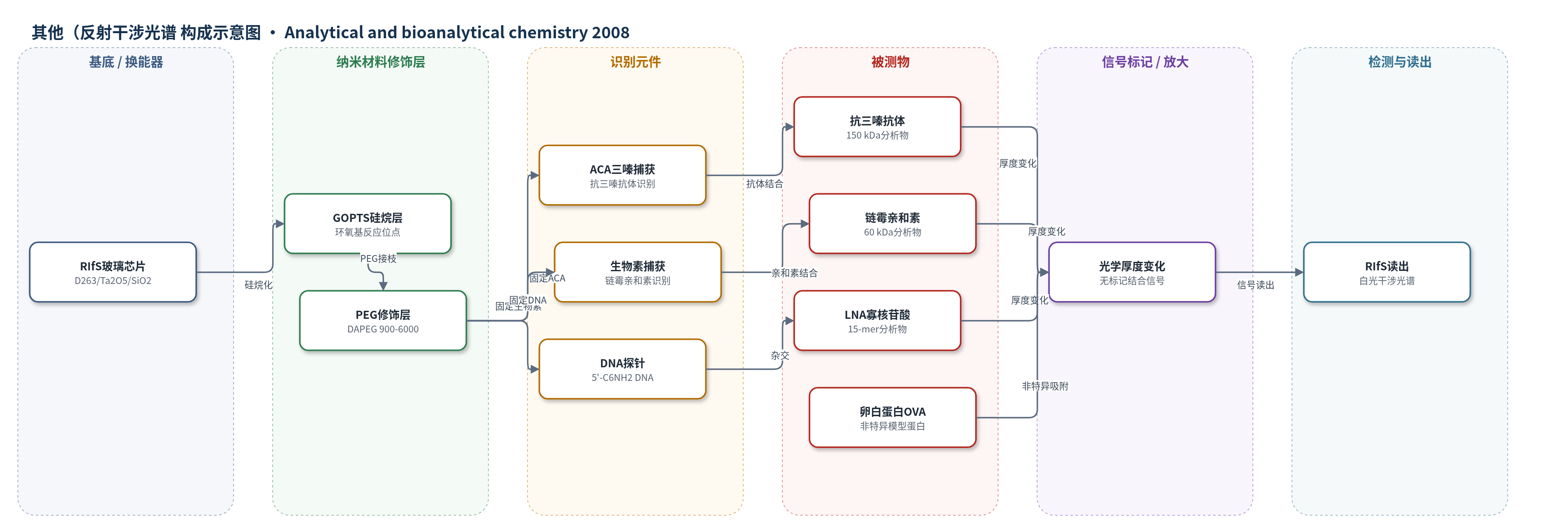
点击图片查看大图 · 依据论文自动绘制
传感器类型
其他(反射干涉光谱(RIfS)生物传感器)
检测对象
抗三嗪抗体(anti-s-triazine antibody)、链霉亲和素(streptavidin)、15-mer LNA寡核苷酸(LNA oligonucleotide);样品基质为PBS缓冲液(含OVA/BSA非特异蛋白模型)
检测原理
该传感器采用RIfS光学换能:D263玻璃芯片上的Ta2O5/SiO2多层膜在白光照射下产生干涉,分析物结合到敏感层后改变SiO2层的表观光学厚度,二极管阵列光谱仪通过干涉光谱位移或表观厚度变化读出信号。PEG层提供抗非特异界面,末端分别固定ACA三嗪、生物素或DNA探针,依次捕获抗三嗪抗体、链霉亲和素或互补LNA寡核苷酸。结合事件使敏感层质量/光学厚度增加,信号随分析物浓度升高而增大并趋于饱和;未结合的非特异蛋白被PEG排斥,因此背景低。方法为无标记检测,未使用酶或核酸放大。
检测灵敏度
原文未报告LOD、线性范围、灵敏度斜率或相关系数。
效应效果
表面抗非特异性能良好:OVA非特异吸附在多数PEG涂层上不可检测,一般不超过最大负载的1%;例外为PEG6000抗体体系2%、PEG900链霉亲和素体系1.6%和PEG900寡核苷酸体系8%。中等长度PEG2000/PEG3000具有最佳最大负载,PEG6000因链缠结和塌陷导致负载下降且标准偏差较高,均质性差。混合PEG未显著提高最大负载。提高PEG制备浓度使抗体特异结合信号增加38%,非特异结合无明显变化。表面可用0.5% SDS(pH 1.9)再生数百次,适合光学生物传感器表面优化。
传感器的构成
- 基底/换能器:D263玻璃RIfS芯片,含10 nm Ta2O5和330 nm SiO2,提供白光干涉光学换能。
- 硅烷化层:GOPTS,在清洁活化玻璃上形成环氧基反应位点。
- PEG修饰层:DAPEG(PEG900/2000/3000/6000)共价接枝,形成抗非特异PEG刷或混合PEG层。
- 识别元件A:ACA三嗪衍生物,共价固定于PEG末端,捕获抗三嗪抗体。
- 识别元件B:生物素,固定于PEG末端,结合链霉亲和素。
- 识别元件C:5'-C6NH2 DNA探针,固定于PEG末端,与互补LNA寡核苷酸杂交。
- 信号读出:无标记分析物结合改变SiO2层表观光学厚度,由RIfS检测。
中文摘要
为在复杂生物基质中利用光学生物传感器检测低浓度分析物,需要高捕获分子表面负载和低非特异结合。作者将不同长度的聚乙二醇(PEG)以不同混合比例和浓度共价固定到玻璃型表面,并用三种受体进行修饰。采用无标记、时间分辨反射干涉光谱(RIfS)监测模型蛋白卵白蛋白(OVA)的非特异结合以及相应分析物的最大表面负载。所用三种分析物尺寸不同:抗三嗪抗体约150 kDa、链霉亲和素约60 kDa、15 bp寡核苷酸约5 kDa。研究考察混合不同长度PEG能否模拟三维基质以提高表面负载,并分析分析物分子大小对混合PEG表面负载的影响。此外,采用偏振调制红外反射吸收光谱(PM-IRRAS)、原子力显微镜(AFM)和椭偏仪对涂层形貌与组成进行表征。
英文摘要
For detection of low concentrations of analytes in complex biological matrices using optical biosensors, a high surface loading with capture molecules and a low nonspecific binding of nonrelevant matrix molecules are essential. To tailor biosensor surfaces in such a manner, poly(ethylene glycols) (PEG) in varying lengths were immobilised covalently onto glass-type surfaces in different mixing ratios and concentrations, and were subsequently modified with three different kinds of receptors. The nonspecific binding of a model protein (ovalbumin, OVA) and the maximum loading of the respective analytes to these prepared surfaces were monitored using label-free and time-resolved reflectometric interference spectroscopy (RIfS). The three different analytes used varied in size: 150 kDa for the anti-atrazine antibody, 60 kDa for streptavidin and 5 kDa for the 15-bp oligonucleotide. We investigated if the mixing of PEG in different lengths could increase the surface loadings of analyte mimicking a three-dimensional matrix as was found using dextrans as sensor coatings. In addition, the effect on the surface loading was investigated with regard to the size of the analyte molecule using such mixed PEGs on the sensor surface. For further characterisation of the surface coatings, polarisation modulation infrared reflection absorption spectroscopy, atomic force microscopy, and ellipsometry were applied.