组成图示
点击图片查看大图 · 依据论文自动绘制
传感器类型
表面等离子共振(SPR)生物传感器
检测对象
DB293 及其衍生物(DB1003、DB75、DB293 等杂环双胍小分子);样品基质:10 mM cacodylic acid buffer(pH 6.25,100 mM NaCl,1 mM EDTA)
检测原理
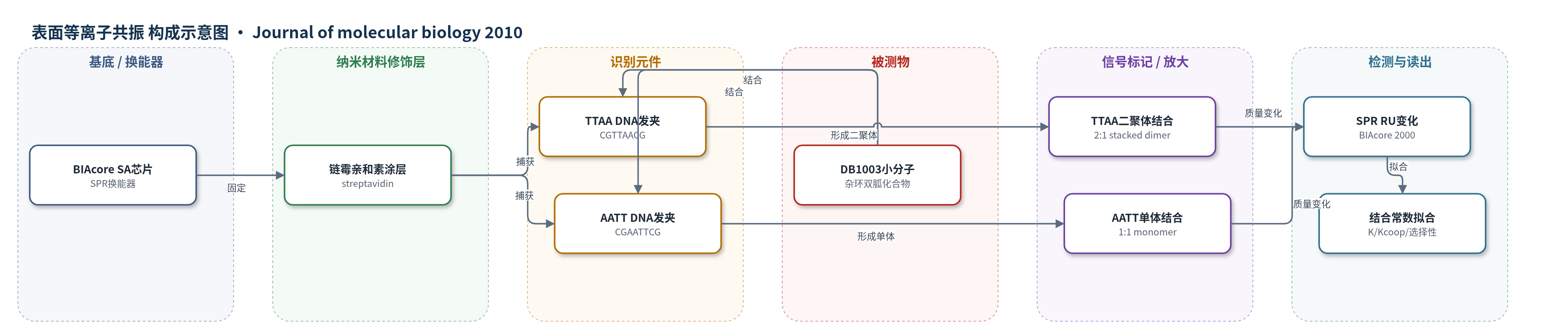
该 SPR 生物传感器以 BIAcore SA 芯片为换能基底,链霉亲和素涂层捕获 5′-生物素标记的 DNA 发夹(CGTTAACG 或 CGAATTCG),使 TTAA/AATT 序列固定于芯片表面。待测 DB293 衍生物溶液流过芯片时,小分子进入 DNA 小沟并与固定化序列结合;DB1003 在 TTAA 位点形成 2:1 堆叠二聚体,在 AATT 位点主要形成 1:1 单体。结合事件增加界面质量并改变局部折射率,使表面等离子共振角发生偏移,仪器以共振单位(RU)记录信号。稳态 RU 与自由化合物浓度作图,按单/双位点模型拟合,得到 K1、K2、Kcoop 和 KTTAA/KAATT。信号大小随结合量增加而增大,二聚体协同结合使 TTAA 响应显著高于 AATT。
检测灵敏度
—
效应效果
SPR 显示 DB1003 对 TTAA 呈强正协同二聚体结合,Kcoop=178,选择性 KTTAA/KAATT=5.8;DB293 虽 Kcoop=400,但 KTTAA/KAATT=0.5,DB75 对 TTAA 仅弱结合。K 在 5×10^6–5×10^8 M^-1 范围重复实验变异小于 ±20%。DNase I 足迹实验表明 DB1003 在长 DNA 中只保护 TTAA,而 DB75 保护 AATTA/ATTT。DB1003-TTAA ΔTm=28.7 °C。作者认为该体系可用于设计选择性靶向 TTAA 的小沟结合剂,以调控基因表达或开发低毒性治疗剂。
传感器的构成
- 基底/换能器:BIAcore 2000 SPR 光学生物传感器与 BIAcore SA 传感器芯片,提供表面等离子共振检测。
- 固定化层:链霉亲和素(streptavidin)涂层,用于捕获生物素标记 DNA。
- 识别/捕获元件:5′-生物素标记 DNA 发夹寡核苷酸(CGTTAACG 或 CGAATTCG),固定于芯片表面作为 TTAA/AATT 结合位点。
- 流动相/缓冲液:10 mM cacodylic acid buffer(pH 6.25,含 100 mM NaCl 和 1 mM EDTA),维持结合平衡。
- 分析物:DB293 及其衍生物(DB1003、DB75、DB293 等)溶液,流过芯片与固定化 DNA 结合。
- 信号读出:SPR 共振单位(RU)变化,由结合质量引起,稳态 RU 用于拟合结合常数。
中文摘要
随着基因组序列信息增加,利用可进入细胞的合成小分子调控基因表达成为可能,但能选择性识别不同 AT 序列的小分子仍有限。多数 DNA 小沟结合剂偏好 AATT 等 A-tract 序列,却难以区分不同 AT 序列。本文围绕 DB293 及其衍生物,研究杂环双胍阳离子在 TTAA 位点诱导二聚体结合的结构基础、结合亲和力与序列特异性。作者通过生物传感器-表面等离子共振(SPR)测定化合物与固定化 TTAA/AATT DNA 发夹的结合常数和化学计量,发现 DB293 可在 TTAA 形成强正协同二聚体,但对 AATT 无选择性;将 DB293 中苯基替换为呋喃得到的 DB1003(呋喃-呋喃-苯并咪唑双胍)以二聚体强结合 TTAA,且 KTTAA/KAATT≈6。圆二色和 DNase I 足迹实验证实 DB1003 偏好 TTAA。结果表明,π 体系堆叠面、苯并咪唑/吲哚 NH 与双胍提供的氢键供体以及二聚体曲率匹配小沟曲率,是区分 TTAA 与 AATT 的关键。
英文摘要
With the increasing number and variations of genome sequences available, control of gene expression with synthetic, cell-permeable molecules is within reach. The variety of sequence-specific binding agents is, however, still quite limited. Many minor groove binding agents selectivity recognize AT over GC sequences but have less ability to distinguish among different AT sequences. The goal with this article is to develop compounds that can bind selectively to different AT sequences. A number of studies indicate that AATT and TTAA sequences have significantly different physical and interaction properties and different requirements for minor groove recognition. Although it has been difficult to get minor groove binding at TTAA, DB293, a phenyl-furan-benzimidazole diamidine, was found to bind as a strong, cooperative dimer at TTAA but with no selectivity over AATT. In order to improve selectivity, we made modifications to each unit of DB293. Binding affinities and stoichiometries obtained from biosensor-surface plasmon resonance experiments show that DB1003, a furan-furan-benzimidazole diamidine, binds strongly to TTAA as a dimer and has selectivity (K(TTAA)/K(AATT)=6). CD and DNase I footprinting studies confirmed the preference of this compound for TTAA. In summary, (i) a favorable stacking surface provided by the pi system, (ii) H-bond donors to interact with TA base pairs at the floor of the groove provided by a benzimidazole (or indole) -NH and amidines, and (iii) appropriate curvature of the dimer complex to match the curvature of the minor groove play important roles in differentiating the TTAA and AATT minor grooves.