组成图示
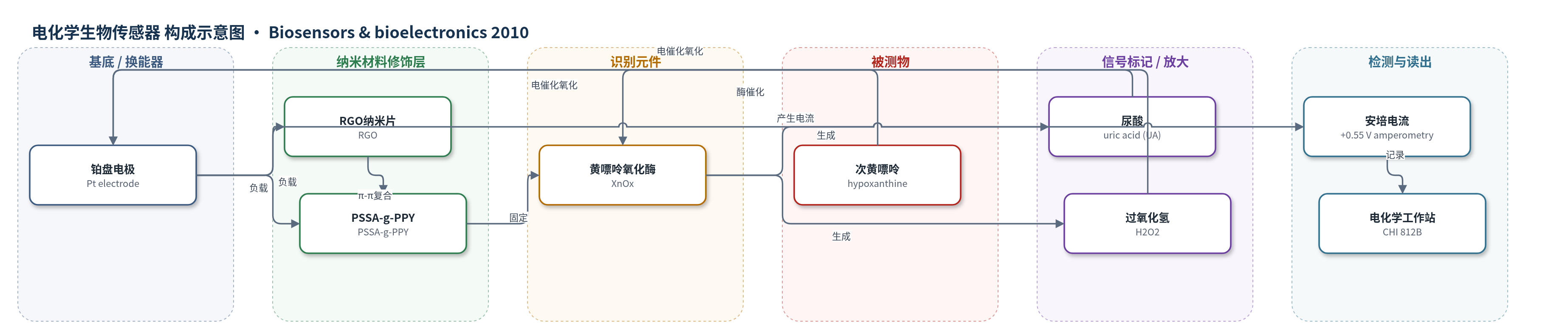
点击图片查看大图 · 依据论文自动绘制
传感器类型
电化学生物传感器
检测对象
次黄嘌呤(hypoxanthine),样品基质为鱼样匀浆滤液(fish sample filtrate)
检测原理
该传感器以黄嘌呤氧化酶(XnOx)为识别/催化元件。次黄嘌呤进入电极界面后,在XnOx催化下与O2反应生成黄嘌呤和H2O2,黄嘌呤进一步被氧化生成尿酸(UA)和H2O2。PSSA-g-PPY/RGO修饰的Pt电极对H2O2和UA具有电催化氧化活性,可显著降低氧化过电位并加快电子转移。在+0.55 V下采用安培法检测,H2O2和UA氧化产生的阳极电流随次黄嘌呤浓度增加而增大。信号放大来自双产物同时电催化氧化以及RGO与导电共聚物提供的高导电、高负载界面。
检测灵敏度
LOD: 10 nM (S/N = 3);线性范围: 3.0 × 10⁻⁸ M–2.8 × 10⁻⁵ M;灵敏度: 673 ± 4 μA M−1 cm−2;R^2 = 0.999
效应效果
传感器响应时间约5 s达到稳态电流的95%。对0.05和5 μM次黄嘌呤的重复测定RSD分别为3.4%和2.2%,六个独立制备电极的RSD为2.6%。4 ℃ PBS中保存4周保留94%响应;每4天使用一次,28天后保留81%。鱼样加标10 μM回收率为93.8%–96.4%。与钌紫介导、电化学发光和金纳米粒子安培传感器相比,线性范围更宽、检出限更低,作者认为可用于鱼产品新鲜度快速检测。
传感器的构成
- 工作电极基底:铂盘电极(Pt electrode),作为电子转导与电催化基底
- 纳米复合修饰层:PSSA-g-PPY/RGO(水溶性导电聚吡咯接枝共聚物PSSA-g-PPY功能化还原氧化石墨烯RGO),提供导电性、生物相容性和电催化活性
- 识别/催化元件:黄嘌呤氧化酶(XnOx),催化次黄嘌呤氧化生成黄嘌呤、尿酸(UA)和过氧化氢(H2O2)
- 固定膜:聚二甲基二烯丙基氯化铵(PDDA),固定含XnOx的PSSA-g-PPY/RGO复合层
- 电解液:0.05 M磷酸盐缓冲液(PBS,pH 7.0),提供酶反应与电催化介质
- 信号产物:H2O2与UA,在+0.55 V下被电催化氧化产生阳极电流
中文摘要
本文通过π–π非共价相互作用,用水溶性导电聚吡咯接枝共聚物聚苯乙烯磺酸-g-吡咯(PSSA-g-PPY)功能化还原氧化石墨烯片(RGO),构建新型电催化生物传感平台。所得PSSA-g-PPY/RGO纳米复合可在水中稳定分散至少2个月,溶解度约3.0 mg/mL,并经AFM、XPS、紫外–可见吸收、接触角和电化学阻抗谱表征。该复合修饰铂电极在中性介质中对过氧化氢(H2O2)和尿酸(UA)氧化具有较高电催化活性。进一步将黄嘌呤氧化酶(XnOx)固定于修饰电极,构建次黄嘌呤生物传感器。传感器在3.0×10−8至2.8×10−5 M范围内线性响应,灵敏度为673±4 μA M−1 cm−2,信噪比3下检出限为10 nM,较此前报道低一个数量级。鱼样中次黄嘌呤检测结果与参考值一致,表明该水溶性导电共聚物可用于石墨烯功能化及生物传感应用。
英文摘要
A novel electrocatalytic biosensing platform was designed by the functionalization of reduced graphene oxide sheets (RGO) with conducting polypyrrole graft copolymer, poly(styrenesulfonic acid-g-pyrrole) (PSSA-g-PPY), via π-π noncovalent interaction. The resulting nanocomposite could well disperse in water for at least 2 months with a solubility of 3.0 mg mL(-1). The nanocomposite was characterized with atomic force microscopy, X-ray photoelectron spectroscopy, ultraviolet-visible absorption, contact angle measurement, and electrochemical impedance spectroscopy. Based on the advantageous functions of PSSA-g-PPY and RGO, the functional nanocomposite modified platinum electrode showed high electrocatalytic activity toward the oxidation of hydrogen peroxide and uric acid in neutral media. Further, a hypoxanthine biosensor was constructed by combining the modified electrode with the enzymatic reaction of xanthine oxidase. The biosensor exhibited a wide linear response ranging from 3.0×10(-8) to 2.8×10(-5) M with a high sensitivity of 673±4 μA M(-1) cm(-2). The detection limit of 10nM at a signal-to-noise ratio of 3 was one order of magnitude lower than that reported previously. The assay results of hypoxanthine in fish samples were in a good agreement with the reference values. The water-soluble conducting copolymer could serve as an efficient species for functionalization and solubilization of graphene sheets in biosensing and biocatalytic applications.