组成图示
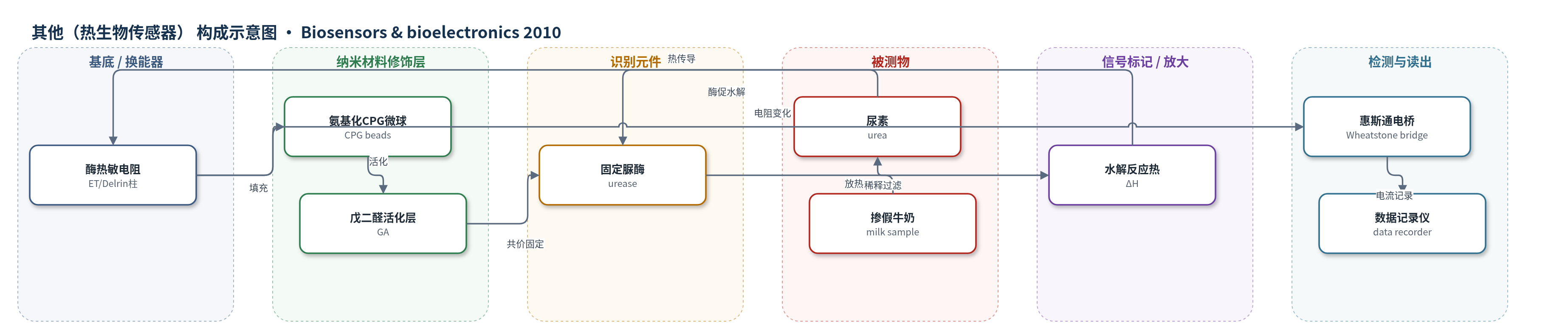
点击图片查看大图 · 依据论文自动绘制
传感器类型
其他(热生物传感器)
检测对象
尿素(urea, CO(NH2)2);样品基质:掺假牛奶/商业牛奶(adulterated milk / commercial milk),磷酸盐缓冲液标准液
检测原理
样品经稀释、过滤后由流动注入系统引入,100 mM磷酸盐缓冲液(pH 7.2)以0.5 mL/min作为载液,0.1 mL样品进入装有固定脲酶CPG柱的酶热敏电阻。脲酶选择性催化尿素水解:CO(NH2)2+H2O→2NH3+CO2,反应放热。尿素浓度越高,单位时间内水解底物越多,释放反应热越大,热敏电阻局部温度/热流变化越明显。热敏电阻的电阻变化经惠斯通电桥转换为电流信号,并由数据记录仪采集。该过程无需外加标记物或化学放大,依靠酶反应热与浓度成正比实现定量,响应时间约2 min。
检测灵敏度
LOD: 0.1 mM (6.06 ppm);线性范围: 1–200 mM(缓冲液与牛奶);宽线性范围: 0.1–200 mM;动态范围: 0.1–250 mM(牛奶);灵敏度: 4.17% mM−1(缓冲液)、4.58% mM−1(牛奶);R^2 = 0.99;%R.S.D. = 0.96(缓冲液)、0.95(牛奶)
效应效果
该传感器对牛奶采用离心、1:4稀释和0.45/0.22 μm过滤进行基质匹配,避免脂肪堵塞。加标牛奶回收率97.56–108.70%,RSD 0.95%;缓冲液RSD 0.96%。响应时间约2 min,每小时分析30个样品。固定脲酶柱室温连续使用180天,前30天保持90%初始响应,45天衰减约16%,75、150、180天分别保持82%、73%、70%,单柱约500个样品。与商业比色试剂盒相比,FIA-ET线性范围更高(0.1–200 mM)、灵敏度更高;试剂盒LOD 40 ppm、每小时最多72个样品。作者认为该方法经济、稳健,适合乳品厂常规监控。
传感器的构成
- 换能器/柱体:酶热敏电阻(enzyme thermistor, ET)与Delrin柱,承载固定脲酶并将反应热转换为电阻/电信号
- 载体修饰层:氨基化控制孔玻璃微球(amine-silanized CPG, Trisoperl, 125–140 μm, 50 nm孔),提供固定脲酶的载体
- 交联活化层:戊二醛(glutaraldehyde, GA)活化CPG表面氨基,用于共价连接脲酶
- 识别元件:刀豆脲酶(urease, Jack bean, EC 3.5.1.5),选择性催化尿素水解
- 封闭剂:三乙醇胺(tri-ethanolamine, TEA)封闭未反应基团,终止活化反应
- 流动注入模块:蠕动泵、注射阀、0.1 mL样品环、PTFE管与100 mM磷酸盐缓冲液(PB)载液,实现连续进样和基线稳定
- 信号读出:惠斯通电桥、斩波稳幅放大器与数据记录仪,将热敏电阻变化转为电流并记录
中文摘要
牛奶中掺入尿素是重大食品安全问题,尤其对孕妇、儿童和病人危害较大,因此需要快速可靠的检测手段替代现有诊断工具。本文报道了一种用于监测掺假牛奶中尿素的流动注入分析-酶热敏电阻(FIA-ET)生物传感系统。该传感器将刀豆脲酶共价固定于氨基化控制孔玻璃(CPG)微球上,并装入热敏电阻内的柱中,选择性水解样品中的尿素。尿素水解产生的反应热被热敏电阻检测,其比热信号与牛奶样品中尿素浓度成正比。在100 mM磷酸盐缓冲液(pH 7.2)中,传感器对尿素具有1–200 mM线性范围,相对标准偏差为0.96%;加标牛奶样品中尿素回收率为97.56–108.7%,RSD为0.95%。分析采用简单过滤和基质匹配处理牛奶,响应时间约2 min,并与比色法结果良好一致。固定脲酶柱在室温连续使用180天仍保持良好操作稳定性。
英文摘要
Urea in adulterated milk is one of the major health concern, it is especially harmful to pregnant women, children, and the sick. A sophisticated and reliable detection system is needed to replace current diagnostic tools for the urea in the milk. In this work, we report a flow injection analysis-enzyme thermistor (FIA-ET) bio-sensing system for monitoring of urea in adulterated milk. This biosensor was made of the covalently immobilized enzyme urease (Jack bean) on controlled pore glass (CPG) and packed into a column inside thermistor, which selectively hydrolysed the urea present in the sample. The specific heat registered from the hydrolysis of urea was found proportional to the concentration of urea present in the milk sample. The biosensor showed a linear range 1-200 mM, with % R.S.D. 0.96 for urea in 100 mM phosphate buffer, pH 7.2. Good recoveries were obtained (97.56-108.7%) for urea up to 200 mM in the spiked milk samples with % R.S.D. 0.95. In the adulterated milk, a simple filtration strategy and matrix matching technique was used to analyse urea. The response time of the sensor was evaluated for urea, which was 2 min, and it gives satisfactory output. A good comparison was observed between the urea concentrations measured through FIA-ET and the colorimetric method. These results indicate that utilizing this system could be very effective to detect low and high level of urea in adulterated milk. The immobilized urease column exhibited a good operational stability up to 180 days when used continuously at room temperature.