组成图示
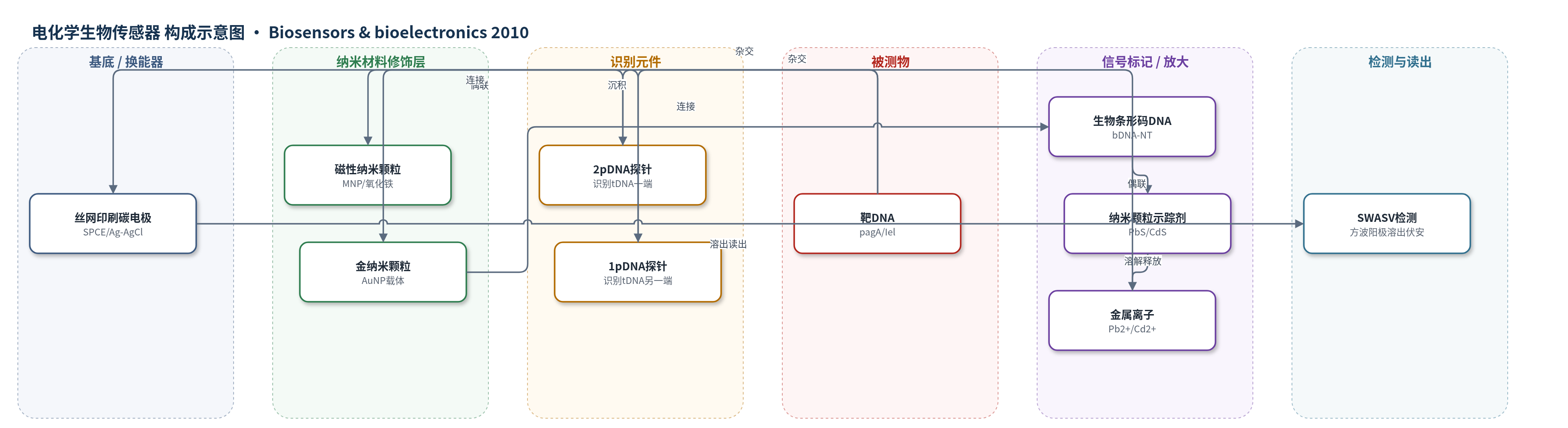
点击图片查看大图 · 依据论文自动绘制
传感器类型
电化学生物传感器
检测对象
炭疽杆菌保护性抗原A基因(pagA, Bacillus anthracis)、肠炎沙门氏菌插入元件基因(Iel, Salmonella enteritidis);样品基质为细菌培养物提取DNA经PCR扩增后的DNA溶液/稀释PCR产物
检测原理
两种靶DNA先经95°C变性为单链。MNP-2pDNA与tDNA一端杂交,1pDNA-AuNP-bDNA-NT与tDNA另一端杂交,形成MNP-2pDNA/tDNA/1pDNA-AuNP-bDNA-NTs三明治复合物。磁场分离去除未反应材料。每个AuNP上连接大量bDNA-NT,NT为PbS或CdS,实现信号放大。复合物用1 M HNO3溶解,释放Pb2+或Cd2+。加入含Bi3+的0.1 M醋酸缓冲液(pH 4.5),在SPCE碳工作电极上-1.2 V原位沉积铋膜和重金属离子,然后正向方波阳极溶出伏安扫描,Pb2+在约-0.61 V、Cd2+在约-0.87 V产生溶出峰。峰电流随靶DNA对数浓度增加而增加,不同金属峰电位区分多靶标。
检测灵敏度
LOD: 0.5 ng/mL(Iel 基因,CdS);LOD: 50 pg/mL(pagA 基因,PbS);单检测 pagA 灵敏度: 0.2 pg/mL(200 fg/mL)
效应效果
该传感器在特异性测试中表现良好:无靶DNA时-0.61 V(Pb)和-0.87 V(Cd)无溶出峰;0.05 μg/mL单靶pagA在-0.61 V产生39 μA峰且-0.87 V无峰,单靶Iel在-0.87 V产生46 μA峰,-0.61 V仅出现可能因清洗不彻底的小峰。多靶0.05 μg/mL时两峰分别为35 μA和39 μA,可区分两种病原。CdS与PbS纳米颗粒在4°C保存1个月稳定不聚集。每次测量重复3次并取平均,但未报告RSD、加标回收率或与ELISA/qPCR等方法的对比。作者认为其可用于生物恐怖剂、共感染及同一样本中多种污染物的快速检测。
传感器的构成
- 换能器电极:丝网印刷碳电极(SPCE)芯片,含碳工作电极与Ag/AgCl对/参比电极,用于SWASV检测Pb2+/Cd2+
- 纳米材料修饰层:金纳米颗粒(AuNPs,平均直径约15 nm),作为1pDNA和bDNA-NT载体
- 纳米材料修饰层:氨基修饰磁性纳米颗粒(MNPs,聚胺功能化氧化铁颗粒),经sulfo-SMCC偶联2pDNA,用于识别靶DNA另一端并磁场分离
- 识别元件:第二靶标特异性DNA探针(2pDNA),修饰于MNPs表面,识别pagA或Iel靶DNA一端
- 识别元件:第一靶标特异性DNA探针(1pDNA),巯基自组装于AuNPs表面,识别靶DNA另一端
- 信号标记/放大元件:生物条形码单链DNA(bDNA-NT),氨基末端经EDC/NHS偶联PbS或CdS纳米颗粒示踪剂(NTs),大量连接于AuNPs,提供信号放大
- 信号标记物:PbS或CdS纳米颗粒示踪剂(NTs),溶解后释放Pb2+或Cd2+,作为电化学溶出信号源
- 封闭剂:sulfo-NHS acetate,封闭MNPs表面未反应sulfo-SMCC;DTT用于还原巯基DNA探针
- 检测介质:1 M HNO3溶解NTs,0.1 M醋酸缓冲液(pH 4.5,含1 mg/L Bi3+)用于原位铋膜沉积与SWASV
中文摘要
本文报道了一种高放大、纳米颗粒基、生物条形码电化学生物传感器,用于同时检测炭疽杆菌(Bacillus anthracis)保护性抗原A基因(pagA)和肠炎沙门氏菌(Salmonella enteritidis)插入元件基因(Iel)。该传感器主要由金纳米颗粒(AuNPs)、磁性纳米颗粒(MNPs)和纳米颗粒示踪剂(NTs,如PbS和CdS)组成。AuNPs表面修饰第一靶标特异性DNA探针(1pDNA)和大量NT末端生物条形码单链DNA(bDNA-NT),分别用于识别靶DNA一端并提供信号报告与放大;MNPs表面修饰第二靶标特异性DNA探针(2pDNA),识别靶基因另一端。靶DNA与两种纳米颗粒结合后形成MNP-2pDNA/tDNA/1pDNA-AuNP-bDNA-NTs三明治结构,并通过磁场分离。由于每个DNA探针结合事件可携带大量NT,信号显著放大。随后NTs在1 M硝酸中溶解,释放的NT2+离子在丝网印刷碳电极(SPCE)芯片上采用方波阳极溶出伏安法(SWASV)检测。结果显示,该多重生物条形码DNA传感器对Iel基因的检出限为0.5 ng/mL(CdS),对pagA基因的检出限为50 pg/mL(PbS),具有同一样本快速检测多种病原体的应用潜力。
英文摘要
A highly amplified, nanoparticle-based, bio-barcoded electrochemical biosensor for the simultaneous multiple detection of the protective antigen A (pagA) gene (accession number, M22589) of Bacillus anthracis and the insertion element (Iel) gene (accession number, Z83734) of Salmonella enteritidis is reported in this paper. The biosensor system is mainly composed of three nanoparticles: gold nanoparticles (AuNPs), magnetic nanoparticles (MNPs), and nanoparticle tracers (NTs, such as PbS and CdS). The AuNPs are coated with the first target-specific DNA probe (1pDNA), which can recognize one end of the target DNA sequence (tDNA), and many NT-terminated bio-barcode ssDNA (bDNA-NT), which act as signal reporter and amplifier. The MNPs are coated with the second target-specific DNA probe (2pDNA) that can recognize the other end of the target gene. After binding the nanoparticles with the target DNA, the following sandwich structure is formed: MNP-2pDNA/tDNA/1pDNA-AuNP-bDNA-NTs. A magnetic field is applied to separate the sandwich structure from the unreacted materials. Because the AuNPs have a large number of nanoparticle tracers per DNA probe binding event, there is substantial amplification. After the nanoparticle tracer is dissolved in 1M nitric acid, the NT(2+) ions are detected by square wave anodic stripping voltammetry (SWASV) on screen-printed carbon electrode (SPCE) chips. The results show that the detection limit of this multiplex bio-barcoded DNA sensor are 0.5 ng/mL of the insertion element (Iel) gene of S. enteritidis using CdS, and 50 pg/mL of the pagA gene of B. anthracis using PbS NTs. The nanoparticle-based bio-barcoded DNA sensor has potential application in rapid detection of multiple pathogenic agents in the same sample.