组成图示
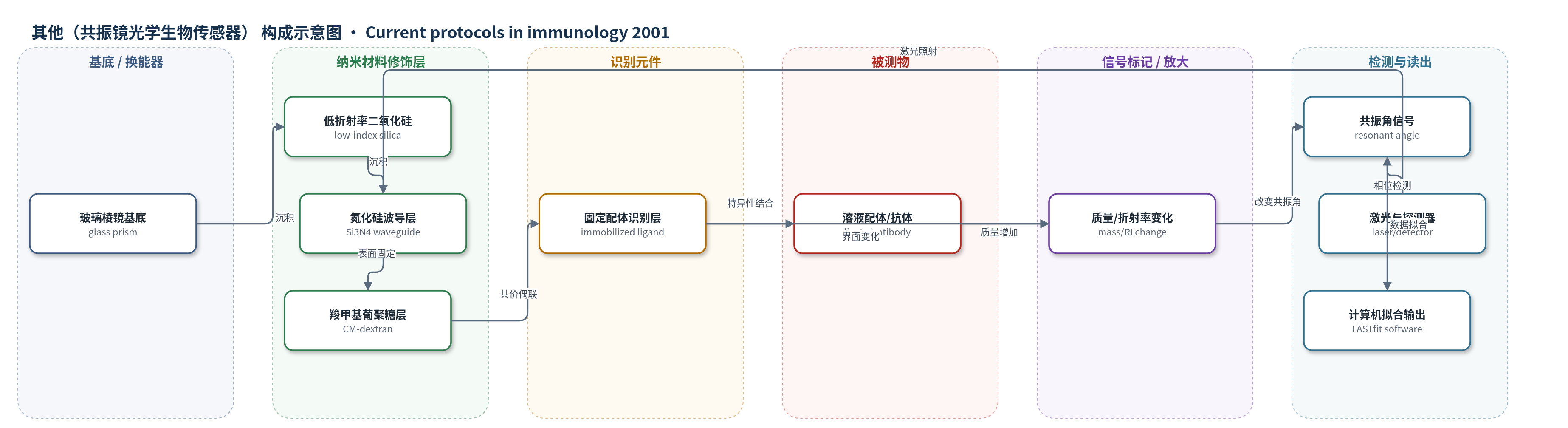
点击图片查看大图 · 依据论文自动绘制
传感器类型
其他(共振镜光学生物传感器)
检测对象
溶液配体/抗体(ligate/antibody,如单链抗体 sFv)、抗原/蛋白/肽(antigen/protein/peptide);样品基质:PBS-Tween 或醋酸盐/磷酸盐缓冲液
检测原理
IAsys 将配体共价固定于 CM-dextran 或氨基硅烷传感表面,溶液中的配体/抗体与固定配体特异性结合。结合事件在倏逝波有效作用距离内增加表面质量并改变局部折射率。共振镜由高折射率氮化硅波导、低折射率二氧化硅和玻璃棱镜构成,偏振激光在特定共振角下隧穿进入波导并产生倏逝波;表面质量/折射率变化改变波导传播条件,使共振角发生角秒级移动。探测器通过相位光学将共振角转换为强度峰,计算机以 0.2–0.3 s 间隔采集信号。结合相响应随配体浓度升高而增大,解离相随时间衰减;通过拟合不同浓度下的结合/解离曲线,可计算 kobs、kass、kdiss 和 Kd。该方法无酶放大,信号近似与结合质量成正比,需控制表面密度和多价性。
检测灵敏度
原文未报告 LOD、线性范围、灵敏度斜率或相关系数;可分析相对响应 10 to 200 arc sec,固定量建议 <1000 arc sec。
效应效果
该方法主要用于动力学分析而非定量检测,因此原文未报告 RSD、加标回收率或与 ELISA/HPLC/qPCR 的直接对比。作者指出可分析相对响应约 10–200 arc sec,固定量通常建议 <1000 arc sec;首次固定约 3 h,后续约 1 h,每个结合-解离-再生周期约 20 min。cuvette 系统不同于 BIACORE 的流动系统,适合可能堵塞微流控通道的样品,如全细胞。特异性依赖负对照(无关抗体或无关配体),并需关注多价性、固定化对表位影响、基线漂移和 bulk shift。通过低表面密度、单链抗体或 Fab 片段可减少多价/再结合伪影。作者认为该传感器使免疫学家能够方便获得结合/解离速率常数和亲和力,用于抗体筛选与生物物理研究。
传感器的构成
- 基底/换能器:玻璃棱镜(glass prism)、低折射率二氧化硅(low-refractive-index silica)与高折射率氮化硅(Si3N4)单模波导,构成共振镜并产生倏逝波。
- 传感表面:羧甲基化葡聚糖水凝胶(CM-dextran hydrogel,约200 nm),提供羧甲基共价结合位点;或氨基硅烷(aminosilane)/生物素化氨基硅烷表面。
- 活化/偶联层:EDC/NHS 活化 CM-dextran 羧基形成琥珀酰亚胺酯,与配体氨基共价结合;或戊二醛聚合物(polymerized glutaraldehyde)交联氨基硅烷与配体。
- 识别元件:固定配体(immobilized ligand,如抗原、蛋白、肽或抗体),用于捕获溶液中的配体/抗体。
- 封闭剂:乙醇胺(ethanolamine,1 M,pH 8.5)封闭未反应活化基团;BSA(10 mg/ml)封闭氨基硅烷表面剩余位点。
- 反应室/搅拌:IAsys cuvette 反应室(200 µl 或 80 µl),propeller/vibrating disc 搅拌并控温,保证溶液均匀。
- 光学读出:偏振激光(polarized laser light)、探测器(detector)与计算机/FASTfit 软件,测量共振角变化(arc sec)并拟合动力学。
中文摘要
本文介绍 IAsys 共振镜生物传感器用于测量生物分子相互作用动力学的方法。生物传感器将传感表面上的结合事件通过换能器转换为电子信号,再由计算机处理得到结合量。IAsys 与 BIACORE 均使用光学检测,但 IAsys 采用共振镜换能器,而 BIACORE 采用表面等离子共振。实验中,先将配体固定到羧甲基化葡聚糖水凝胶或氨基硅烷表面,常用 EDC-NHS 或戊二醛化学实现共价偶联,并用乙醇胺或 BSA 封闭剩余位点;随后加入不同浓度溶液配体(如抗体或单链抗体),连续监测结合、洗涤、解离和表面再生。共振镜由玻璃棱镜、低折射率二氧化硅和高折射率氮化硅波导组成,偏振激光在特定共振角下隧穿并在波导中传播;表面结合改变倏逝波附近折射率,使共振角发生角秒级移动,探测器将其转换为强度信号。通过 FASTfit 软件拟合结合与解离曲线,可获得结合速率常数、解离速率常数和亲和力,适用于抗体-抗原等免疫学相互作用分析。
英文摘要
In this unit, the resonant mirror biosensor or IAsys, produced by Affinity Sensors, is discussed for the measurement of the kinetics of biomolecular interactions. All biosensors operate using a common principle--that binding events occurring on the sensing surface of the biosensor are converted by a transducer into an electronic signal which can then be processed by a computer to yield information on the amount of binding. Where biosensors vary is in their configuration and the nature of the transducer. Both the IAsys and BIACORE series of machines use optical techniques to detect the binding event, but the IAsys uses a resonant mirror device as the transducer, while the BIACORE uses surface plasmon resonance. When using biosensors the experiment can be divided into various phases, which are separately in this unit. The phases involve (1) the immobilization of the ligand onto the sensing surface; (2) addition of the ligate to the sensing surface, and following its association to the ligand, including the kinetics of binding; (3) washing of free ligate from chamber and following the dissociation of the ligand-ligate complex; (4) regeneration of the surface; repetition of phases 2 and 3; and (5) data analysis. A protocol is also included for optimization of ligand pH for immobilization to the carboxymethylated dextran surfaces described in this unit.