组成图示
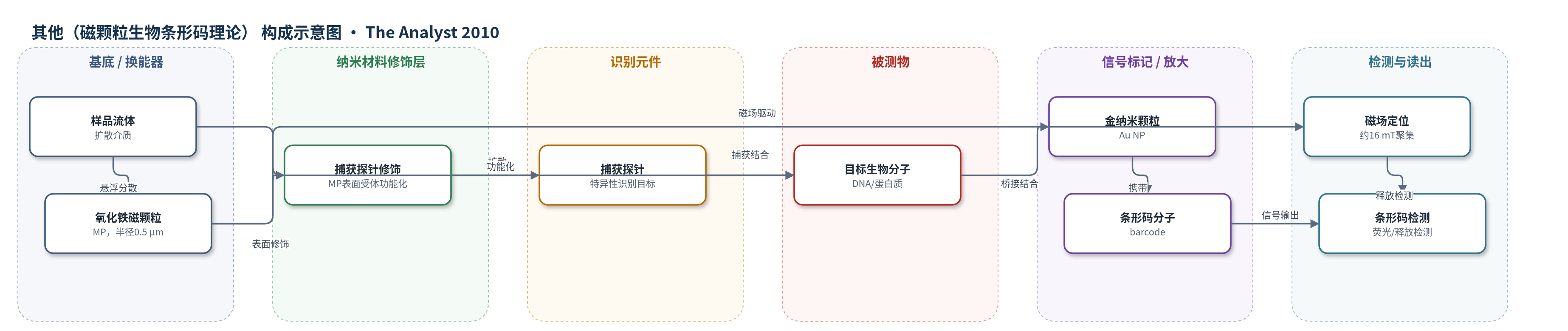
点击图片查看大图 · 依据论文自动绘制
传感器类型
其他(磁颗粒生物条形码理论)
检测对象
目标生物分子(DNA、蛋白质),样品基质:溶液样品(未限定具体临床/环境基质)
检测原理
目标分子在样品流体中扩散,被表面功能化捕获探针的氧化铁磁颗粒不可逆捕获;随后金纳米颗粒携带的条形码分子与MP-目标复合物结合,形成MP-目标-NP共轭。外磁场使共轭颗粒聚集定位,实现局部浓度放大,再释放条形码分子并进行检测。信号强度取决于被捕获目标数量,随目标密度增加而增强。当磁颗粒密度远高于目标密度时,沉降时间由磁颗粒密度、扩散系数和颗粒半径决定,ts=1/(4πrMPDa0),与目标浓度无关;因此MP传感器以“分而搜索”方式缩短扩散搜索距离,使亚阿摩尔检测在合理时间内可行。
检测灵敏度
原文未报告具体数值。
效应效果
该文为理论分析,未报告RSD、稳定性或实际样品回收率。模型预测MP传感器相对经典平面/纳米线传感器的沉降时间缩短rMP/rT倍,文献中约10^3–10^6,使亚阿摩尔检测在合理时间内可行,而经典传感器可能需要数天孵育。最大等待时间tmax∝log(Vsample rT)/rMP,表明目标稀释时统计涨落降低。选择性方面,磁场不受溶液离子静电屏蔽影响,且标记式方案可避免传感器表面非特异吸附带来的背景噪声。作者还提出经典无标签传感器可通过微孔阵列单分子检测逼近MP极限。
传感器的构成
- 磁性颗粒载体:氧化铁磁性颗粒(MP,半径约0.5 μm,密度约0.1 pM),作为捕获载体与磁场响应单元
- 识别元件:MP表面功能化的捕获探针/受体,特异性结合目标分子
- 信号标记物:金纳米颗粒(Au NP)功能化的条形码分子,与MP-目标形成共轭并携带条形码
- 磁场定位模块:外磁场(约16 mT)驱动MP-目标-NP共轭聚集,实现局部浓度放大
- 信号读出:条形码分子释放后的检测(文献中为荧光斑点/条形码检测),输出与目标量相关的信号
中文摘要
本文建立了磁性颗粒(MP)生物传感器(如生物条形码检测)亚阿摩尔检测极限的标度理论,并将其与经典平面、纳米线等生物传感器统一在同一扩散捕获框架中。模型指出,传感器性能由目标分子扩散至捕获位点的动力学决定,并取决于磁颗粒密度 rMP 与目标密度 rT 的相对大小:当 rMP≈rT 时,沉降时间 ts∝1/rT;当 rMP≫rT 时,ts∝1/rMP,且与目标浓度无关。该结果解释了 MP 传感器通过“分而搜索”策略将检测时间缩短 rMP/rT 倍(文献中约10^3–10^6),从而在合理孵育时间内实现亚阿摩尔检测;同时说明最大等待时间随目标稀释而降低,统计涨落减小。理论还指出经典无标签传感器可通过微孔阵列单分子检测逼近 MP 极限。
英文摘要
A scaling theory of the sub atto-molar (aM) detection limits of magnetic particle (MP) based biosensors (e.g., bio-barcode assays) is developed and discussed. Despite the dramatic differences of sensing protocols and detection limits, the MP-based sensors can be interpreted within the same theoretical framework as any other classical biosensor (e.g., nanowire sensors), except that these sensors are differentiated by the geometry of diffusion and the probe (ρ(MP))/target (ρ(T)) density ratio. Our model predicts two regimes for biomolecule detection: For classical biosensors with ρ(MP) ≤ ρ(T), the response time t(s) proportional to 1/ρ(T); while for MP-based biosensors with ρ(MP) > ρ(T), t(s) proportional to 1/ρ(MP). The theory (i) explains the performance improvement of MP-sensors by ρ(MP)/ρ(T) (order of 10(3)-10(6)), broadly validating the sub-aM detection limits reported in literature, (ii) offers intuitive interpretation for the counter-intuitive ρ(T)-independence of detection time in MP-sensors, (iii) shows that statistical fluctuations should reduce with ρ(T) for MP sensors, and (iv) offers obvious routes to sensitivity improvement of classical sensors.