组成图示
点击图片查看大图 · 依据论文自动绘制
传感器类型
综述或非传感器论文
检测对象
神经生长因子(nerve growth factor, NGF);样品基质为PBS/PBST缓冲液(生物传感器结合实验),文中另在PC12分化培养基/细胞上清中用ELISA检测NGF
检测原理
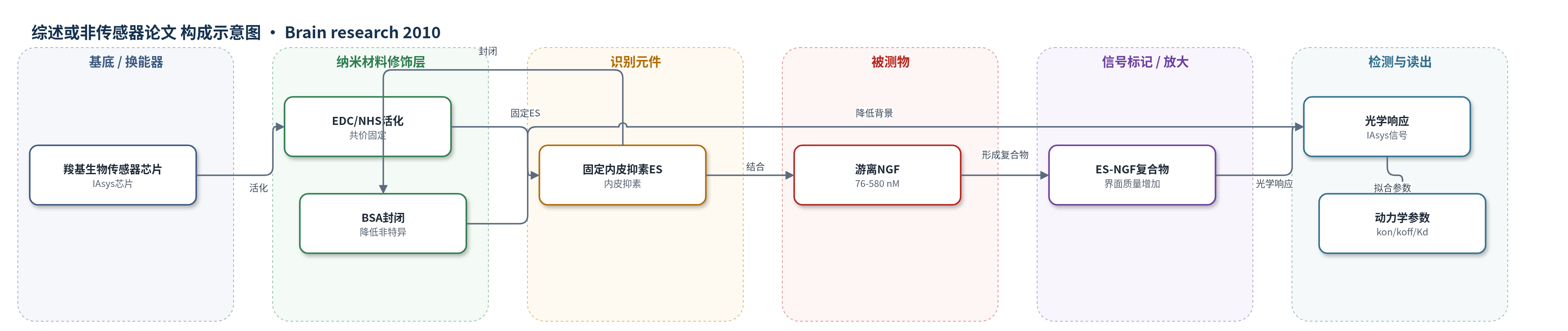
将人重组内皮抑素ES通过EDC/NHS共价固定于IAsys羧基芯片表面,并用Tris-HCl和BSA封闭。随后在PBST中注入不同浓度游离NGF,NGF与固定ES发生特异性结合,使芯片界面质量/折射率增加,产生可被光学生物传感器记录的响应。结合相与解离相曲线经CLAMP双分子模型拟合,得到kon、koff和Kd。该信号不依赖酶或荧光标记,直接反映ES-NGF结合强度;NGF浓度越高,界面结合量越大,响应越强,从而证明ES可直接捕获NGF并降低其生物可利用性。
检测灵敏度
浓度范围: 76 nM–580 nM;kon: 1.7×10^6 M−1 s−1;koff: 2.5 s−1;Kd: 1.5×10⁻⁷ M
效应效果
ES以浓度依赖方式抑制NGF诱导的PC12分化,神经突起阳性细胞由84.15±2.82%降至14.44±2.77%;小脑颗粒细胞迁移由613.2±50.6%降至15.6±6.17%,且600 ng/mL ES不降低存活。抑制在胶原基质上强于层粘连蛋白。ELISA显示胶原+ES使NGF由42.64±2.87降至31.67±1.07 ng/mL。Western blot显示ES不降解NGF(P=0.2076),而胰蛋白酶显著降解(P=0.0127)。基质结合ES使胶原保留NGF约增加5倍(P=0.0364),支持ES通过捕获NGF抑制神经发生。
传感器的构成
- 基底/换能器:IAsys羧基生物传感器芯片(Affinity Sensors),提供光学换能表面
- 活化层:EDC/NHS混合液(0.4 M EDC、0.1 M NHS),活化芯片羧基以共价固定ES
- 识别元件:人重组内皮抑素ES(Cell Sciences),固定于芯片表面,特异性结合NGF
- 封闭层:1 M Tris-HCl(pH 8.5)封闭残余活化基团;1% BSA/PBS封闭非特异位点
- 运行缓冲液:PBS含0.05% Tween-20(PBST),用于平衡、结合、解离与再生
- 读出:IAsys光学生物传感器与CLAMP拟合,记录结合/解离并计算kon、koff、Kd
中文摘要
内皮抑素(ES)是胶原XVIII的C端片段,以抗血管生成功能著称,并与哺乳动物神经系统疾病相关。本研究考察ES对神经生长因子(NGF)诱导的PC12细胞分化、小脑颗粒细胞迁移、神经突起发生与延伸的影响。结果显示,ES部分抑制PC12细胞分化和小脑颗粒细胞迁移,并以浓度依赖方式抑制神经突起生长;该抑制具有基质依赖性,在胶原基质上强于层粘连蛋白基质。胶原和ES可部分消耗NGF,而层粘连蛋白不能,提示NGF与细胞外基质相互作用对突起生长重要,ES竞争性抑制或低亲和力基质会削弱PC12分化和突起生长。进一步利用生物传感器技术证明NGF与ES直接结合,提示ES通过捕获NGF发挥抑制作用。综上,ES通过NGF捕获抑制神经发生多个步骤,既可能损害损伤后脑修复,也可能在轴突寻找和异常神经营养因子升高疾病中成为治疗靶点。
英文摘要
Endostatin (ES), the C-terminal fragment of collagen XVIII known for its anti-angiogenic properties, is associated with neurological diseases in mammals. In this study, we investigated the effect of ES on nerve growth factor (NGF)-induced neuronal differentiation, migration, neuritogenesis, and neurite extension. ES partially inhibited PC12 cell differentiation and cerebellar granule cell migration. In addition, neurite outgrowth was inhibited in a concentration-dependent manner. This effect was also matrix-dependent, as we observed better inhibition on PC12 cells grown on collagen compared to laminin matrices. Furthermore, we observed partial NGF depletion by collagen and ES, but not by laminin suggesting that NGF-matrix interactions may be important for promoting neuritogenesis, competitive inhibition by ES or low affinity matrix impairs PC12 differentiation and neurite outgrowth. Finally, using a biosensor technique, we demonstrated a direct interaction between NGF and ES suggesting the mechanism of action of ES may involve NGF sequestration. In conclusion, our study demonstrates the inhibitory effect of ES on different steps of neurogenesis including cell differentiation and migration and neuritogenesis by NGF sequestration. Such sequestration may compromise brain repair following injury, but also may play important role in axon finding as well as a potent therapeutical target in diseases involving abnormal elevated neurotrophic growth factor levels. Taken together, this study raises the consideration of ES as a double-edge sword that carries both deleterious and putative therapeutical effects.