组成图示
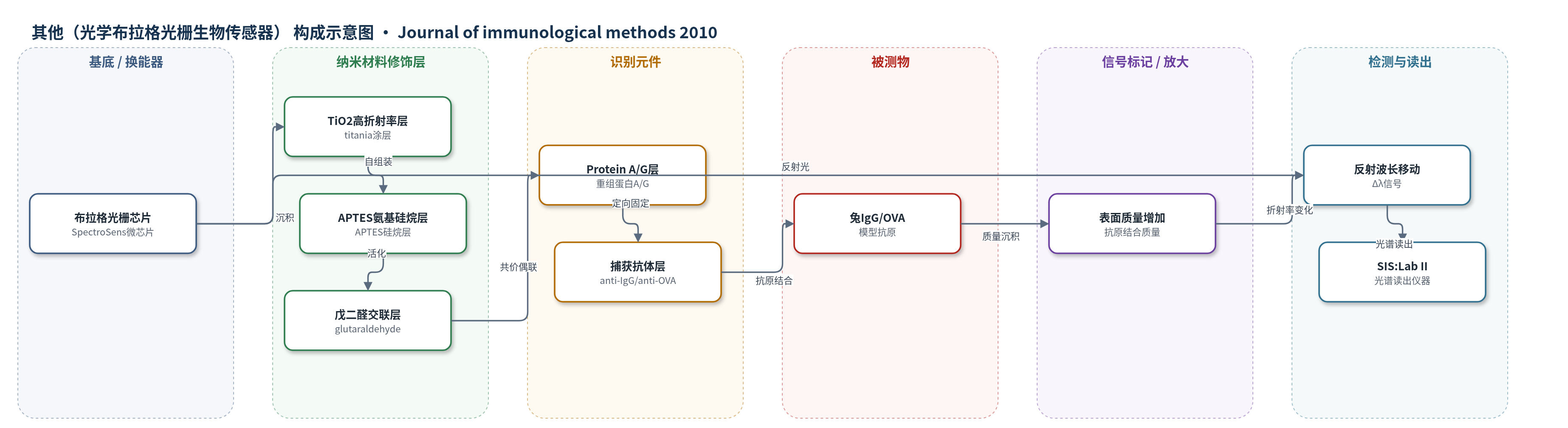
点击图片查看大图 · 依据论文自动绘制
传感器类型
其他(光学布拉格光栅生物传感器)
检测对象
兔免疫球蛋白G(rabbit IgG)、卵白蛋白(ovalbumin, OVA);样品基质为PBS缓冲液中的蛋白溶液(流动池进样)
检测原理
SpectroSens芯片中的平面布拉格光栅按布拉格定律λmax=2Λneff反射特定波长光。传感表面经TiO2、APTES、戊二醛和Protein A/G修饰后,定向固定捕获抗体。当兔IgG或OVA与对应抗体结合时,界面质量增加,引起光栅传感区局部有效折射率neff变化,反射峰波长发生移动。在质量传输限制条件下,初始结合速率与样品中抗原浓度成正比,因此通过实时记录反射峰波长随时间的变化率可定量分析抗原浓度。该过程无需标记,直接以光学波长位移作为读出信号。
检测灵敏度
兔IgG: LOD: approximately 250 ng/ml;线性范围: 500 ng/ml–20 μg/ml;灵敏度斜率: y=0.0027x+0.0003 (x: μg/ml, y: nm/min);R^2 = 0.987。OVA: LOD: 250 ng/ml;线性范围: 250 ng/ml–10 μg/ml;灵敏度斜率: y=0.0031x–0.0002 (x: μg/ml, y: nm/min);R^2 = 0.993。
效应效果
传感器对互补抗原表现出高选择性,mouse IgG控制芯片上未见明显非特异结合。兔IgG 2 μg/ml结合约15 min引起约20 pm波长移动,OVA 20 μg/ml引起约240 pm移动。芯片间重现性方面,6片独立芯片中每浓度3片,5 μg/ml和2 μg/ml IgG响应最大标准差约7 pm,分别小于平均总响应的10%和15%。作者认为该无标记光学微芯片可用于生命科学研发、蛋白浓度测定、抗体筛选、生物制药开发和临床诊断,但尚未报告实际样品加标回收率或与ELISA/HPLC/qPCR等方法的直接对比。
传感器的构成
- 基底/换能器:SpectroSens™光学微芯片,集成平面布拉格光栅(Bragg grating),通过反射峰波长变化检测局部折射率变化
- 高折射率涂层:TiO2(titanium oxide/titania)层,覆盖传感区,提供硅烷自组装表面并增强折射率响应
- 氨基硅烷修饰层:APTES(3-aminopropyltriethoxysilane)自组装层,提供氨基反应位点
- 交联活化层:glutaraldehyde(戊二醛)活化氨基硅烷表面,用于胺偶联固定Protein A/G
- 定向连接层:recombinant Protein A/G,共价固定于芯片,通过Fc结合区定向捕获抗体
- 识别元件:goat anti-rabbit IgG或rabbit anti-OVA抗体,特异性捕获目标抗原;mouse IgG作控制
- 封闭层:BSA(bovine serum albumin)1%封闭非特异性结合位点
- 流体/读出模块:PTFE FlowCubes流动池、注射泵与SIS:Lab II光谱仪,用于PBS进样和反射光谱读出
中文摘要
本文报道了一种快速、无标记的光学生物传感器系统,用于实时灵敏监测生物分子相互作用。SpectroSens™传感器芯片基于集成平面布拉格光栅,对局部折射率变化敏感。传感表面通过固定针对目标物的抗体实现生物分子识别。研究中,利用重组Protein A/G对选定蛋白抗体进行定向,并通过戊二醛活化的硅烷层以胺偶联方式共价固定到芯片上。以兔IgG和卵白蛋白为模型抗原-抗体体系进行免疫检测。互补抗原与抗体功能化传感器结合后,表现为从光学传感器反射光的波长变化。采用平面二维表面涂层,两种抗原均获得中ng/ml量级的定量结合动力学检测灵敏度。结果表明,SpectroSens™传感器可作为生命科学研发中监测生物特异性相互作用、测定蛋白浓度和筛选抗体的有价值工具;其光学集成与分析特性提示其可能广泛应用于生物制药开发和临床诊断。
英文摘要
A rapid, label-free optical biosensor system for sensitive monitoring of bio-molecular interactions in real-time is presented. SpectroSens sensor chips are based on integrated planar Bragg gratings sensitive to localised changes in refractive index. Bio-molecule recognition is imparted by functionalisation of the sensing surface with antibodies against targets of interest. In this study, antibodies against selected proteins were oriented with recombinant Protein A/G, which was covalently immobilised to the sensor chip via amine coupling to a glutaraldehyde-activated silane layer. Immunoassays for the detection of rabbit IgG and ovalbumin proteins as model antibody-antigen interaction systems were performed. Binding of complementary antigens to respective antibody-functionalised sensors manifested as changes in wavelength of light reflected from the optical sensors. Quantitative binding kinetics with detection sensitivities in the mid ng/ml range were obtained for both antigens using this planar, two-dimensional surface coating. Data presented demonstrate the suitability of SpectroSens sensors as a valuable tool in life science research and development for monitoring bio-specific interactions, protein concentration determination and antibody selection; the optical integration and analytical characteristics of these sensors suggest that they may find numerous applications in bio-pharmaceutical development and clinical diagnostics.