组成图示
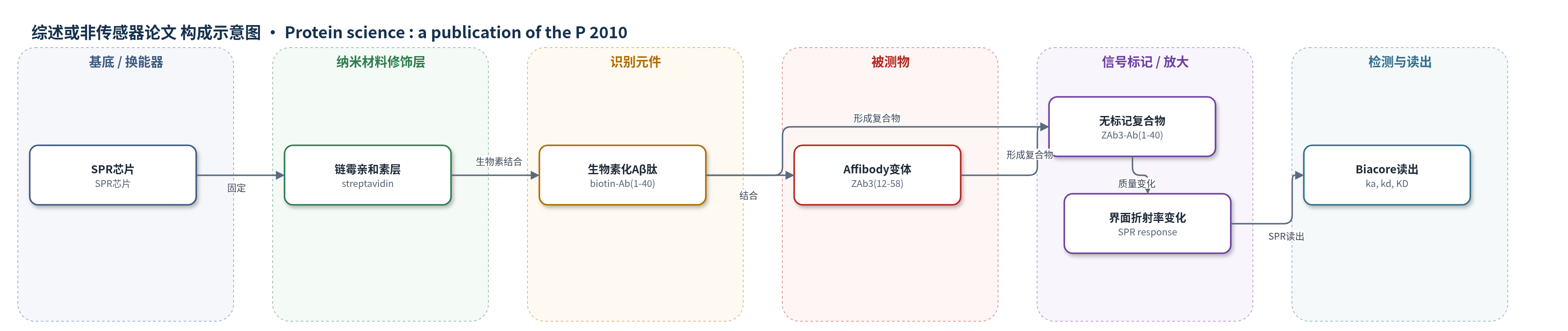
点击图片查看大图 · 依据论文自动绘制
传感器类型
综述或非传感器论文
检测对象
Aβ(1-40) 肽(amyloid-beta 1-40, Ab(1-40))与 Affibody 变体(ZAb3(1-58)、ZAb3(12-58)、ZAb3(15-58)、ZAb3(18-58));样品基质:缓冲液(10 mM Na-phosphate pH 7.4 或 HBS-EP)
检测原理
该论文并非报道新型传感器,而是用 SPR 生物传感器表征 Affibody 与 Aβ(1-40) 的结合。SPR 芯片表面先固定链霉亲和素,再通过生物素-链霉亲和素作用定向固定 biotin-LC-Ab(1-40) 或 Ab(1-40)-LC-biotin。不同浓度的 Affibody 变体在 HBS-EP 缓冲液中流过芯片,与表面 Aβ(1-40) 结合。结合事件增加界面质量并改变局部折射率,使 SPR 反射角/响应单位(RU)随结合量增加而上升;解离阶段响应下降。通过 1:1 Langmuir 模型拟合结合/解离曲线获得 ka、kd 和 KD。截短 N 端去除不参与结合的无序区,提高结合速率,使 ZAb3(12-58) 和 ZAb3(15-58) 的 KD 降至 0.69 和 0.48 nM。无酶催化或核酸放大策略。
检测灵敏度
原文未报告 LOD、线性范围、灵敏度斜率或相关系数;SPR 结合常数 KD: ZAb3(1-58) 9.5×10^-9 M, ZAb3(12-58) 6.9×10^-10 M, ZAb3(15-58) 4.8×10^-10 M;ka: 4.1×10^4, 4.5×10^5, 6.3×10^5 M^-1 s^-1;kd: 3.9×10^-4, 3.1×10^-4, 3.0×10^-4 s^-1
效应效果
截短 Affibody 的固相肽合成产率显著提高:ZAb3(18-58) 35%、ZAb3(15-58) 30%、ZAb3(12-58) 29%、ZAb3(9-58) 20%,而全长 ZAb3(1-58) 仅 7–8%。SPR 显示 ZAb3(12-58) KD 0.69 nM、ZAb3(15-58) 0.48 nM,较全长 9.5 nM 提高约一个数量级,主要因 ka 从 4.1×10^4 增至 4.5×10^5 和 6.3×10^5 M^-1 s^-1;ZAb3(18-58) 无结合。CD 热稳定性中,ZAb3(12-58) 和 ZAb3(15-58) 与 Aβ(1-40) 复合物的 ΔTm 分别为 16.4 和 14.7°C,高于全长的 7.6°C。NMR 表明复合物结构与全长 ZAb3/Aβ(1-40) 相似,Aβ 形成 β-hairpin。作者认为截短体适合化学合成、标记和后续工程化,可用于 Aβ 单体结合与抗聚集研究。
传感器的构成
- 基底/换能器:SPR 芯片(streptavidin sensor chip,Biacore 3000 用),提供表面等离子共振检测界面
- 修饰层:链霉亲和素(streptavidin)定向固定层,用于捕获生物素化 Aβ 肽
- 识别/捕获元件:生物素化 Aβ(1-40) 肽(biotin-LC-Ab(1-40) 或 Ab(1-40)-LC-biotin),作为固定配体识别 Affibody
- 分析物/结合分子:Affibody 变体(ZAb3(1-58)、ZAb3(12-58)、ZAb3(15-58)、ZAb3(18-58)),与 Aβ(1-40) 结合
- 信号标记物:无外源标记,SPR 直接监测结合引起的界面折射率变化
- 参考面:未固定 Aβ 肽的参考表面,用于扣除非特异响应
中文摘要
淀粉样蛋白β(Aβ)肽聚集被认为是阿尔茨海默病发生和进展的重要因素。高亲和力和选择性结合 Aβ 肽的分子是研究聚集过程的重要工具。此前通过噬菌体展示筛选的 Aβ 结合 Affibody 分子 ZAb3 能以纳摩尔亲和力结合 Aβ(1-40) 并抑制 Aβ 肽聚集。本研究构建了更适合化学合成的 ZAb3 截短功能版本。通过固相肽合成制备不同长度的工程化 Affibody 分子,并经二硫键形成共价连接的同源二聚体。N 端截短的 ZAb3(12-58)、ZAb3(15-58) 和 ZAb3(18-58) 的合成产率显著高于全长 ZAb3(1-58)。圆二色光谱和表面等离子共振生物传感器分析显示,最短的 ZAb3(18-58) 完全丧失与 Aβ(1-40) 的结合,而 ZAb3(12-58) 和 ZAb3(15-58) 对 Aβ(1-40) 的结合亲和力较全长分子提高约一个数量级。核磁共振表明,截短 Affibody 二聚体与 Aβ(1-40) 复合物结构与全长 ZAb3 复合物非常相似。因此 ZAb3(12-58) 和 ZAb3(15-58) 有望用于进一步工程化及作为单体 Aβ(1-40) 的结合剂。
英文摘要
The aggregation of amyloid-β (Aβ) peptides is believed to be a major factor in the onset and progression of Alzheimer's disease. Molecules binding with high affinity and selectivity to Aβ-peptides are important tools for investigating the aggregation process. An Aβ-binding Affibody molecule, ZAβ3 , has earlier been selected by phage display and shown to bind Aβ(1-40) with nanomolar affinity and to inhibit Aβ-peptide aggregation. In this study, we create truncated functional versions of the ZAβ3 Affibody molecule better suited for chemical synthesis production. Engineered Affibody molecules of different length were produced by solid phase peptide synthesis and allowed to form covalently linked homodimers by S-S-bridges. The N-terminally truncated Affibody molecules ZAβ3 (12-58), ZAβ3 (15-58), and ZAβ3 (18-58) were produced in considerably higher synthetic yield than the corresponding full-length molecule ZAβ3 (1-58). Circular dichroism spectroscopy and surface plasmon resonance-based biosensor analysis showed that the shortest Affibody molecule, ZAβ3 (18-58), exhibited complete loss of binding to the Aβ(1-40)-peptide, while the ZAβ3 (12-58) and ZAβ3 (15-58) Affibody molecules both displayed approximately one order of magnitude higher binding affinity to the Aβ(1-40)-peptide compared to the full-length Affibody molecule. Nuclear magnetic resonance spectroscopy showed that the structure of Aβ(1-40) in complex with the truncated Affibody dimers is very similar to the previously published solution structure of the Aβ(1-40)-peptide in complex with the full-length ZAβ3 Affibody molecule. This indicates that the N-terminally truncated Affibody molecules ZAβ3 (12-58) and ZAβ3 (15-58) are highly promising for further engineering and future use as binding agents to monomeric Aβ(1-40).