组成图示
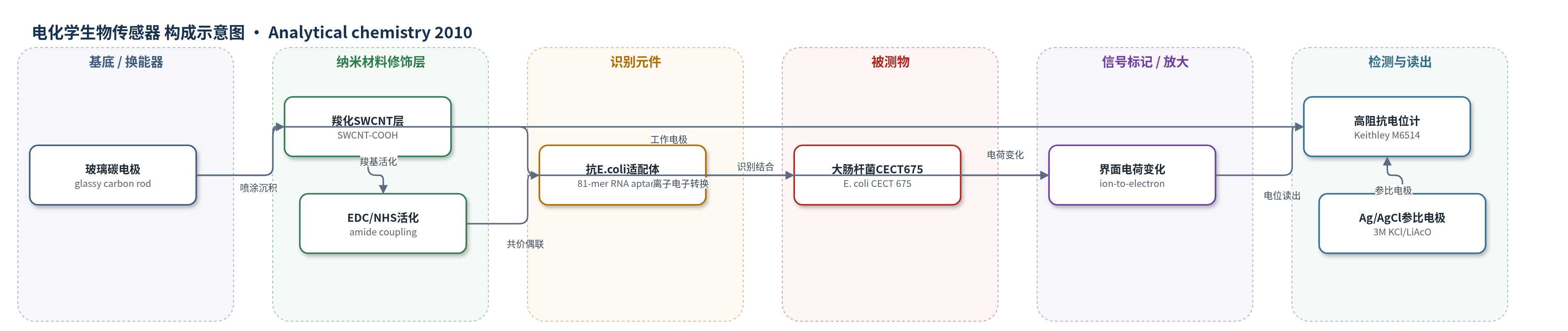
点击图片查看大图 · 依据论文自动绘制
传感器类型
电化学生物传感器
检测对象
大肠杆菌 E. coli CECT 675(E. coli O157:H7 非致病替代株);样品基质:牛奶(milk)、苹果汁(apple juice)、PBS
检测原理
该传感器为无标记电位法。羧化 SWCNT 喷涂在玻璃碳电极上,经 EDC/NHS 与 3′端氨基适配体共价偶联。当 E. coli CECT 675 与适配体特异性结合时,适配体构象变化并改变细菌细胞壁周围离子在 SWCNT 界面处的屏蔽与电荷转移;SWCNT 的高比表面积和双电层电容将离子信号转换为电子电位信号。低离子强度 PBS 中,EMF 随菌浓度对数增加而线性变化,无需酶或标记放大。真实样品经在线过滤、PBS 洗涤和洗脱去除带电基质后直接注入测量池,电位计记录 EMF 变化。
检测灵敏度
LOD: 4 CFU/mL(PBS);6 CFU/mL(牛奶);26 CFU/mL(苹果汁);线性范围: 4–10^4 CFU/mL(原文另述 4–2.4×10^4 CFU/mL 线性可接受);斜率: 2.0 mV/decade(SD 0.8 mV/decade);R^2 = 0.96
效应效果
对沙门氏菌、干酪乳杆菌和 E. coli CECT 4558 无交叉反应,未修饰 SWCNT 与非共价适配体对照无信号。EMF 在低于 10^4 CFU/mL 时至少稳定 1.5 h;2 M NaCl 再生后至少 5 个循环不降低 LOD 和灵敏度,噪声不变。三个传感器斜率标准偏差 0.8 mV/decade。真实样品前处理回收率 80–90%,6 mL PBS 洗脱在 22 CFU/mL 时回收最佳。牛奶和苹果汁最低检出分别为 6 和 26 CFU/mL,低于苹果汁法规限值 1000 CFU/mL,牛奶略高于 5 CFU/mL。相比 PCR、磁分离和电化学方法,分析时间接近实时且操作更简单。
传感器的构成
- 基底/工作电极:玻璃碳圆柱棒(glassy carbon rod),经氧化铝抛光,作为固体接触电位传感器基底
- 绝缘包覆:聚四氟乙烯(Teflon)套管,覆盖玻璃碳棒,仅暴露工作表面
- 纳米换能层:羧化单壁碳纳米管(carboxylated SWCNT)喷涂层,约30 µm,作为离子-电子换能器并提供高比表面积
- 化学活化层:EDC/NHS 活化羧基(MES pH 5),形成活性酯以便与适配体氨基偶联
- 识别元件:抗 E. coli CECT 675 的 81-mer RNA 适配体(3′端氨基修饰),共价固定于 SWCNT 羧基,识别靶菌
- 参考电极:Ag/AgCl/KCl(3 M)双盐桥参比电极,含 1 M LiAcO 液桥,提供稳定电位参考
- 测量介质:1.7 mM PBS pH 7.4,低离子强度缓冲液,用于电位测量和样品洗脱
中文摘要
病原菌的快速检测与鉴定对食品安全和感染控制至关重要。传统培养法耗时且真实样品前处理复杂。本文报道一种基于单壁碳纳米管(SWCNT)和适配体的无标记电位生物传感器,可在数分钟内直接、简单、选择性地检测复杂样品中的活菌。以大肠杆菌 CECT 675 作为致病性 E. coli O157:H7 的非致病替代物,传感器利用羧化 SWCNT 作为离子-电子换能器,并将抗 E. coli 适配体共价固定于其表面。适配体与靶菌的特异性结合引起界面电势显著变化,从而实现种间和株间选择性检测。该方法在牛奶中最低检出 6 CFU/mL,在苹果汁中最低检出 26 CFU/mL,样品前处理简单;对活菌具有即时线性响应,范围可达 10^4 CFU/mL。传感器易于制备和再生,至少可重复使用 5 次而不降低最低检测量。
英文摘要
Detecting and identifying pathogen bacteria is essential to ensure quality at all stages of the food chain and to diagnose and control microbial infections. Traditional detection methods, including those based on cell culturing, are tedious and time-consuming, and their further application in real samples generally implies more complex pretreatment steps. Even though state-of-the-art techniques for detecting microorganisms enable the quantification of very low concentrations of bacteria, to date it has been difficult to obtain successful results in real samples in a simple, reliable, and rapid manner. In this Article, we demonstrate that the label-free detection and identification of living bacteria in real samples can be carried out in a couple of minutes and in a direct, simple, and selective way at concentration levels as low as 6 colony forming units/mL (CFU) in complex matrices such as milk or 26 CFU/mL in apple juice where the pretreatment step of samples is extremely easy. We chose Escherichia coli ( E. coli ) CECT 675 cells as a model organism as a nonpathogenic surrogate for pathogenic E. coli O157:H7 to test the effectiveness of a potentiometric aptamer-based biosensor. This biosensor uses single-walled carbon nanotubes (SWCNT) as excellent ion-to-electron transducers and covalently immobilized aptamers as biorecognition elements. The selective aptamer-target interaction significantly changes the electrical potential, thus allowing for both interspecies and interstrain selectivity and enabling the direct detection of the target. This technique is therefore a powerful tool for the immediate identification and detection of microorganisms. We demonstrate the highly selective detection of living bacteria with an immediate linear response of up to 10(4) CFU/mL. The biosensor can be easily built and used, is regenerated without difficulty, and can be used at least five times with no loss in the minimum amount of detected bacteria.