组成图示
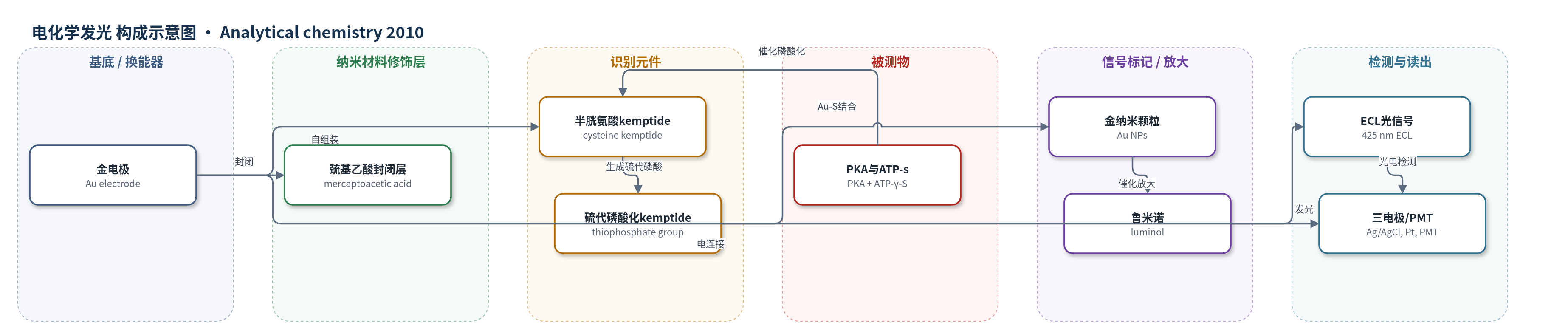
点击图片查看大图 · 依据论文自动绘制
传感器类型
电化学发光(ECL)生物传感器
检测对象
蛋白激酶A(protein kinase A, PKA)活性;激酶抑制剂(ellagic acid、Tyrphostin AG1478);样品基质:体外磷酸化反应缓冲液(Tris-HCl/MgCl2 buffer)
检测原理
半胱氨酸终止 kemptide 通过 Au-S 键自组装于金电极,MAA 封闭非特异性位点。PKA 以 ATP-γ-S 为共底物催化 kemptide 磷酸化,在丝氨酸残基引入硫代磷酸基团。Au NPs 通过 Au-S 键结合硫代磷酸基团,形成导电纳米界面。在 PBS(pH 10.5)中,luminol 去质子化后在电极上氧化生成自由基,并与 O2 反应形成激发态产物,发射 425 nm 光。Au NPs 增大界面面积、促进电子转移并电催化 luminol 氧化,从而放大 ECL。PKA 活性越高,表面硫代磷酸基团和 Au NPs 密度越高,ECL 越强;无 PKA 时肽层绝缘且无 Au NPs,信号弱。
检测灵敏度
LOD: 0.07 U mL-1 (signal-to-noise ratio of 3);线性范围: 0.07 to 35 U mL-1(摘要: 0.07 to 32 U mL-1);灵敏度斜率: 130.97;R^2 = 0.9963
效应效果
该传感器对 PKA 的检出限为 0.07 U/mL,低于此前报道的电化学激酶检测方法。连续扫描下 ECL 信号稳定,因 luminol ECL 无需 H2O2 或 Na2S2O3 等共反应物,避免了对修饰层和生物分子的损伤。75 U/mL PKA 的批内和批间变异系数分别为 4.6% 和 5.9%,重现性良好。选择性方面,PKA 抑制剂 ellagic acid 使 ECL 随浓度升高而下降,IC50 为 3.78 μM,与常规激酶实验结果一致;酪氨酸激酶抑制剂 Tyrphostin AG1478 在 30 μM 下几乎不改变 ECL 信号,表明其对 PKA 抑制剂筛选具有良好特异性。作者认为该简单、灵敏的平台可用于体外激酶活性高通量检测和抑制剂筛选,具有临床诊断和药物开发应用潜力。
传感器的构成
- 基底/换能器电极:金电极(Au electrode,直径2 mm),作为工作电极,经氧化铝抛光和电化学清洗。
- 识别元件:半胱氨酸终止 kemptide(cysteine-terminated kemptide, H-CLRRASLG-OH),通过 Au-S 键自组装于金电极,作为 PKA 磷酸化底物。
- 封闭剂:巯基乙酸(mercaptoacetic acid, MAA),封闭金电极非特异性结合位点。
- 反应试剂:硫代三磷酸腺苷(ATP-γ-S, ATP-s),作为 PKA 磷酸化共底物,在 kemptide 上引入硫代磷酸基团。
- 信号标记/放大元件:金纳米颗粒(gold nanoparticles, Au NPs),通过 Au-S 键结合硫代磷酸基团,作为信号转导探针放大 luminol ECL。
- 发光介质:鲁米诺(luminol),在 PBS(pH 10.5)中作为 ECL 发光剂,经 Au NPs 电催化产生 425 nm 光。
- 读出系统:三电极体系(工作电极为修饰金电极,参比电极 Ag/AgCl,对电极 Pt 线)与光电倍增管(PMT,600 V),读取 ECL 光强。
中文摘要
本文报道了一种以金纳米颗粒(Au NPs)为信号转导探针的电化学发光(ECL)生物传感器,用于蛋白激酶活性与抑制分析。半胱氨酸终止的 kemptide 通过 Au-S 键固定于金电极表面,巯基乙酸封闭非特异性位点。在硫代三磷酸腺苷(ATP-γ-S)存在下,蛋白激酶A(PKA)催化 kemptide 磷酸化,在丝氨酸残基引入硫代磷酸基团。Au NPs 通过 Au-S 键特异性结合该基团,并凭借良好导电性、大比表面积及对鲁米诺(luminol)氧化的电催化作用,显著放大 luminol 的 ECL 信号。以 PKA 为模型,该传感器检出限为 0.07 U/mL,线性范围为 0.07–32 U/mL,且稳定性良好。基于 ECL 信号随抑制剂浓度变化,可定量评估激酶抑制:PKA 抑制剂 ellagic acid 的 IC50 为 3.78 μM,与常规激酶实验一致;酪氨酸激酶抑制剂 Tyrphostin AG1478 几乎不改变信号,显示良好选择性。该方法有望用于体外激酶活性高通量检测和抑制剂筛选。
英文摘要
A novel electrogenerated chemiluminescence (ECL) biosensor using gold nanoparticles as signal transduction probes was described for the detection of kinase activity. The gold nanoparticles were specifically conjugated to the thiophosphate group after the phosphorylation process in the presence of adenosine 59-[c-thio] triphosphate (ATP-s) cosubstrate. Due to its good conductivity, large surface area, and excellent electroactivity to luminol oxidization, the gold nanoparticles extremely amplified the ECL signal of luminol, offering a highly sensitive ECL biosensor for kinase activity detection. Protein kinase A (PKA), an important enzyme in regulation of glycogen, sugar, and lipid metabolism in the human body, was used as a model to confirm the proof-of-concept strategy. The as-proposed biosensor presented high sensitivity, low detection limit of 0.07 U mL(-1), wide linear range (from 0.07 to 32 U mL(-1)), and excellent stability. Moreover, this biosensor can also be used for quantitative analysis of kinase inhibition. On the basis of the inhibitor concentration dependent ECL signal, the half-maximal inhibition value IC(50) of ellagic acid, a PKA inhibitor, was estimated, which was in agreement with those characterized with the conventional kinase assay. While nearly no ECL signal change can be observed in the presence of Tyrphostin AG1478, a tyrosine kinase inhibitor, but not PKA inhibitor, shows its excellent performance in kinase inhibitor screening. The simple and sensitive biosensor is promising in developing a high-through assay of in vitro kinase activity and inhibitor screening for clinic diagnostic and drug development.