组成图示
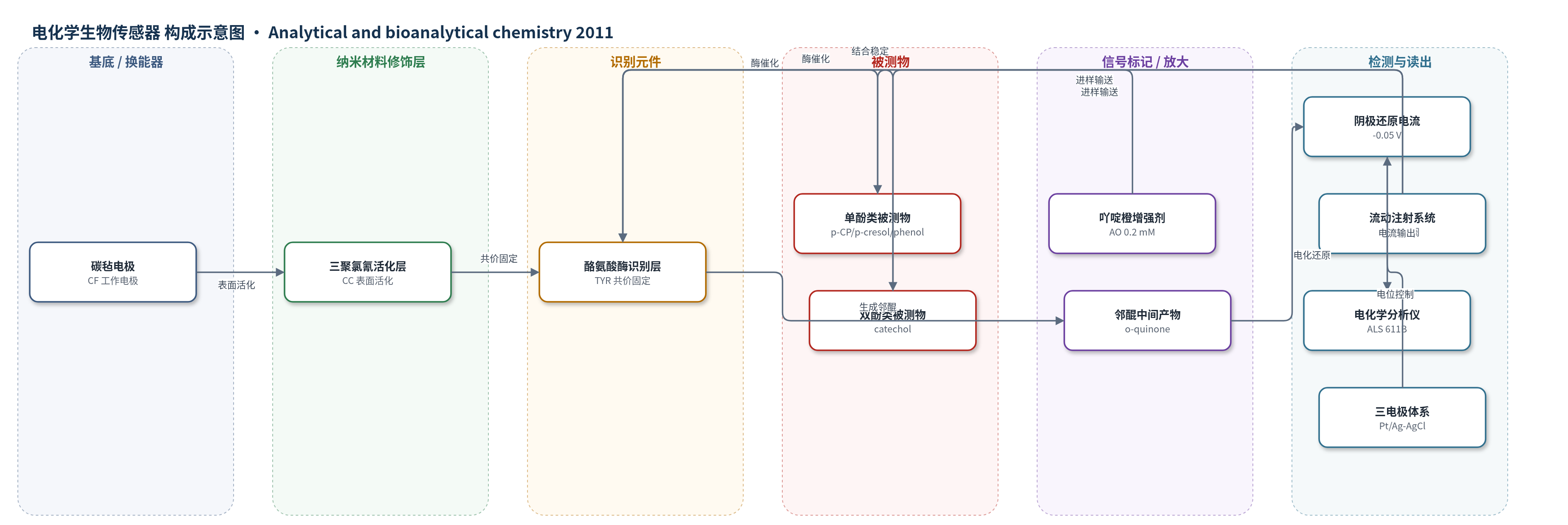
点击图片查看大图 · 依据论文自动绘制
传感器类型
电化学生物传感器
检测对象
对氯苯酚(p-chlorophenol, p-CP)、对甲酚(p-cresol)、苯酚(phenol)、邻苯二酚(catechol);样品基质为空气饱和 0.1 M 磷酸盐缓冲液(pH 7.0)流动注射标准溶液
检测原理
固定于碳毡的 TYR 作为识别/催化元件,与单酚(p-CP、p-cresol、phenol)发生邻位羟基化,或与双酚(catechol)发生氧化,消耗 O2 生成邻醌(o-quinone)。在 −0.05 V(vs. Ag/AgCl)下,邻醌被电化还原为邻二酚,再生邻二酚再被 TYR 氧化,形成酶催化—电化还原循环,使阴极电流随被测物浓度增加而增大,直至酶或传质饱和。AO 在固定过程中与 TYR 相互作用,增强单酚酶活性、促进 p-氯-o-苯醌电化还原并稳定固定 TYR 结构,降低界面电子转移阻力,从而放大信号。
检测灵敏度
TYR/AO-CF:p-CP LOD: 2.6 nM;线性范围: 2.6×10⁻⁹–3×10⁻⁶ M;灵敏度斜率: 11.8 μA/μM;R^2 = 0.9996;p-cresol LOD: 2.7 nM;线性范围: 2.7×10⁻⁹–1×10⁻⁶ M;灵敏度斜率: 11.2 μA/μM;R^2 = 0.9993;phenol LOD: 18.7 nM;线性范围: 1.9×10⁻⁸–1×10⁻⁵ M;灵敏度斜率: 1.6 μA/μM;R^2 = 0.9976;catechol LOD: 2.3 nM;线性范围: 2.3×10⁻⁹–3×10⁻⁶ M;灵敏度斜率: 13.2 μA/μM;R^2 = 0.9893。TYR-CF:p-CP LOD: 30 nM;线性范围: 3.0×10⁻⁸–1×10⁻⁵ M;灵敏度斜率: 0.99 μA/μM;R^2 = 0.9722;p-cresol LOD: 14 nM;线性范围: 1.4×10⁻⁸–3×10⁻⁶ M;灵敏度斜率: 2.1 μA/μM;R^2 = 0.9955;phenol LOD: 143 nM;线性范围: 1.4×10⁻⁷–3×10⁻⁵ M;灵敏度斜率: 0.2 μA/μM;R^2 = 0.9951;catechol LOD: 5.3 nM;线性范围: 5.3×10⁻⁹–1×10⁻⁵ M;灵敏度斜率: 5.7 μA/μM;R^2 = 0.9994。
效应效果
TYR/AO-CF 对 p-CP、p-cresol、phenol 的灵敏度分别约为 TYR-CF 的 12、5、8 倍,catechol 为 2.3 倍;p-CP 和 p-cresol 检出限降至纳摩尔级,单酚 Imax 约提高 3–4 倍,Km 更小。选择性由 catechol≫p-cresol≫p-CP>phenol 变为 p-CP、p-cresol 与 catechol 灵敏度接近,p-CP 灵敏度优于多种 TYR 基生物传感器。连续 10 次注入 1 μM p-CP 的 RSD 为 1.74%,三个电极灵敏度 RSD 为 3.1%,同浓度标准 RSD 为 0.33–3.7。作者认为其可用于连续监测高毒酚类和临床儿茶酚胺。
传感器的构成
- 基底/换能器电极:碳毡(CF,GF-20-3F,微碳纤维三维多孔结构,高比表面积和高孔隙率,用作流动注射电化学工作电极)
- 表面活化层:三聚氯氰(CC,10 mM 甲苯溶液处理,将 CF 表面羟基转化为可共价偶联位点)
- 识别/催化元件:酪氨酸酶(TYR,EC 1.14.18.1,共价固定于 CC 活化 CF,催化单酚邻位羟基化和双酚氧化生成邻醌)
- 信号增强/结构调节剂:吖啶橙(AO,0.2 mM,存在于 TYR 固定液中,增强单酚酶活性、促进邻醌电化还原并稳定固定 TYR 结构)
- 辅助电极:铂丝(Pt,1 mm,三电极体系辅助电极)
- 参比电极:Ag/AgCl(BAS RE-1B,提供稳定电位参考)
- 流动注射载体:0.1 M 磷酸盐缓冲液(PB,pH 7.0,空气饱和,作为流动相并供给 O2)
中文摘要
将酪氨酸酶(TYR,EC 1.14.18.1)从含吖啶橙(AO)的混合缓冲液中,共价修饰到三聚氯氰(CC)活化的碳毡(CF)表面,制备 TYR/AO-CF 工作电极,用于电化学流动检测单酚和双酚类化合物(对氯苯酚 p-CP、对甲酚、苯酚、邻苯二酚)。该传感器在 −0.05 V(vs. Ag/AgCl)下检测酶催化生成的邻醌的还原电流。固定过程中加入 0.2 mM AO 可显著增强信号,尤其 p-CP;TYR/AO-CF 的 p-CP 阴极峰电流明显高于无 AO 的 TYR-CF。Clark 型氧电极显示,在 1 mM 磷酸盐缓冲液(pH 7.0)中,AO 显著增强游离 TYR 的单酚酶活性,而对双酚酶活性影响较小。循环伏安法表明,p-氯-o-苯醌在 TYR/AO-CF 上的电化还原速率更快;电化学阻抗谱表明 AO 影响固定 TYR 的结构性质。AO 与 TYR 的相互作用通过改变酶动力学和固定酶结构,实现单酚类检测信号增强。
英文摘要
Tyrosinase (TYR: EC 1.14.18.1) was covalently modified onto the surface of a cyanuric chloride-activated carbon felt (CF) from the mixed buffer solution of TYR and acridine orange (AO). The resulting TYR-immobilized CF (TYR/AO-CF) was used as a working electrode unit of an electrochemical flow-through detector for mono- and di-phenolic compounds (i.e., p-chlorophenol (p-CP), p-cresol, phenol, and catechol), which detects the reduction current of enzymatically produced o-quinones at -0.05 V (vs. Ag/AgCl). The presence of AO (0.2 mM) in TYR solution during the enzyme immobilization step was significantly effective for the signal enhancements especially for p-CP, and the cathodic peak currents of p-CP by the TYR/AO-CF-based detector were much larger than those by the TYR-CF-based detector prepared from TYR solution without AO. The oxymetry with Clark-type oxygen electrode revealed that monophenolase activity of free TYR in 1 mM phosphate buffer (pH 7.0) was greatly enhanced in the presence of AO (0.2 mM), whereas diphenolase activity was not so much influenced. Furthermore, the comparison of cyclic voltammograms of TYR/AO-CF and TYR-CF in air-saturated phosphate buffer containing each substrate revealed that the electrochemical reduction rate of p-chloro-o-benzoquinone at TYR/AO-CF was faster than that at TYR-CF. In addition, the electrochemical impedance spectroscopy revealed that the structural properties of immobilized TYR on the CF would be influenced by AO. Some kinds of interaction of AO with TYR would affect the enzymatic kinetics and the structural properties of the immobilized TYR, leading to the signal enhancement of the TYR-CF-based flow biosensor especially for monophenolic compounds.