组成图示
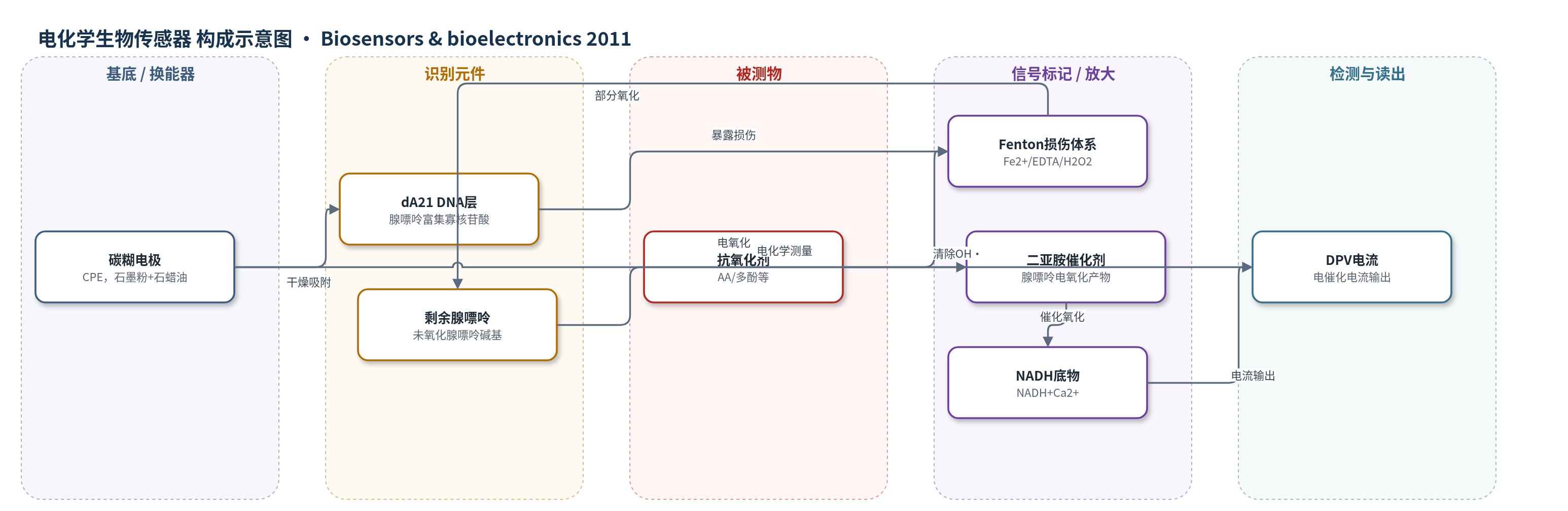
点击图片查看大图 · 依据论文自动绘制
传感器类型
电化学生物传感器
检测对象
总抗氧化能力(TAC,以抗坏血酸 AA 当量计)、抗坏血酸(ascorbic acid, AA);样品基质:柠檬风味水、柠檬香精/饮料
检测原理
将 dA21 干燥吸附于 CPE 形成腺嘌呤富集 DNA 层。将电极浸入含抗氧化剂的 Fenton 体系,Fe2+ 与 H2O2 生成 OH•,OH• 部分氧化腺嘌呤;抗氧化剂清除 OH•,浓度越高,被保护的腺嘌呤越多。随后在 pH 9.0 磷酸盐缓冲液中循环扫描,将剩余腺嘌呤电化学氧化为吸附的二亚胺氧化产物。该产物在含 Ca2+ 的 NADH 溶液中作为电催化剂,显著降低 NADH 氧化过电位,使 DPV 电催化电流增大。因此,抗氧化剂浓度与剩余腺嘌呤量正相关,最终表现为 NADH 电催化电流随 TAC 升高而增大。
检测灵敏度
LOD: 50 nmol l−1;线性范围: 0.05–1.00 μmol l−1;斜率: 9.34 nA/(μmol l−1);r = 0.995 (n = 5)
效应效果
该传感器为一次性 CPE,制备简单、快速且可重复,以 TAC 当量输出,不区分单一抗氧化组分。在 1 μmol/L AA 下 RSD 为 3.2%。Fenton 体系对 dA21 造成 87.6% 损伤;不同抗氧化剂保护效率为 19.3%–58.6%,其中 AA 最高(58.6%),咖啡酸 34.1%、白藜芦醇 37.9%、没食子酸 19.3%、Trolox 20%。实际样品中,柠檬香精 TAC 为 480±20 μmol/L(85±4 mg/L),品牌 A 柠檬风味水 0.19±0.08 μmol/L,品牌 B 2.8±0.3 μmol/L,品牌 B 因含绿茶多酚而高约一个数量级。结果与 TPC、DPPH 和还原力法趋势一致,作者认为其低检出限(50 nM)适合食品/饮料 TAC 快速评价。
传感器的构成
- 工作电极基底:碳糊电极(CPE,石墨粉与石蜡油混合,3 mm 直径),作为导电换能器与 DNA 吸附载体
- 识别元件:腺嘌呤富集寡核苷酸(dA21,deoxyadenylic acid oligonucleotide),干燥吸附于 CPE,提供可氧化腺嘌呤碱基层
- 损伤试剂:Fenton 体系(Fe2+:EDTA:H2O2 = 1:2:40),用于原位生成羟基自由基(OH•)并部分氧化 dA21
- 信号标记物:剩余腺嘌呤电氧化生成的二亚胺氧化产物(diimine species),原位形成并催化 NADH 氧化
- 电子供体:还原型烟酰胺腺嘌呤二核苷酸(NADH,0.5 mmol/L),在 Tris–HCl pH 9.0 与 CaCl2(0.01 mol/L)中提供电催化底物
- 缓冲介质:2×SSPE(固定/损伤)、磷酸盐缓冲液 pH 9.0(腺嘌呤电氧化)、Tris–HCl pH 9.0(NADH 检测)
中文摘要
活性氧(ROS)是正常有氧代谢的产物,可诱导 DNA 氧化损伤。在细胞水平上,可通过电化学技术检测 DNA 碱基完整性来评价抗氧化剂的保护效应。本文提出将腺嘌呤富集寡核苷酸(dA21)吸附于碳糊电极(CPE)表面,用于评估抗氧化能力。该方法基于 Fenton 反应产生的羟基自由基(OH•)对电极表面 DNA 层造成部分损伤,随后将未受损的腺嘌呤碱基电化学氧化,生成能够催化 NADH 氧化的氧化产物。当体系中存在抗氧化化合物时,其清除羟基自由基,使更多腺嘌呤保持未氧化状态,从而增大差分脉冲伏安法(DPV)测得的 NADH 电催化电流。以抗坏血酸(AA)为模型抗氧化剂,该方法可在水溶液中检测低至 50 nM 的 AA,并评价了多种抗氧化化合物的保护效率。所构建的生物传感器被应用于饮料中总抗氧化能力(TAC)的测定。
英文摘要
Reactive oxygen species (ROS) are produced as a consequence of normal aerobic metabolism and are able to induce DNA oxidative damage. At the cellular level, the evaluation of the protective effect of antioxidants can be achieved by examining the integrity of the DNA nucleobases using electrochemical techniques. Herein, the use of an adenine-rich oligonucleotide (dA(21)) adsorbed on carbon paste electrodes for the assessment of the antioxidant capacity is proposed. The method was based on the partial damage of a DNA layer adsorbed on the electrode surface by OH radicals generated by Fenton reaction and the subsequent electrochemical oxidation of the intact adenine bases to generate an oxidation product that was able to catalyze the oxidation of NADH. The presence of antioxidant compounds scavenged hydroxyl radicals leaving more adenines unoxidized, and thus, increasing the electrocatalytic current of NADH measured by differential pulse voltammetry (DPV). Using ascorbic acid (AA) as a model antioxidant species, the detection of as low as 50 nM of AA in aqueous solution was possible. The protection efficiency was evaluated for several antioxidant compounds. The biosensor was applied to the determination of the total antioxidant capacity (TAC) in beverages.