组成图示
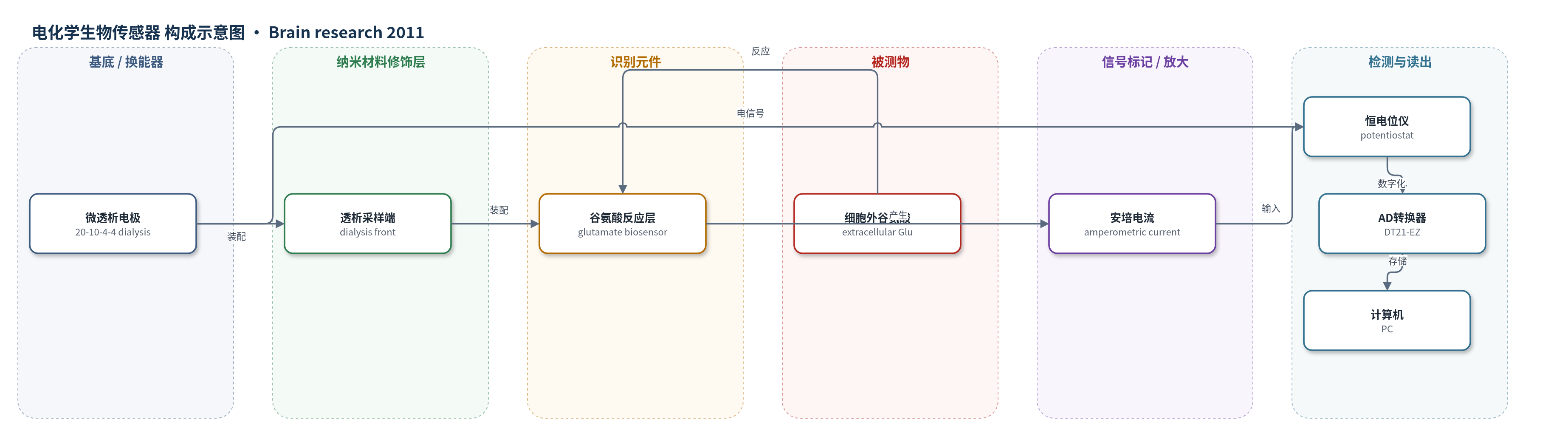
点击图片查看大图 · 依据论文自动绘制
传感器类型
电化学生物传感器
检测对象
细胞外谷氨酸(extracellular glutamate, Glu);样品基质:大鼠脑运动皮层微透析液/组织间液
检测原理
微透析电极插入大鼠运动皮层,细胞外谷氨酸经透析端进入检测区,并在谷氨酸生物识别/反应层发生选择性转化,产生与谷氨酸浓度成正比的电化学活性产物。恒电位仪对检测端施加固定电位,谷氨酸浓度升高时氧化还原电流增大,形成安培信号。该传感器在50–450 μM谷氨酸标准液中呈线性响应,灵敏度0.22 nA/μM,R^2=0.998。模拟电流经DT21-EZ AD转换器以256次/秒数字化后传输至计算机,实现缺血与再灌注过程中细胞外谷氨酸的实时监测。原文未报告额外信号放大策略。
检测灵敏度
线性范围: 50–450 μM;灵敏度: 0.22 nA/μM;R^2 = 0.998
效应效果
传感器在50–450 μM谷氨酸标准液中线性,灵敏度0.22 nA/μM,R^2=0.998,可实时监测11VO大鼠皮层谷氨酸动态。缺血组缺血期谷氨酸峰值182.9±64.0 μM、再灌注峰值197.21±67.21 μM;MgSO4组为53.46±12.64和62.69±19.63 μM,显著降低。再灌注CBF峰值由212.30±54.36%降至81.23±23.64%。72 h海马Nissl存活率18.5±5.8%对77.2±5.7%,cleaved caspase-3 90.2±6.3%对21.1±2.2%。作者认为MgSO4通过抑制谷氨酸释放和再灌注高血流保护神经元。
传感器的构成
- 微透析探头:20–10–4–4 型 dialysis electrode(Sycopel International),插入运动皮层,作为采样与检测一体化探头
- 采样端:dialysis electrode 前端,接触脑组织间液,允许细胞外谷氨酸进入检测区
- 电化学换能端:potentiostat 连接的安培检测端(amperometric biosensor),将谷氨酸反应转为电流
- 校准标准:50–450 μM glutamate 标准溶液,用于建立线性响应(0.22 nA/μM,R^2=0.998)
中文摘要
本研究考察硫酸镁(MgSO4)对大鼠十一血管闭塞(11VO)脑缺血模型中脑血流(CBF)和细胞外谷氨酸浓度的神经保护作用。21只雄性Sprague–Dawley大鼠经10 min短暂闭塞建立缺血模型,分为缺血组、MgSO4组和假手术组。采用微透析生物传感器实时测定细胞外谷氨酸浓度,并用激光多普勒血流仪监测CBF。缺血后72 h,通过Nissl、DAPI、NeuN和cleaved caspase-3染色观察海马神经元死亡。缺血组和MgSO4组缺血期%CBF均显著降至约10%,但MgSO4组再灌注初期%CBF峰值显著低于缺血组;缺血与再灌注期MgSO4组谷氨酸释放也显著低于缺血组。染色结果显示MgSO4组海马神经元死亡显著减少。结果表明,MgSO4可通过抑制缺血条件下细胞外谷氨酸释放并降低再灌注初期CBF反应,发挥神经元保护作用。
英文摘要
This study examined the neuroprotective effects of magnesium-sulfate (MgSO(4)) on the cerebral blood flow (CBF) and extracellular glutamate concentration in an eleven vessel occlusion (11VO) rat model. Twenty-one male Sprague-Dawley rats (250-350g) were used for the 11VO ischemic model, which was induced by a 10-min transient occlusion. The animals were divided into 3 groups, including ischemic-induced animals (ischemia group), ischemic-induced and MgSO(4) treated animals (MgSO(4) group), and sham animals for comparison. The real-time extracellular glutamate concentration was measured using a microdialysis biosensor, and the CBF was monitored by laser Doppler flowmetry. Neuronal cell death in the hippocampal region was observed 72h after ischemia by several stains (Nissl, DAPI, NeuN, and cleaved caspase3). A significant decrease in %CBF was observed in both the ischemia and MgSO(4) groups, such as ~10% during the ischemic period. However, the MgSO(4) group showed a significant decrease in the initial reperfusion %CBF compared to the ischemia group. A significantly lower level of glutamate release was observed in the MgSO(4) group than in the ischemia group during the ischemic and reperfusion episode. Our staining results revealed a significant decrease in neuronal cell death in the hippocampus in the MgSO(4) group compared to the ischemia group. These results suggest that MgSO(4) is responsible for the protection of neuronal cells by suppressing the release of extracellular glutamate under ischemic conditions and the CBF response during the initial reperfusion period.