组成图示
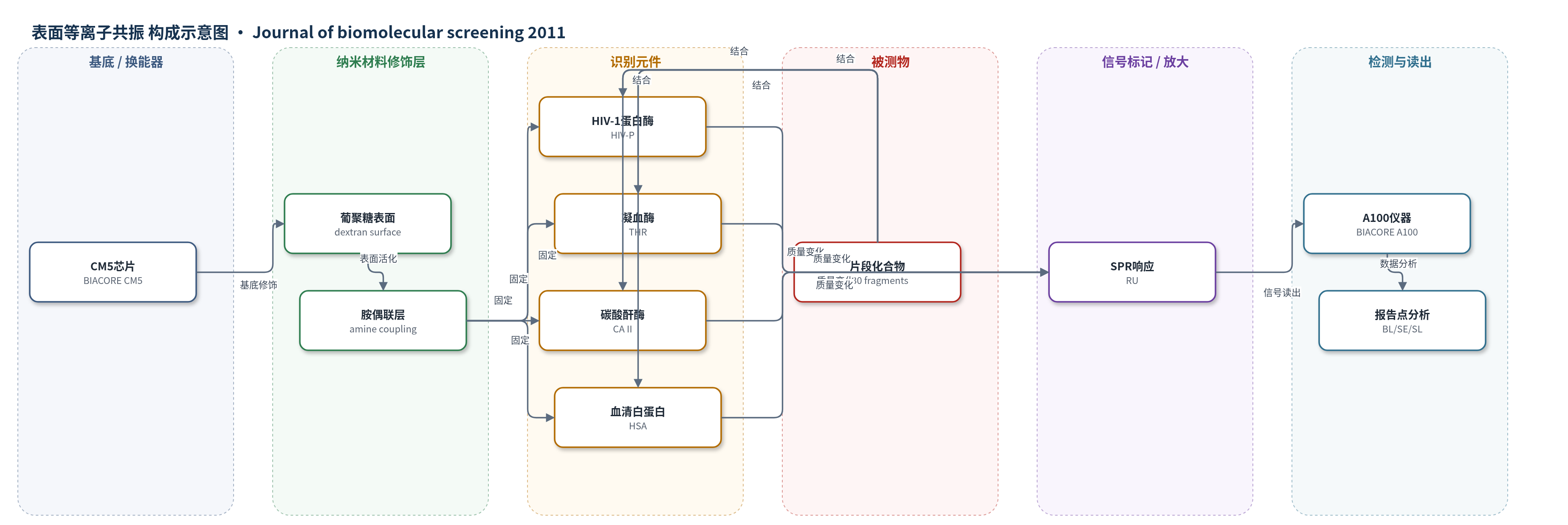
点击图片查看大图 · 依据论文自动绘制
传感器类型
表面等离子共振(SPR)生物传感器
检测对象
片段化合物(fragment compounds,MW 117–290 Da);样品基质:PBS-P 含 5% DMSO 的 384 孔板溶液
检测原理
目标蛋白通过胺偶联共价固定于 CM5 芯片的葡聚糖表面,形成识别层。片段化合物随含 5% DMSO 的 PBS-P 运行液流经传感芯片,与固定蛋白发生特异性或非特异性结合。结合事件改变传感芯片表面附近介质中的质量浓度和折射率,使表面等离子共振角发生偏移,BIACORE A100 将其转换为响应单位(RU)。信号大小与结合片段质量及浓度相关;通过参考区扣除、DMSO 体折射率校正和正/负对照表面活性校正,提取结合晚期(BL)、解离早期(SE)和解离晚期(SL)报告点,用于评估结合、化学计量比和解离动力学。
检测灵敏度
检测阈值(mean + 3SD): 11.6 RU(CA)、7.4 RU(HSA)、5.3 RU(THR)、12.0 RU(HIV-P);最低可检测 KD(117 Da 片段): 0.28 mM(CA)、0.42 mM(HSA)、0.48 mM(THR)、0.45 mM(HIV-P)
效应效果
930 个片段以 200 μM 浓度、相反进样顺序重复筛选,共获得 9040 条传感图,所有片段在 5% DMSO/PBS-P 中溶解良好。各表面 Z′ 因子为 HSA 0.84、CA 0.73、THR 0.87、HIV-P 0.71。按检测阈值,35%–97% 片段与不同靶标产生显著信号;267 个(29%)与全部 4 种蛋白均显著结合,6 个无信号,50 个(5%)仅与单一靶标结合。26 个(3%)片段对至少一种蛋白呈≥5:1 超化学计量比,35 个片段对至少一种蛋白解离缓慢(DR≥0.8),仅 2 个化合物对全部 4 种蛋白解离缓慢。两次实验定性结果一致,证明该片段库适用于 SPR 生物传感器筛选。
传感器的构成
- 基底/换能器:CM5 传感器芯片(BIACORE Series S CM5,葡聚糖表面),提供 SPR 换能表面
- 识别元件:HIV-1 蛋白酶(HIV-P)、人 α-凝血酶(THR)、碳酸酐酶 II(CA)、人血清白蛋白(HSA),经胺偶联共价固定
- 参考区:活化/去活化葡聚糖表面(REF),用于参考信号扣除
- 运行液:PBS-P(10 mM 磷酸盐,pH 7.4,2.7 mM KCl,0.14 M NaCl,0.05% Tween)加 5% DMSO,维持蛋白活性与片段溶解
- 分析物样品:930 个片段化合物(MW 117–290 Da),以 200 μM 浓度注入
- 正对照:benzamidine hydrochloride、furosemide、benzothiadiazine、acetyl pepstatin/indinavir,用于表面活性校正
- 负对照:含 5% DMSO 的 PBS-P,用于非特异信号扣除
中文摘要
本研究设计并实验验证了一种用于表面等离子共振(SPR)生物传感器筛选的新片段库。该库从460万种可购买商品化合物中,经一系列理化性质和药物化学过滤,最终选出930个片段化合物。作者将片段库针对3个典型药物靶标——HIV-1蛋白酶、凝血酶和碳酸酐酶——以及1个非靶标蛋白人血清白蛋白进行筛选。在筛选条件下,化合物溶解性良好。高灵敏度传感表面使不同靶标蛋白可检测到35%至97%片段的相互作用。没有任何片段表现出与全部4种蛋白均呈≥5:1化学计量比的泛结合行为,仅2个化合物从全部4种蛋白上解离缓慢。使用多个靶标蛋白证明有价值,因为若使用较少靶标,一些化合物可能因泛结合被错误剔除。该实验流程可高效评估和探索新片段库,并确认其适用于SPR生物传感器筛选。
英文摘要
A new fragment library for lead discovery has been designed and experimentally validated for use in surface plasmon resonance (SPR) biosensor-based screening. The 930 compounds in the library were selected from 4.6 million commercially available compounds using a series of physicochemical and medicinal chemistry filters. They were screened against 3 prototypical drug targets: HIV-1 protease, thrombin and carbonic anhydrase, and a nontarget: human serum albumin. Compound solubility was not a problem under the conditions used for screening. The high sensitivity of the sensor surfaces allowed the detection of interactions for 35% to 97% of the fragments, depending on the target protein. None of the fragments was promiscuous (i.e., interacted with a stoichiometry ≥5:1 with all 4 proteins), and only 2 compounds dissociated slowly from all 4 proteins. The use of several targets proved valuable since several compounds would have been disqualified from the library on the grounds of promiscuity if fewer target proteins had been used. The experimental procedure allowed an efficient evaluation and exploration of the new fragment library and confirmed that the new library is suitable for SPR biosensor-based screening.