组成图示
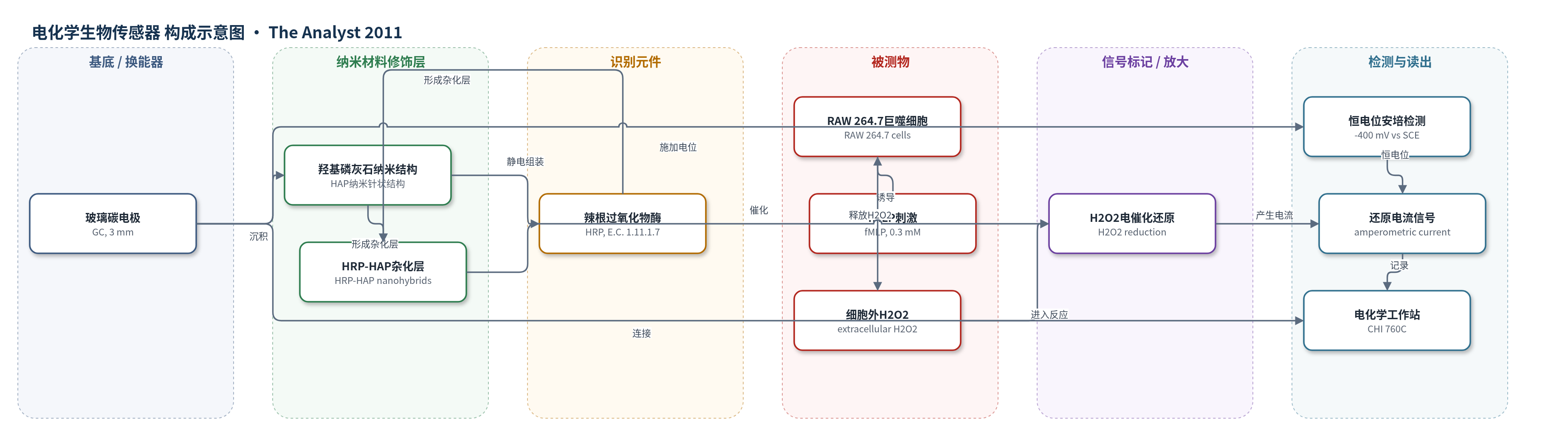
点击图片查看大图 · 依据论文自动绘制
传感器类型
电化学生物传感器
检测对象
过氧化氢(hydrogen peroxide, H2O2);样品基质:RAW 264.7小鼠巨噬细胞细胞外释放液、细胞裂解液(PBS, pH 7.4)
检测原理
传感器以玻璃碳电极为基底,HRP通过静电作用负载于带负电的HAP纳米针状结构表面,形成HRP-HAP纳米杂化层。HAP的三维多孔结构增大有效面积并促进H2O2扩散,同时促进HRP血红素中心与电极间的直接电子转移。检测时,细胞释放的H2O2进入杂化层,在-400 mV(vs SCE)下被HRP催化还原为水,电子经HRP传递至GC电极,产生与H2O2浓度相关的阴极电流。低工作电位避免尿酸、抗坏血酸等干扰。酶催化循环和HAP多孔结构提供信号增强,电流随H2O2浓度升高而增大,符合Michaelis-Menten特征。
检测灵敏度
LOD: 0.1 ± 0.02 mM;线性范围: 5 mM to 0.82 mM;R^2 = 0.998;KMapp: (0.47 ± 0.08) mM
效应效果
传感器响应快,95%稳态响应约2 s,短于文献中35、15和8 s的电极。7个不同电极校准斜率RSD约2.2%,0.5 mM H2O2十次测定RSD约2.8%。4 ℃保存2周后对0.5 mM H2O2仍保持约90%初始电流;在-400 mV下持续极化4 h响应基本不变。葡萄糖、抗坏血酸、尿酸和DOPAC在低电位下干扰可忽略。细胞内H2O2测得约8.0±0.4 nM,与荧光法一致;0.3 mM fMLP诱导30 min时H2O2最高约17±0.8 nM,3 h约13 nM;加入过氧化氢酶后信号消失,证明响应来自H2O2。作者认为可用于细胞内外H2O2及病理生理研究。
传感器的构成
- 基底/换能器电极:玻璃碳电极(GC,3 mm直径),提供导电基底与电子转能界面
- 纳米材料修饰层:羟基磷灰石纳米结构(HAP,针状,宽20–25 nm、长160–180 nm),提供三维多孔结构、负电荷表面和生物相容性,用于负载酶并促进电子转移
- 识别/催化元件:辣根过氧化物酶(HRP,E.C. 1.11.1.7),通过静电作用组装在HAP表面,催化H2O2还原并实现直接电子转移
- 纳米杂化传感层:HRP–HAP纳米杂化材料(HRP–HAP nanohybrids),由HRP与HAP复合形成,沉积于GC表面作为电化学生物传感单元
中文摘要
为可靠测定细胞外和细胞内过氧化氢(H2O2)并理解其在病理生理、环境应激和脂质过氧化中的作用,本文开发并验证了一种电化学方法,用于测定RAW 264.7小鼠巨噬细胞释放的细胞外H2O2。该方法基于HRP–HAP/GC生物传感器对释放H2O2的电催化还原,传感器通过将辣根过氧化物酶–羟基磷灰石(HRP–HAP)纳米杂化材料沉积在玻璃碳(GC)电极上制备。传感器响应快(小于2 s),检出限低(0.1±0.02 mM),线性范围宽(5 mM–0.82 mM),稳定性和重复性良好。由于在较低工作电位(-400 mV,vs SCE)下检测,尿酸(UA)、抗坏血酸(AA)、葡萄糖和3,4-二羟基苯乙酸(DOPAC)等常见干扰物不产生干扰。该工作证明了一种简单有效的传感平台,可用于检测RAW 264.7等细胞释放的细胞外H2O2,在生物电化学分析、细胞生物学和病理生理学中具有潜在应用价值。
英文摘要
A new method developed for the reliable determination of extracellular and intracellular H(2)O(2) is very useful for gaining a full understanding of the role that H(2)O(2) plays in pathology and physiology, and the relationship between H(2)O(2) and environmental stresses and lipid peroxidation. This work developed and validated an electrochemical approach for the determination of extracellular H(2)O(2) released from RAW 264.7 murine macrophage cells. This approach is based on the electrocatalytic reduction of the released H(2)O(2) at the biosensor of HRP-HAP/GC, which was fabricated by depositing the horseradish peroxidase-hydroxyapatite (HRP-HAP) nanohybrids on a glassy carbon (GC, 3 mm in diameter) electrode. The biosensor exhibited a rapid response (less than 2 s), a low detection limit (0.1±0.02 μM), a wide linear range (5 μM to 0.82 mM), as well as good stability and repeatability. In addition, the common interfering species, such as uric acid (UA), ascorbic acid (AA), glucose, and 3,4-dihydroxyphenylacetic acid (DOPAC), etc., did not cause any interference due to the use of a low operating potential (-400 mV, versus SCE). Therefore, this work has demonstrated a simple and effective sensing platform for the detection of extracellular H(2)O(2) released from cells such as RAW 264.7 cells, which has potential utility to bioelectroanalytical chemistry, cellular biology, and pathophysiology.