组成图示
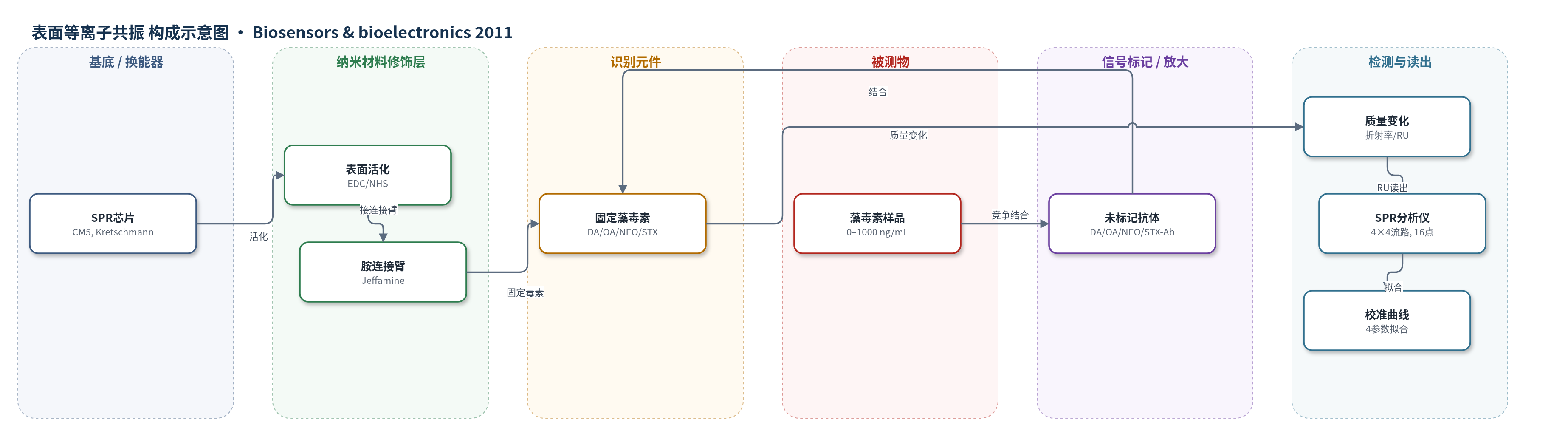
点击图片查看大图 · 依据论文自动绘制
传感器类型
表面等离子共振(SPR)生物传感器
检测对象
膝痛酸(domoic acid, DA)、奥卡达酸(okadaic acid, OA)、新河豚毒素(neosaxitoxin, NEO)、河豚毒素(saxitoxin, STX);样品基质:HBS-EP+缓冲液中的标准品(面向贝类/食品样品)。验证模型还包括人血清白蛋白(HSA)、肌红蛋白(myoglobin)、胰岛素样生长因子结合蛋白-2(IGFBP-2),基质为缓冲液/牛血浆。
检测原理
该SPR传感器采用无标记间接抑制法。CM5芯片经EDC/NHS活化后,通过Jeffamine或醛基反应将DA、OA、NEO、STX分别固定于四个流路,形成空间隔离的识别区。样品中的游离藻毒素与未标记抗体(DA-Ab、OA-Ab、NEO-Ab、STX-Ab)结合,竞争性地减少抗体与芯片上固定毒素的结合。结合事件改变金表面附近质量密度,引起Kretschmann构型下表面等离子体共振折射率变化,以共振单位(RU)实时读出。游离毒素浓度越高,抗体结合越少,RU响应越低;通过4参数拟合获得IC50和IC20–IC80。蛋白模型则采用固定抗体直接捕获分析物,RU随分析物浓度增加。系统无酶或核酸放大,依靠微流控分区实现多重检测。
检测灵敏度
LOD: 1.0–1.7 ng/mL(原文:theoretical lower limits of detection, based on the IC20 values);校准范围: 0–1000 ng/mL;IC50: DA 2.6 ng/mL、OA 4.9 ng/mL、NEO 2.6 ng/mL、STX 1.9 ng/mL;IC20–IC80: DA 1.0–6.4 ng/mL、OA 1.7–14.4 ng/mL、NEO 1.1–6.0 ng/mL、STX 1.0–3.7 ng/mL。
效应效果
固定单元16点位无交叉污染,HSA与myoglobin混合注入结合水平与单独相近。112点平均6404 RU,点间CV 17%,7片同点位CV 11%;与Biacore T100(CV 3%)略高,与接触打印(14%)和微点样(10%)接近。固定量随配体0.5–10 μg/mL在1400–14000 RU(1.4–14 ng/mm2)变化。IGFBP-2芯片30天16次阳性对照CV 2.5–2.9%,分析>150份牛血浆。藻毒素IC50<5 ng/mL,理论LOD 1.0–1.7 ng/mL,与单通道SPR相当;分区可缩短时间并允许各流路独立再生/进样。
传感器的构成
- 基底/换能器:Series S CM5 SPR芯片(羧甲基葡聚糖修饰金表面,Kretschmann构型)与微流控卡盒(IFC)形成4个独立流路
- 表面活化层:EDC/NHS活化CM5表面羧基,形成氨基反应性偶联位点
- 连接/固定层:Jeffamine(2,2-(ethylenedioxy)bis(ethylamine))胺连接臂用于藻毒素共价固定;EDC/NHS直接偶联抗体/蛋白
- 识别元件:固定藻毒素(domoic acid, DA;okadaic acid, OA;neosaxitoxin, NEO;saxitoxin, STX)或固定抗体(anti-HSA、anti-myoglobin、anti-IGFBP-2)作为捕获配体
- 样品识别/信号元件:未标记抗体(DA-Ab、OA-Ab、NEO-Ab、STX-Ab)或蛋白分析物(HSA、myoglobin、IGFBP-2)与固定配体结合,产生质量变化
- 封闭/失活层:1 M ethanolamine封闭未反应羧基;水/缓冲液洗涤;NaOH/HCl/acetonitrile再生液恢复表面
- 微流控固定单元:PDMS双层微流控(32通道、16个100 μm宽固定池)、96孔板样品井、PMMA盖与压气驱动,实现16点线性阵列固定
- 读出系统:原型多路SPR分析仪(4×4流路、16个SPR检测点),以共振单位(RU)输出信号
中文摘要
随着食品安全与动物掺假监测需求增加,亟需可同时进行生物标志物谱分析和多种化学污染物/毒素检测的生物传感器。表面等离子共振(SPR)是无标记检测技术,通过监测特异性生物分子识别元件与其结合伙伴的结合,实时反映传感器表面质量变化。本文开发了一种微流控固定装置,可在单一SPR芯片表面以线性阵列共价固定最多16种结合伙伴,并与原型多路SPR分析仪兼容。该固定单元和多路SPR分析仪分别用于评估高、低分子量分子的固定与检测能力,并以藻毒素浓度分析作为模型体系。四种毒素母体化合物被固定在同一芯片的不同流路中,获得校准曲线。芯片分区设计使各毒素家族的结合事件相互隔离,可区分毒素家族并进行浓度分析,为替代生物法筛查藻毒素提供了可行方案。
英文摘要
There is an increasing demand to develop biosensor monitoring devices capable of biomarker profiling for predicting animal adulteration and detecting multiple chemical contaminants or toxins in food produce. Surface plasmon resonance (SPR) biosensors are label free detection systems that monitor the binding of specific biomolecular recognition elements with binding partners. Essential to this technology are the production of biochips where a selected binding partner, antibody, biomarker protein or low molecular weight contaminant, is immobilised. A micro-fluidic immobilisation device allowing the covalent attachment of up to 16 binding partners in a linear array on a single surface has been developed for compatibility with a prototype multiplex SPR analyser. The immobilisation unit and multiplex SPR analyser were respectively evaluated in their ability to be fit-for-purpose for binding partner attachment and detection of high and low molecular weight molecules. The multiplexing capability of the dual technology was assessed using phycotoxin concentration analysis as a model system. The parent compounds of four toxin groups were immobilised within a single chip format and calibration curves were achieved. The chip design and SPR technology allowed the compartmentalisation of the binding interactions for each toxin group offering the added benefit of being able to distinguish between toxin families and perform concentration analysis. This model is particularly contemporary with the current drive to replace biological methods for phycotoxin screening.