组成图示
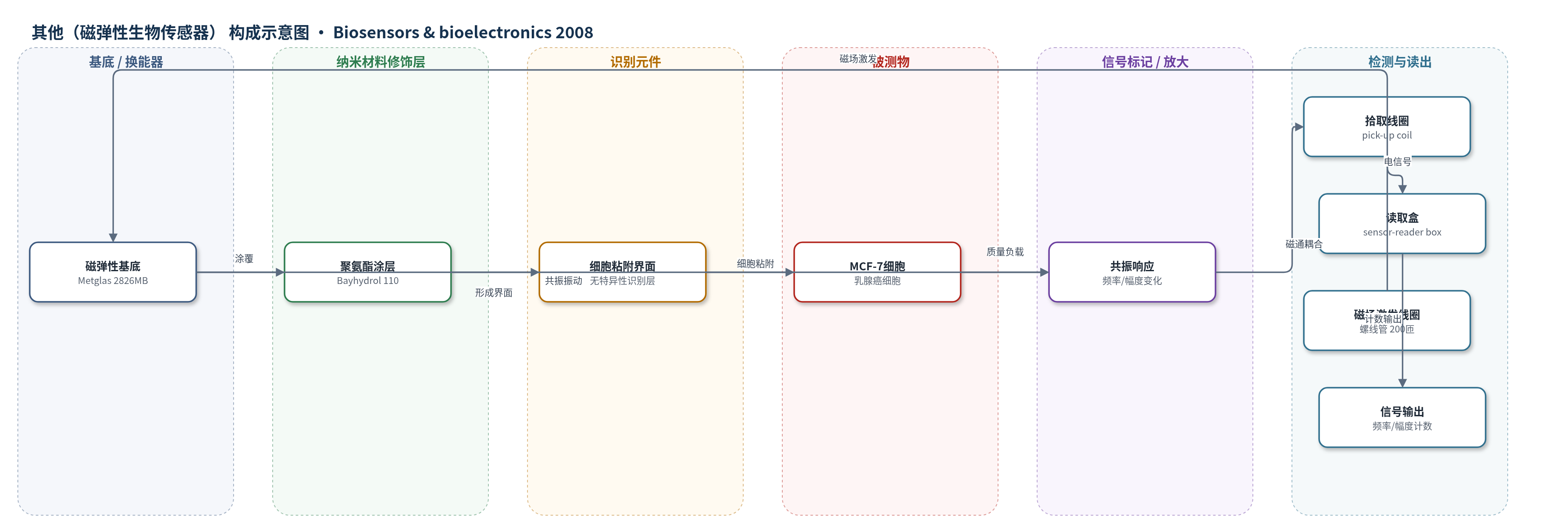
点击图片查看大图 · 依据论文自动绘制
传感器类型
其他(磁弹性生物传感器)
检测对象
人乳腺癌细胞 MCF-7(MCF-7 cells)、氟尿嘧啶(fluorouracil)、顺铂(cisplatin);样品基质:RPMI-1640 细胞培养基
检测原理
该装置以 Metglas 2826MB 磁弹性带状厚膜为换能器,表面涂覆 Bayhydrol 110 聚氨酯形成细胞相容界面。外部螺线管产生时变磁场,使磁弹性传感器沿纵向发生共振振动,并产生随振动变化的磁通。MCF-7 细胞加入培养基后粘附到聚氨酯表面,细胞质量负载和界面阻尼增加,导致共振频率和共振幅度下降;其中幅度变化信噪比更高,且与细胞浓度呈线性关系。拾取线圈远程感应磁通变化,传感器读取盒通过微处理器频率计数获得共振频率和幅度。加入氟尿嘧啶或顺铂后,药物抑制细胞增殖并引起细胞死亡脱落,使幅度变化随药物浓度和时间改变,从而定量评价细胞毒性。
检测灵敏度
LOD: 1.2 × 10^4 cells ml−1;线性范围: 5 × 10^4–1 × 10^6 cells ml−1
效应效果
空白培养基孵育数小时未观察到非特异吸附,背景干扰低。通过逐步提高激发电压(1.2–2.7 V)“摇落”松散细胞后,传感器恢复原共振频率和幅度,说明紧密粘附细胞膜稳定。每组实验重复 3 次,误差棒小,重现性满意。药物实验中,10.0 μM 氟尿嘧啶或顺铂约抑制 30% 细胞增殖;30.0 μM 氟尿嘧啶 16 h 抑制 60%,20.0 μM 顺铂 16 h 抑制 67%;20 h LC50 分别为 19.9 μM 和 13.1 μM。荧光显微镜和倒置相差显微镜结果与传感器一致。作者认为该无线磁弹性装置可低成本、快速、实时监测细胞生长和药物毒性,适合无菌细胞培养。
传感器的构成
- 换能器基底:Metglas 2826MB 磁弹性带状厚膜(Fe40Ni40P14B6),13 mm,提供磁弹性共振振动
- 保护/细胞相容层:Bayhydrol 110 聚氨酯,浸涂于传感器两侧并 150 °C 退火 2 h,防氧化并提供细胞粘附表面
- 识别/界面层:无特异性识别分子,MCF-7 细胞直接粘附于聚氨酯表面,形成质量负载
- 样品环境:小玻璃瓶(vial)盛 1 mL RPMI-1640 培养基,提供细胞培养环境
- 磁场激发元件:螺线管(2 Ω,200 匝,2 cm 长,8 mm 直径)产生时变磁场,驱动传感器振动
- 信号读出元件:拾取线圈(pick-up coil)与传感器读取盒(sensor-reader box),微处理器频率计数检测共振频率和幅度
中文摘要
本文开发了一种无线磁弹性传感装置,用于原位监测人乳腺癌细胞 MCF-7 的生长并评价抗癌药物氟尿嘧啶和顺铂的细胞毒性。该传感器由带状磁弹性传感器表面涂覆聚氨酯层制成,聚氨酯可保护富铁磁弹性材料免受氧化,并提供细胞相容表面。在时变磁场作用下,磁弹性传感器发生纵向振动并产生磁通,可被拾取线圈远程检测,传感器与检测系统之间无需物理连接。无线特性有利于无菌生物操作,尤其适用于细胞培养。细胞粘附到传感器表面后,其共振幅度下降,且下降幅度与细胞浓度成正比。在 5×10^4 至 1×10^6 cells/mL 范围内获得线性响应,检出限为 1.2×10^4 cells/mL。通过增大磁场激发幅度可定性评价细胞粘附强度。利用该磁弹性生物传感器评价了氟尿嘧啶和顺铂的细胞毒性,细胞抑制曲线与药物剂量相关;细胞与药物孵育 20 h 后,氟尿嘧啶和顺铂的半数致死浓度 LC50 分别计算为 19.9 μM 和 13.1 μM。
英文摘要
A wireless sensing device was developed for the in-situ monitoring of the growth of human breast cancer cells (MCF-7) and evaluation of the cytotoxicity of the anticancer drugs fluorouracil and cisplatin. The sensor is fabricated by coating a magnetoelastic ribbon-like sensor with a layer of polyurethane that protects the iron-rich sensor from oxidation and provides a cell-compatible surface. In response to a time-varying magnetic field, the magnetoelastic sensor longitudinally vibrates, emitting magnetic flux that can be remotely detected by a pick-up coil. No physical connections between the sensor and the detection system are required. The wireless property facilitates aseptic biological operation, especially in cell culture as illustrated in this work. The adhesion of cells on the sensor surface results in a decrease in the resonance amplitude, which is proportional to the cell concentration. A linear response was obtained in cell concentrations of 5 x 10(4) to 1 x 10(6)cells ml(-1), with a detection limit of 1.2 x 10(4) cells ml(-1). The adhesion strength of cells on the sensor is qualitatively evaluated by increasing the amplitude of the magnetic excitation field. And the cytotoxicity of the anticancer drugs fluorouracil and cisplatin is evaluated by the magnetoelastic biosensor. The cytostatic curve is related with the quantity of cytostatic drug. The lethal concentration (LC50) for cells incubated in the presence of drugs for 20 h is calculated to be 19.9 microM for fluorouracil and 13.1 microM for cisplatin.