组成图示
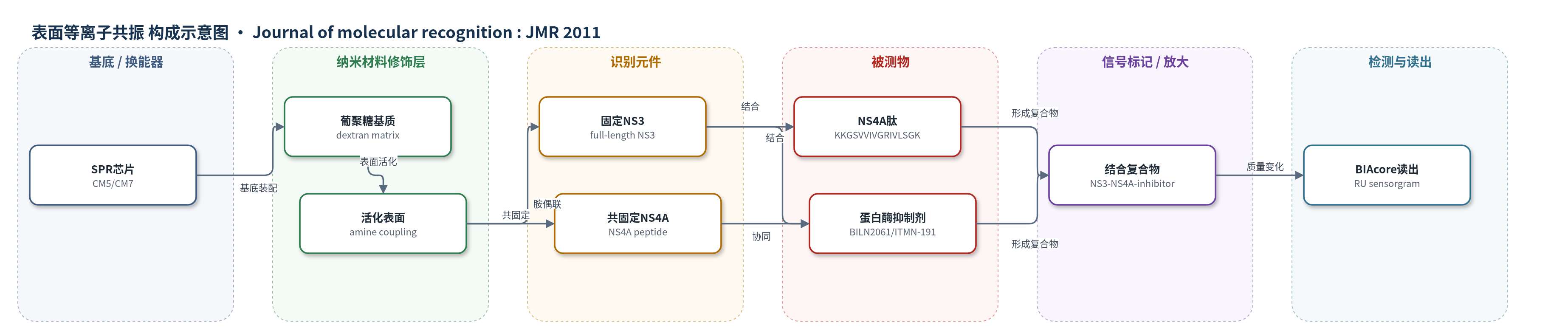
点击图片查看大图 · 依据论文自动绘制
传感器类型
表面等离子共振(SPR)生物传感器
检测对象
HCV NS3蛋白酶抑制剂(BILN 2061、ITMN-191、VX-950及化合物1–6)、NS4A辅因子肽(NS4A peptide);样品基质为SPR运行缓冲液(50 mM HEPES pH 7.4、0.1% n-octyl-β-D-glucopyranoside、2 mM DTT、3% DMSO)
检测原理
该传感器以CM5/CM7芯片为换能基底,全长HCV NS3经胺偶联固定于dextran基质表面,NS4A肽可共固定形成NS3–NS4A表面。当NS4A肽或蛋白酶抑制剂随运行缓冲液流过芯片时,与固定化NS3或NS3–NS4A发生特异性结合,使表面质量/折射率增加,改变表面等离子体共振条件,BIAcore记录响应单位(RU)随时间的sensorgram。结合相信号随分析物浓度升高而增大,解离相反映koff;通过全局拟合获得kon、koff和KD。VX-950先形成初始复合物,再缓慢转化为更稳定复合物,表现为时间依赖基线漂移。方法无外源标记和酶促放大,依靠直接质量传感与多浓度/多接触时间实验实现动力学解析。
检测灵敏度
原文未报告LOD、线性范围、灵敏度斜率或相关系数。
效应效果
CM5芯片NS3固定量约4000 RU,NS4A约1500 RU,结合容量10–20%;CM7芯片NS3可达12000 RU,容量30–40%。NS3–NS4A结合呈异质性,KD1=53.2±18.5 nM、KD2=2.1±1.0 mM。所有抑制剂在NS4A存在下亲和力提高,化合物3和5提高30–40倍。VX-950呈两步结合,NS3/NS4A表面koff由0.52 s−1降至0.41 s−1。ITMN-191高亲和力位点KD较BILN 2061低8倍。koff、KD、Ki与复制子EC50高度相关,说明SPR动力学可预测细胞水平抑制活性,适用于抗HCV先导化合物筛选与优化。
传感器的构成
- 基底/换能器:CM5/CM7 SPR传感器芯片,提供表面等离子共振换能与固定化平台
- 修饰层:CM5/CM7芯片表面dextran基质,经胺偶联活化用于固定NS3
- 识别元件:全长HCV基因型1a NS3蛋白(NS3,约72 kDa),共价固定于芯片表面,结合NS4A与抑制剂
- 共识别/辅因子元件:NS4A肽(KKGSVVIVGRIVLSGK,约1.6 kDa),与NS3共固定,稳定NS3并调节抑制剂结合
- 封闭剂:乙醇胺或20 mM Tris-HCl(pH 7.4),失活未反应表面基团,减少非特异结合
- 信号读出介质:无外源标记,SPR直接监测结合引起的表面响应单位(RU)变化
中文摘要
本研究利用表面等离子共振(SPR)生物传感器技术,对固定化全长丙型肝炎病毒(HCV)基因型1a NS3蛋白与配体的相互作用机制和动力学进行了表征。作者以NS3蛋白酶抑制剂系列及代表NS4A辅因子的肽段为分析物,发现NS3与NS4A及多种抑制剂的结合均呈异质性,可能反映NS3存在两种稳定构象。NS3–NS4A相互作用包含高亲和力(KD=50 nM)和低亲和力(KD=2 mM)两个组分,且对总结合贡献相近。将NS3单独或与NS4A共固定后,所有抑制剂在NS4A存在下对NS3的亲和力均提高,表明NS4A不仅影响催化,还直接影响抑制剂结合。机制型抑制剂VX-950表现出时间依赖性结合,缓慢形成稳定复合物;BILN 2061和ITMN-191未见明显时间依赖性,其中ITMN-191亲和力最高,解离最慢、结合最快。抑制剂解离常数与NS3蛋白酶抑制活性及复制子细胞培养中的抗病毒效应高度相关,说明该SPR方法可用于理解HCV NS3功能并支持抗HCV先导化合物发现与优化。
英文摘要
The mechanism and kinetics of the interactions between ligands and immobilized full-length hepatitis C virus (HCV) genotype 1a NS3 have been characterized by SPR biosensor technology. The NS3 interactions for a series of NS3 protease inhibitors as well as for the NS4A cofactor, represented by a peptide corresponding to the sequence interacting with the enzyme, were found to be heterogeneous. It may represent interactions with two stable conformations of the protein. The NS3-NS4A interaction consisted of a high-affinity (K(D) = 50 nM) and a low-affinity (K(D) = 2 µM) interaction, contributing equally to the overall binding. By immobilizing NS3 alone or together with NS4A it was shown that all inhibitors had a higher affinity for NS3 in the presence of NS4A. NS4A thus has a direct effect on the binding of inhibitors to NS3 and not only on catalysis. As predicted, the mechanism-based inhibitor VX 950 exhibited a time-dependent interaction with a slow formation of a stable complex. BILN 2061 or ITMN-191 showed no signs of time-dependent interactions, but ITMN-191 had the highest affinity of the tested compounds, with both the slowest dissociation (k(off)) and fastest association rate, closely followed by BILN 2061. The k(off) for the inhibitors correlated strongly with their NS3 protease inhibitory effect as well as with their effect on replication of viral proteins in replicon cell cultures, confirming the relevance of the kinetic data. This approach for obtaining kinetic and mechanistic data for NS3 protease inhibitor and cofactor interactions is expected to be of importance for understanding the characteristics of HCV NS3 functionality as well as for anti-HCV lead discovery and optimization.