组成图示
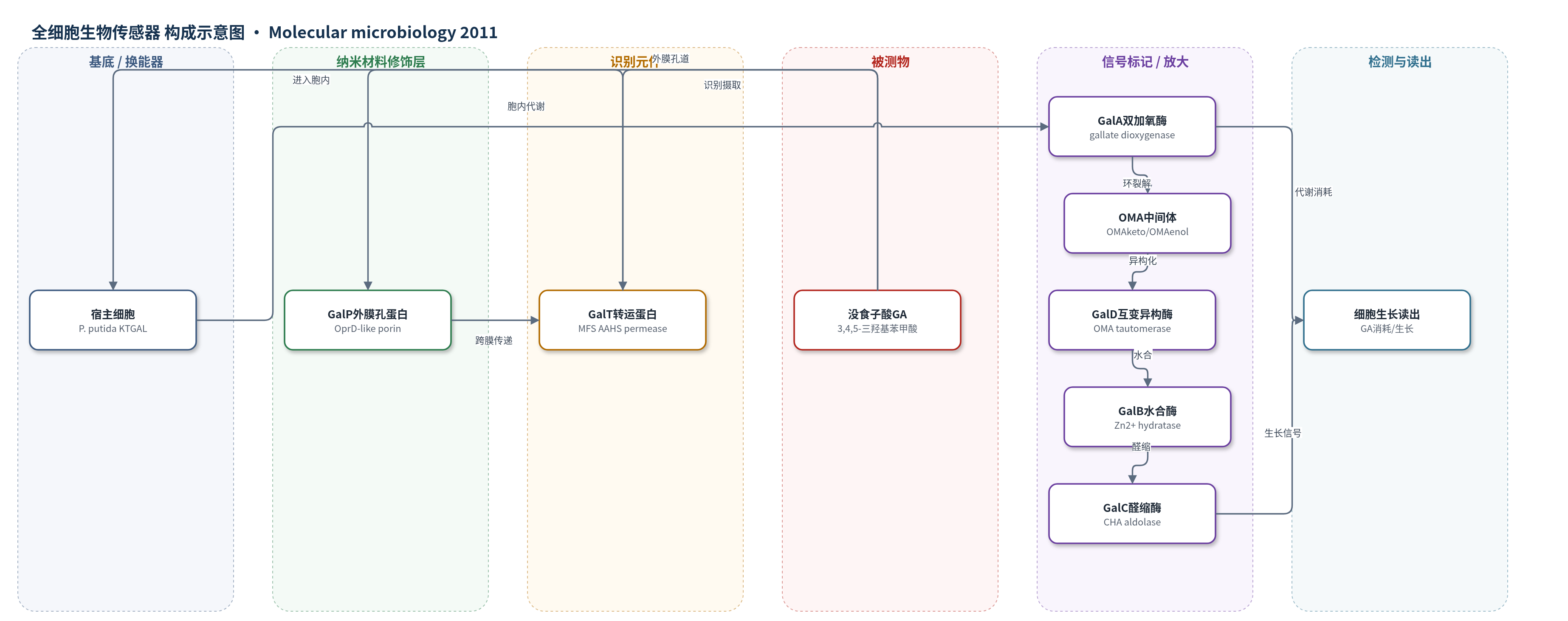
点击图片查看大图 · 依据论文自动绘制
传感器类型
全细胞生物传感器
检测对象
没食子酸(gallic acid, GA);样品基质:细菌培养基/溶液(原文未明确实际样品基质)
检测原理
该全细胞生物传感器以表达 gal 基因簇的 Pseudomonas putida 细胞为传感单元。GA 首先经外膜 GalP 孔蛋白辅助并通过内膜 GalT 转运蛋白高亲和摄取,GalT 的转运由质子动力势驱动,因此 GA 进入细胞构成识别事件。进入胞内后,GalA 邻位裂解双加氧酶催化 GA 环裂解生成 OMAketo;GalD 酮-烯醇互变异构酶将 OMAketo 转化为 OMAenol;GalB 锌依赖水合酶将 OMAenol 水合为 CHA;GalC 醛缩酶将 CHA 裂解为丙酮酸和草酰乙酸,进入中央代谢并产生能量与生物量。GA 浓度越高,碳源和能量供应越强,细胞生长或 GA 消耗速率随之变化,形成可检测信号。完整酶促代谢级联将单个 GA 分子转化为多种代谢产物和生物量,实现信号放大。
检测灵敏度
LOD: 0.5–1 mM(原文:able to detect GA concentrations as low as 0.5–1 mM)
效应效果
选择性方面,GalT 对 GA 呈高亲和特异性,Vmax 为 8.4 nmol min−1 (mg protein)−1,Km 为 4.3 mM;对原儿茶酸效率较低,Vmax 3.2 nmol min−1 (mg protein)−1,Km 9.1 mM;不转运甲基没食子酸、丁香酸、对苯二酚、咖啡酸、4-羟基苯甲酸等类似物。GA 摄取可被 FCCP、CCCP 和 DNP 等质子动力势解偶联剂抑制,说明转运依赖膜电位。gal 基因簇可转移至 Pseudomonas sp. MT14 和 Escherichia coli W,使原本不能利用 GA 的宿主获得 GA 降解能力。作者构建的 GA 细胞生物传感器可检测低至 0.5–1 mM 的 GA,主张用于扩展异源宿主代谢能力并检测工业废水或环境样品中的 GA。原文未报告 RSD、稳定性、回收率或与 ELISA/HPLC/qPCR 的对比。
传感器的构成
- 传感单元:Pseudomonas putida KTGAL 全细胞,表达完整 gal 基因簇,作为 GA 识别、摄取与代谢平台
- 识别/摄取元件:GalT(MFS 家族 AAHS 转运蛋白),介导 GA 高亲和特异性跨膜摄取,依赖质子动力势
- 外膜辅助层:GalP(OprD 家族外膜孔蛋白),辅助低浓度 GA 通过外膜
- 代谢酶层:GalA(邻位裂解没食子酸双加氧酶),催化 GA 环裂解生成 OMAketo
- 代谢酶层:GalD(OMA 酮-烯醇互变异构酶),将 OMAketo 转化为 OMAenol
- 代谢酶层:GalB(锌依赖 OMA 水合酶),将 OMAenol 水合为 CHA
- 代谢酶层:GalC(CHA 醛缩酶),裂解 CHA 生成丙酮酸和草酰乙酸
- 信号读出:细胞生长或 GA 消耗变化,作为全细胞生物传感信号(原文未给出具体换能器/标记物)
中文摘要
没食子酸(GA,3,4,5-三羟基苯甲酸)广泛存在于自然界,是主要酚类污染物,也常用作抗氧化剂和药物开发构建块。本研究在假单胞菌 Pseudomonas putida KT2440 的 GA 适应株中鉴定并表征了首个完整负责以 GA 为唯一碳源和能源生长的基因簇(gal 基因簇)。GalT 介导 GA 的特异性摄取和趋化性,凸显 GA 转运在细菌适应 GA 消耗中的关键作用。研究重新审视了经中心中间体 4-氧代草酰庚酮酸(OMA)的 GA 降解途径,并鉴定了所有相关酶。GalD 是新型异构酶亚家族原型,催化此前未知的生化步骤,即将 GalA 双加氧酶生成的 OMAketo 互变异构为 OMAenol。GalB 是新型含锌水合酶家族创始成员,将 OMAenol 转化为 4-羧基-4-羟基-2-氧代己二酸(CHA)。galC 编码催化 CHA 裂解为丙酮酸和草酰乙酸的醛缩酶。假单胞菌属外同源 gal 基因簇的存在揭示了 GA 降解菌中 gal 基因的进化与生态。gal 基因被用于扩展异源宿主的 GA 降解代谢能力,并用于构建 GA 细胞生物传感器。
英文摘要
Gallic acid (3,4,5-trihydroxybenzoic acid, GA) is widely distributed in nature, being a major phenolic pollutant and a commonly used antioxidant and building-block for drug development. We have characterized the first complete cluster (gal genes) responsible for growth in GA in a derivative of the model bacterium Pseudomonas putida KT2440. GalT mediates specific GA uptake and chemotaxis, and highlights the critical role of GA transport in bacterial adaptation to GA consumption. The proposed GA degradation via the central intermediate 4-oxalomesaconic acid (OMA) was revisited and all enzymes involved have been identified. Thus, GalD is the prototype of a new subfamily of isomerases that catalyses a biochemical step that remained unknown, i.e. the tautomerization of the OMAketo generated by the GalA dioxygenase to OMAenol. GalB is the founding member of a new family of zinc-containing hydratases that converts OMAenol into 4-carboxy-4-hydroxy-2-oxoadipic acid (CHA). galC encodes the aldolase catalysing CHA cleavage to pyruvic and oxaloacetic acids. The presence of homologous gal clusters outside the Pseudomonas genus sheds light on the evolution and ecology of the gal genes in GA degraders. The gal genes were used for expanding the metabolic abilities of heterologous hosts towards GA degradation, and for engineering a GA cellular biosensor.