组成图示
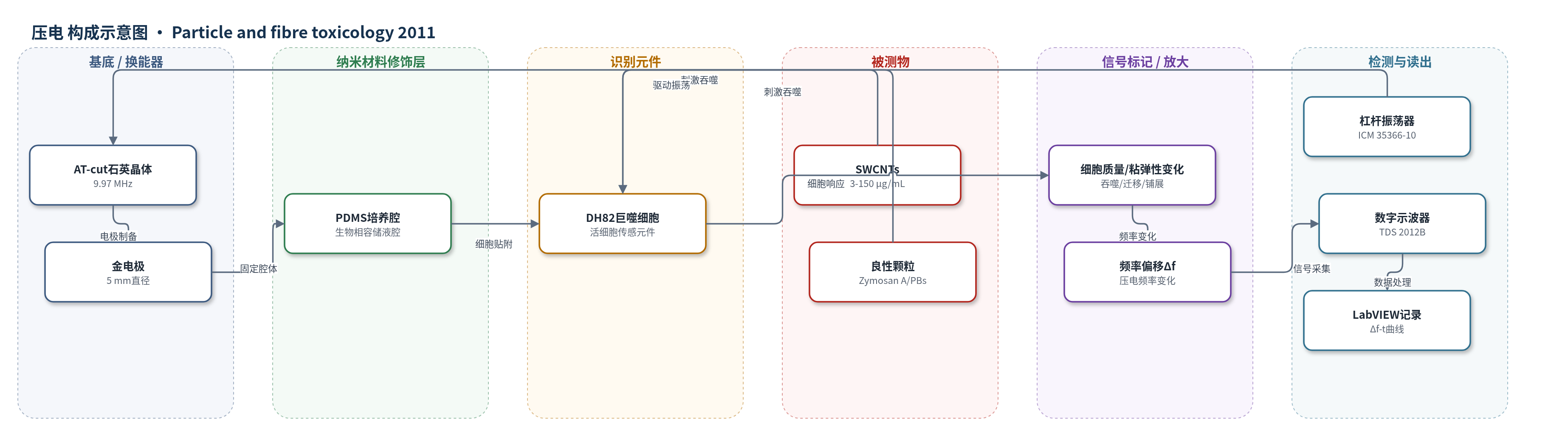
点击图片查看大图 · 依据论文自动绘制
传感器类型
压电(QCM)生物传感器
检测对象
单壁碳纳米管(SWCNTs)、曲霉聚糖A(Zymosan A)、聚苯乙烯微球(PBs);样品基质:细胞培养基(EMEM/15% FBS),亦可用于空气样品灌注
检测原理
该传感器以贴附于金电极石英晶体表面的DH82巨噬细胞为活细胞识别/传感元件。当培养基中加入SWCNTs、Zymosan A或PBs时,巨噬细胞发生吞噬、迁移、伪足伸出和细胞骨架重排,导致细胞质量分布、粘弹性及与晶体表面的耦合状态改变。AT-cut石英晶体在lever oscillator驱动下发生压电振荡,其频率对表面耦合质量敏感:质量增加或粘弹性变化使频率下降,质量/耦合恢复使频率回升。系统以Δf-t曲线连续读出,低剂量刺激出现短暂下降后逆转,高剂量SWCNTs造成持续下降并伴随凋亡/坏死,从而反映剂量依赖的细胞毒性动力学。
检测灵敏度
未报告LOD、线性范围、灵敏度斜率或相关系数;实验剂量范围: 3-150 μg/mL;Δf与log[SWCNT]呈线性关系;Δf反转滞后时间与SWCNT剂量呈线性关系
效应效果
QCMB在18 h内区分良性与毒性暴露:单独细胞、Zymosan A、PBs或无细胞高剂量SWCNTs频率稳定;刺激后1–6 h频率下降,3–30 μg/mL SWCNTs在6–18 h逆转并恢复或超过基线,常规实验证实恢复;100–150 μg/mL SWCNTs频率未逆转,24/48 h证实凋亡/坏死。LDH显示24 h基础损失9.8%,10和30 μg/mL分别造成22.3%和22.4%损失,100 μg/mL约35%死亡;30–50 μg/mL组78%恢复。该无标记系统避免染料吸附/荧光猝灭,可连续实时便携监测,适用于纳米材料毒性筛查与暴露剂量学。
传感器的构成
- 基底/换能器:AT-cut石英晶体(9.97 MHz)与金电极(5 mm直径),作为压电换能器,其振荡频率随表面耦合质量与粘弹性变化。
- 培养腔:PDMS(聚二甲基硅氧烷)管/圆柱腔,固定于晶体外壳,形成细胞与培养基储液腔,生物相容且无毒。
- 识别/传感元件:DH82巨噬细胞单层,贴附于金电极表面,作为活细胞传感元件,通过吞噬、迁移、铺展和细胞骨架变化响应刺激。
- 样品介质:EMEM(Eagle’s Minimum Essential Medium)含15% FBS、L-谷氨酰胺、青霉素、链霉素和两性霉素B,维持细胞活性并输送被测物。
- 读出电路:lever oscillator(ICM 35366-10)与Tektronix TDS 2012B示波器/LabVIEW,驱动晶体并自动记录频率。
中文摘要
背景:工程纳米材料(ENMs)不断涌现,纳米毒理学与环境健康安全亟需在材料广泛使用前评估其毒性。传统细胞检测以离散时间点和有机染料为主,易受ENMs干扰,需要无标记、连续、快速且具有生物学意义的检测系统。我们开发了一种活细胞石英晶体微天平生物传感器(QCMB),利用贴附于石英晶体上的巨噬细胞,通过晶体振荡频率变化(Δf)连续监测细胞群对处理的响应。结果:在QCMB中连续18 h分析巨噬细胞对曲霉聚糖A、聚苯乙烯微球(PBs)及3–150 μg/mL单壁碳纳米管(SWCNTs)的响应,并以常规活力实验和组织学染色平行监测24/48 h毒性。单独细胞、曲霉聚糖A、PBs或无细胞高剂量SWCNTs均保持频率稳定;加入上述物质后,1–6 h出现显著频率下降,SWCNTs的Δf呈剂量依赖。6–18 h,良性物质或低剂量SWCNTs(3–30 μg/mL)频率下降逆转并恢复或超过基线,常规实验证实细胞恢复;Δf逆转滞后时间与SWCNTs剂量呈线性关系。高剂量SWCNTs(100–150 μg/mL)频率未逆转,24/48 h实验证实凋亡/坏死。结论:该QCMB可在常规细胞实验之前检测并提供ENMs峰值、亚致死和毒性暴露的独特动力学信息。
英文摘要
BACKGROUND: Numerous engineered nanomaterials (ENMs) exist and new ENMs are being developed. A challenge to nanotoxicology and environmental health and safety is evaluating toxicity of ENMs before they become widely utilized. Cellular assays remain the predominant test platform yet these methods are limited by using discrete time endpoints and reliance on organic dyes, vulnerable to interference from ENMs. Label-free, continuous, rapid response systems with biologically meaningful endpoints are needed. We have developed a device to detect and monitor in real time responses of living cells to ENMs. The device, a living cell quartz crystal microbalance biosensor (QCMB), uses macrophages adherent to a quartz crystal. The communal response of macrophages to treatments is monitored continuously as changes in crystal oscillation frequency (Δf). We report the ability of this QCMB to distinguish benign from toxic exposures and reveal unique kinetic information about cellular responses to varying doses of single-walled carbon nanotubes (SWCNTs).
RESULTS: We analyzed macrophage responses to additions of Zymosan A, polystyrene beads (PBs) (benign substances) or SWCNT (3-150 μg/ml) in the QCMB over 18 hrs. In parallel, toxicity was monitored over 24/48 hrs using conventional viability assays and histological stains to detect apoptosis. In the QCMB, a stable unchanging oscillation frequency occurred when cells alone, Zymosan A alone, PBs alone or SWCNTs without cells at the highest dose alone were used. With living cells in the QCMB, when Zymosan A, PBs or SWCNTs were added, a significant decrease in frequency occurred from 1-6 hrs. For SWCNTs, this Δf was dose-dependent. From 6-18 hrs, benign substances or low dose SWCNT (3-30 μg/ml) treatments showed a reversal of the decrease of oscillation frequency, returning to or exceeding pre-treatment levels. Cell recovery was confirmed in conventional assays. The lag time to see the Δf reversal in QCMB plots was linearly SWCNT-dose dependent. Lastly, the frequency never reversed at high dose SWCNT (100-150 μg/ml), and apoptosis/necrosis was documented in conventional 24 and 48 hr-assays.
CONCLUSION: These data suggest that the new QCMB detects and provides unique information about peak, sub-lethal and toxic exposures of living cells to ENMs before they are detected using conventional cell assays.