组成图示
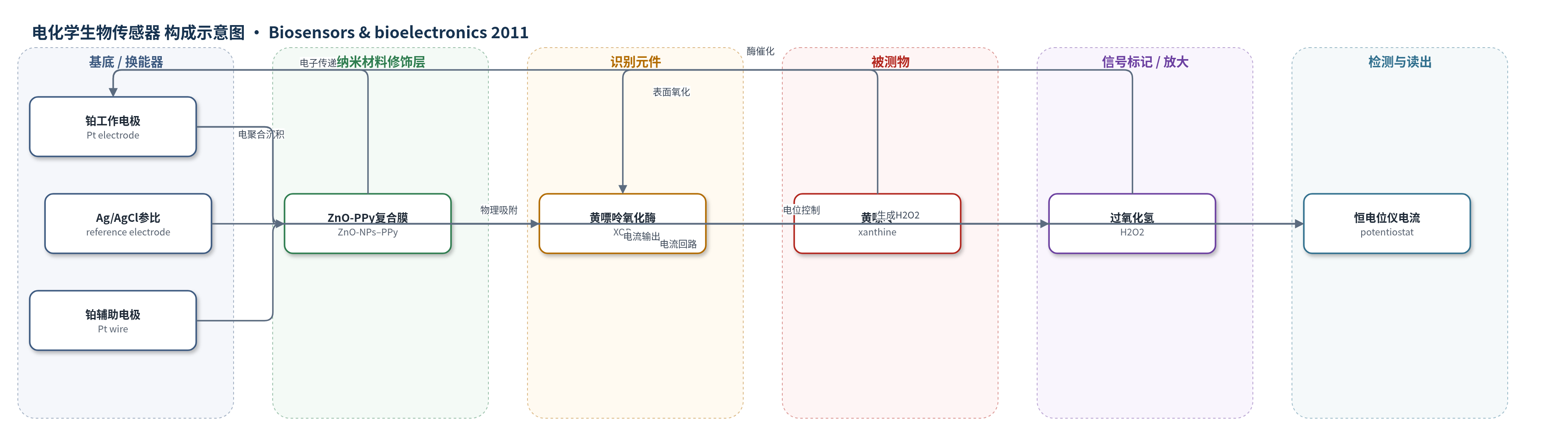
点击图片查看大图 · 依据论文自动绘制
传感器类型
电化学生物传感器
检测对象
黄嘌呤(xanthine),样品基质为鱼肉提取物(fish meat extract)
检测原理
该传感器以XOD为识别元件,黄嘌呤在XOD催化下与O2和H2O反应生成尿酸和H2O2。ZnO-NPs/PPy复合膜为酶提供高比表面积和导电微环境,促进电子传递。生成的H2O2在0.38 V工作电位下于电极表面发生氧化反应,释放电子;电子经ZnO-NPs和PPy传导至Pt基底,再由恒电位仪记录电流。电流大小与H2O2生成量成正比,因而随黄嘌呤浓度增加而增大,在0.8–40 μM范围内呈线性。
检测灵敏度
LOD: 0.8 μM (S/E = 3);线性范围: 0.8 μM–40 μM
效应效果
传感器在pH 7.0、35 ℃下5 s内达到最佳响应,线性范围0.8–40 μM,LOD 0.8 μM,优于Nafion修饰Pt电极(2–18.5 μM),低于CNT修饰碳糊电极(1–100 μM)。鱼肉加标回收率为94.2%和95.1%(10、20 mg/L),批内CV<5.1%、批间CV<5.34%。与酶法比色法比较相关系数r=0.93。4 ℃保存下经100天200次使用后活性损失40%。作者认为该传感器可用于鱼肉新鲜度监测。
传感器的构成
- 基底/工作电极:铂电极(Pt electrode,1.85 cm×1 mm),经氧化铝抛光和超声清洗,提供电子传导基底。
- 纳米材料修饰层:氧化锌纳米颗粒–聚吡咯复合膜(ZnO-NPs–PPy),由ZnO-NPs与吡咯在100 mM NaClO4中电聚合形成,ZnO-NPs提供高比表面积、生物相容性和电子传递,PPy提供导电网络。
- 识别元件:黄嘌呤氧化酶(XOD,E.C.1.1.3.2),通过物理吸附/静电相互作用固定于ZnO-NPs/PPy膜表面,催化黄嘌呤氧化。
- 信号产物:过氧化氢(H2O2),由XOD催化黄嘌呤与O2、H2O反应生成,在0.38 V下氧化产生电流。
- 参比/辅助电极:Ag/AgCl参比电极和Pt丝辅助电极,与恒电位仪连接构成三电极体系。
- 反应介质:0.05 M磷酸盐缓冲液(PBS,pH 7.0),维持酶活性和电化学测量环境。
中文摘要
本文报道了一种基于氧化锌纳米颗粒–聚吡咯复合膜的安培型黄嘌呤生物传感器。氧化锌纳米颗粒(ZnO-NPs)由硝酸锌在55 ℃水相中简单合成,无需煅烧;将ZnO-NPs与吡咯在铂电极上电聚合,形成ZnO-NPs–聚吡咯(PPy)复合膜,并通过物理吸附固定黄嘌呤氧化酶(XOD)。采用FTIR、CV、XRD、SEM、TEM和EIS对修饰前后电极进行表征。以XOD/ZnO-NPs–PPy/Pt为工作电极、Ag/AgCl为参比电极、Pt丝为辅助电极,经恒电位仪构成黄嘌呤传感器。该传感器在pH 7.0、35 ℃下5 s内达到最佳响应,对黄嘌呤线性范围为0.8–40 μM,检出限0.8 μM(S/E=3),Km为13.51 μM,Imax为0.071 μA。传感器用于鱼肉中黄嘌呤测定,4 ℃保存下经100天200次使用后活性损失40%。
英文摘要
Zinc oxide nanoparticles (ZnO-NPs) were synthesized from zinc nitrate by simple and efficient method in aqueous media at 55°C without any requirement of calcinations step. A mixture of ZnO-NPs and pyrrole was eletropolymerized on Pt electrode to form a ZnO-NPs-polypyrrole (PPy) composite film. Xanthine oxidase (XOD) was immobilized onto this nanocomposite film through physiosorption. The ZnO-NPs/polypyrrole/Pt electrode was characterized by Fourier transform infrared (FTIR), cyclic voltammetry (CV), X-ray diffraction (XRD), scanning electron microscopy (SEM), transmission electron microscopy (TEM) and electrochemical impedance spectroscopy (EIS) before and after immobilization of XOD. The XOD/ZnO-NPs-PPy/Pt electrode as working electrode, Ag/AgCl as reference electrode and Pt wire as auxiliary electrode were connected through a potentiostat to construct a xanthine biosensor. The biosensor exhibited optimum response within 5s at pH 7.0, 35°C and linearity from 0.8 μM to 40 μM for xanthine with a detection limit 0.8 μM (S/E=3). Michaelis Menten constant (K(m)) for xanthine oxidase was 13.51 μM and I(max) 0.071 μA. The biosensor measured xanthine in fish meat and lost 40% of its initial activity after its 200 uses over 100 days, when stored at 4°C.