组成图示
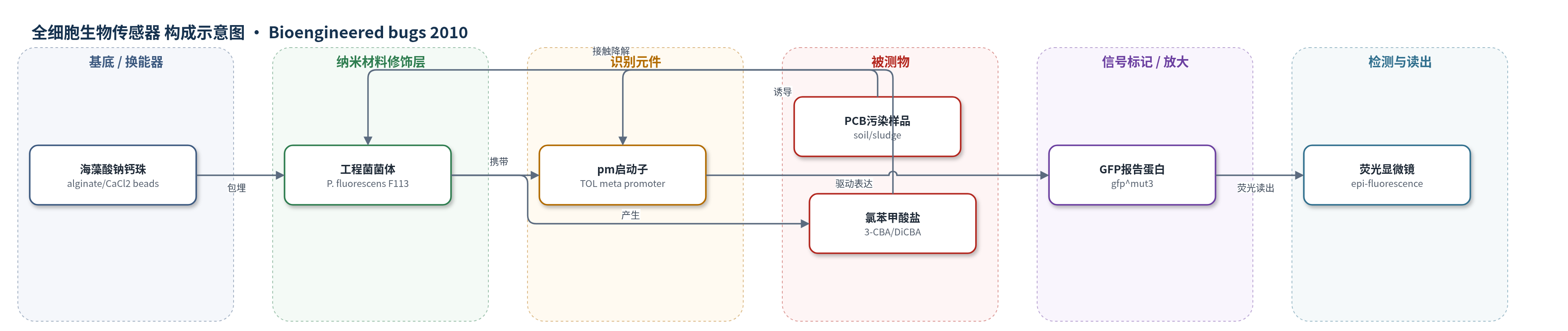
点击图片查看大图 · 依据论文自动绘制
传感器类型
全细胞生物传感器
检测对象
多氯联苯(PCBs)及其降解产物氯苯甲酸盐(chlorobenzoates,3-CBA、2,3-DiCBA、3,5-DiCBA);样品基质:污染土壤、污泥、根际土壤和豌豆根际。
检测原理
传感器以工程化荧光假单胞菌为识别与降解单元。菌体携带 bph 操纵子,可将 PCB 降解为氯苯甲酸盐(如 3-CBA、2,3-DiCBA、3,5-DiCBA);这些产物作为诱导物激活 TOL 质粒来源的 pm 启动子,驱动 gfp^mut3 报告基因转录翻译。GFP 积累后产生绿色荧光,荧光强度或 GFP 阳性细胞比例随诱导物浓度及 PCB 生物可利用性升高而增加。海藻酸钠钙珠将菌体固定,便于在土壤/污泥中回收和原位观察。最终通过荧光显微镜或荧光光谱读取信号,从而反映污染样品中 PCB 的生物可利用性和降解活性。
检测灵敏度
灵敏度: 0.1 ppm(原文称 sensitivity,针对 3-CBA、2,3-DiCBA、3,5-DiCBA,荧光显微镜);线性范围: 4–400 ppm(荧光强度与 log10 浓度线性)
效应效果
选择性:2-CBA、4-CBA、3,4-DiCBA 不诱导;PCB 同系物仅诱导含 bph 的降解型传感器。实际样品中,F113L::1180gfp 在 A、B、C、D 样品 14 d 后 GFP 阳性细胞占菌体 43.8%、26.7%、10.7%、0.01%,与 PCB 水平正相关;非降解 F113rifgfp <0.01%。海藻酸钙珠固定提高准确性;未种植土中菌 1 个月后由 1×10^8 CFU/g 降至 ≤1×10^4 CFU/g,豌豆根际 3 个月维持 10^6–10^7 bphC 拷贝/g 根。接种豌豆处理去除总 PCB 38.7%(F113L::1180gfp)和 32.8%(F113rifPCBgfp),高于直接接种;qPCR 比平板计数高约 10 倍。
传感器的构成
- 基底/固定载体:海藻酸钠钙珠(sodium alginate/CaCl2 beads,约1 mm),包埋菌体并作为原位检测界面。
- 传感菌体:工程化 Pseudomonas fluorescens F113 衍生菌(F113rifgfp、F113rifPCBgfp、F113L::1180gfp),含 bph 操纵子用于 PCB 降解。
- 识别/感应元件:pm 启动子(TOL 质粒 meta-pathway promoter),被氯苯甲酸盐诱导。
- 信号标记物:绿色荧光蛋白 GFP(gfp^mut3),表达后产生可检测绿色荧光。
- 辅助标记:0.1% acridine orange 或 0.05% methyl violet,将非 GFP 菌/植物细胞染红,便于区分阳性细胞。
- 读出系统:荧光显微镜/荧光光谱(465–495 nm 或 450–490 nm 激发),统计 GFP 阳性细胞比例。
中文摘要
全细胞微生物生物传感器为评估污染土壤中污染物生物可利用和生物可及组分提供了可能,而这些组分目前难以直接测定。本文报道并评价了三种用于检测污染土壤和沉积物中多氯联苯(PCBs)及其降解产物生物可利用性与生物降解性的微生物传感器菌株。PCBs 是分布广、危害大且持久性强的污染物。结果表明,样品中 PCB 水平与表达报告基因 gfp 的传感器细胞百分比呈正相关。将传感器固定于海藻酸钙珠中,可在污染土壤和污泥样品中方便、准确地检测传感器菌株。传感器还显示,接种豌豆的种植土壤中 PCB 降解活性明显高于仅接种未种植土壤,表明根际修复(植物根际微生物去除污染物)在去除环境有机异源物方面具有显著应用前景。
英文摘要
Whole cell microbial biosensors offer excellent possibilities for assaying the complex nature of the bioavailable and bioaccessible fraction of pollutants in contaminated soils, which currently cannot be easily addressed. This paper describes the application and evaluation of three microbial biosensor strains designed to detect the bioavailability and biodegradation of PCBs (and end-products) in contaminated soils and sediments. Polychlorinated biphenyls (PCBs) are considered to be one of the most wide spread, hazardous and persistent pollutants. Herein we describe that there was a positive correlation between the PCB levels within the samples and the percentage of biosensor cells that were expressing their reporter gene; gfp. Immobilisation of the biosensors in calcium alginate beads allowed easy and accurate detection of the biosensor strains in contaminated soil and sludge samples. The biosensors also showed that PCB degradation activity was occurring at a much greater level in Pea inoculated planted soil compared to inoculated unplanted soil indicating rhizoremediation (the removal of pollutants by plant root associated microbes) shows considerable promise as a solution for removing organic xenobiotics from the environment.