组成图示
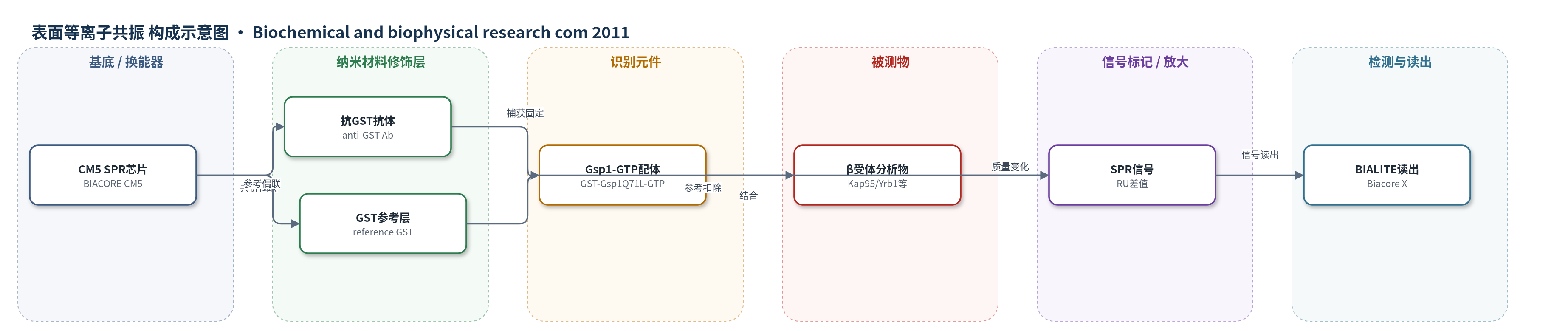
点击图片查看大图 · 依据论文自动绘制
传感器类型
表面等离子共振(SPR)生物传感器
检测对象
酵母 β-受体(importin β receptors,如 Kap95、Kap104、Pse1、Sxm1、Kap114、Kap123、Nmd5、Msn5、Mtr10、Pdr6、Kap120)及 Ran 结合蛋白 Yrb1;样品基质:纯化重组蛋白 PBSKMT 缓冲液
检测原理
CM5 金膜 SPR 芯片表面先共价偶联单克隆抗 GST 抗体,再捕获 GST-Gsp1Q71L-GTP 融合蛋白,使 Gsp1-GTP 作为固定配体暴露于样品流室。纯化 β-受体或 Yrb1 等分析物随 PBSKMT 缓冲液流过表面,与 Gsp1-GTP 发生特异性结合,使界面质量增加,引起表面等离子共振信号变化,以共振单位 RU 实时记录。随后仅用缓冲液冲洗进入解离相,获得结合—解离曲线。样品流室与仅含 GST 的参考流室信号相减,扣除非特异吸附。曲线按 1:1 Langmuir 模型拟合,得到 ka、kd、Ka 和 Kd;信号随分析物浓度升高而增大并趋于饱和。
检测灵敏度
未报告LOD、线性范围、灵敏度斜率或相关系数
效应效果
SPR 方法通过参考流室中的 GST 扣除非特异结合,结合常数与既有 GTP 交换抑制和 GTPase 保护实验一致。该方法可实时区分强、中、弱结合受体,type IV 受体 Xpo1、Cse1、Los1 在最高浓度下无可检测信号。Kd 范围为 230 pM–270 nM,on-rate 差异约 20 倍,off-rate 差异约 500 倍;Kap95/Gsp1-GTP 复合体 kd=6.3×10^-5 s^-1,Yrb1 Kd=0.45 nM。定量显示 Gsp1 为 16 μM(674,500 分子/细胞),10 个 β-受体合计约 530,000 分子/细胞,核内 Ran-GTP 估计过量约 3 倍。作者认为不同亲和力提示核质运输存在新调控模式。
传感器的构成
- 基底/换能器:CM5 SPR 芯片(BIACORE),提供金膜表面等离子共振换能
- 捕获抗体层:单克隆抗 GST 抗体(anti-GST Ab)共价偶联于 CM5 芯片,用于捕获 GST 融合蛋白
- 配体识别层:GST-Gsp1Q71L-GTP 融合蛋白结合于抗 GST 抗体,作为 Ran 同源物 Gsp1-GTP 配体
- 参考通道:单独 GST 结合于参考流室,用于扣除非特异相互作用
- 分析物溶液:纯化酵母 β-受体或 Yrb1 等 Ran 结合蛋白,溶于 PBSKMT 缓冲液并流过样品流室
中文摘要
进入或离开细胞核的货物通常由 importin β 家族受体介导,通过核孔复合体完成转运。酿酒酵母含有 14 个该家族成员,可分为 importin 和 exportin。Ran GTPase 通过其 GTP 结合状态调控受体与货物的结合、解离及转运方向,且受体仅在核内与 Ran-GTP 结合。本研究利用生物传感器测量了全部酵母转运受体与 Ran-GTP 的结合性质,发现不同 importin 对 Ran-GTP 的亲和力差异显著,解离常数范围为 230 pM 至 270 nM,这种差异主要来源于解离速率常数的不同。结果表明 importin 对 Ran-GTP 的亲和力分化可能代表一种新的核质运输调控方式。此外,作者还测定了 β-受体及其他 Ran 结合蛋白的细胞内浓度,发现 β-受体总量大致等于酵母 Ran 总量,但核内 Ran-GTP 并不构成限制因素。文章讨论了这些结果对核质运输机制的意义。
英文摘要
Cargos destined to enter or leave the cell nucleus are typically transported by receptors of the importin β family to pass the nuclear pore complex. The yeast Saccharomyces cerevisiae comprises 14 members of this protein family, which can be divided in importins and exportins. The Ran GTPase regulates the association and dissociation of receptors and cargos as well as the transport direction through the nuclear pore. All receptors bind to Ran exclusively in its GTP-bound state and this event is restricted to the nuclear compartment. We determined the Ran-GTP binding properties of all yeast transport receptors by biosensor measurements and observed that the affinity of importins for Ran-GTP differs significantly. The dissociation constants range from 230 pM to 270 nM, which is mostly based on a variability of the off-rate constants. The divergent affinity of importins for Ran-GTP suggests the existence of a novel mode of nucleocytoplasmic transport regulation. Furthermore, the cellular concentration of β-receptors and of other Ran-binding proteins was determined. We found that the number of β-receptors altogether about equals the amounts of yeast Ran, but Ran-GTP is not limiting in the nucleus. The implications of our results for nucleocytoplasmic transport mechanisms are discussed.