组成图示
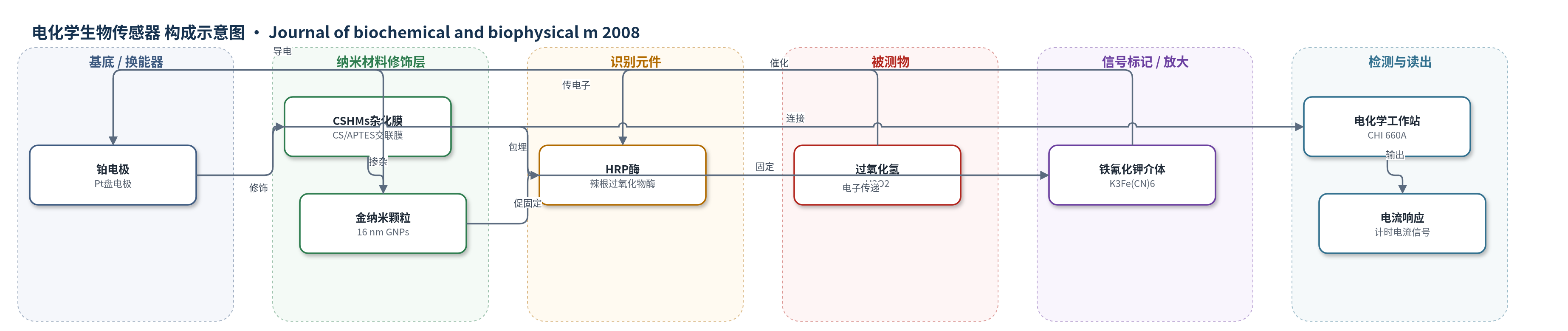
点击图片查看大图 · 依据论文自动绘制
传感器类型
电化学生物传感器
检测对象
过氧化氢(Hydrogen peroxide, H2O2);样品基质:消毒剂样品(用PBS稀释)、PBS缓冲液
检测原理
HRP包埋于CSHMs中,在−0.05 V低电位下催化H2O2还原:H2O2+2H+与还原态HRP反应生成水和氧化态HRP。氧化态HRP被固定在膜内的Fe(CN)6^4−还原再生,生成Fe(CN)6^3−;Fe(CN)6^3−在电极表面获得电子再生为Fe(CN)6^4−,形成循环电子传递。GNPs掺杂在杂化膜中形成导电通道,提高膜导电性并促进介体/酶与电极间电子转移。H2O2浓度增加时,酶催化速率和介体循环通量增大,电极阴极电流增大,通过计时电流法读出。CSHMs网络固定介体与酶,减少泄漏并维持酶活性。
检测灵敏度
LOD: 8.0×10⁻⁷ M (S/N = 3);线性范围: 3.5×10⁻⁶–1.4×10⁻³ M;R^2 = 0.997
效应效果
传感器在−0.05 V低电位下工作,对葡萄糖、乙醇、半胱氨酸、抗坏血酸、L-亮氨酸和L-酪氨酸(各8.0×10⁻⁴ mol/L,存在4.0×10−4 mol/L H2O2)无明显干扰,电流比分别为1.022、0.996、0.982、0.995、0.988和0.998。连续100次循环伏安扫描后,0.04 mmol/L H2O2响应仅下降6.8%;9次连续测量RSD为4.3%。4℃保存3天后响应下降约5.6%,超过1个月下降约22%,即保留约78%灵敏度。响应时间快,10 s内达到95%响应。实际消毒剂样品稀释20倍后测定,与高锰酸钾滴定法结果接近,表明可用于实际样品。作者认为该传感器成本低、操作简便,可拓展到其他安培酶传感器。
传感器的构成
- 基底电极:铂盘电极(Pt,直径2.0 mm),作为工作电极与电子传导基底
- 杂化膜修饰层:壳聚糖/硅溶胶-凝胶杂化膜(CSHMs,由CS与APTES交联),提供多孔网络并固定酶与介体
- 纳米导电层:金纳米颗粒(GNPs,平均粒径16 nm),掺杂于CSHMs中,提高导电性并促进电子传递
- 识别/催化元件:辣根过氧化物酶(HRP),包埋于CSHMs中,催化H2O2还原
- 电子介体:铁氰化钾(K3Fe(CN)6,Fe(CN)6^3−/4−),掺杂于CSHMs中,在电极与HRP间传递电子
- 保护层:上层CSHMs,覆盖电极表面,防止HRP和K3Fe(CN)6泄漏
中文摘要
本文报道了一种基于壳聚糖/硅溶胶-凝胶杂化膜(CSHMs)固定辣根过氧化物酶(HRP)的过氧化氢(H2O2)生物传感器的简便制备方法。该杂化膜由壳聚糖(CS)与3-氨基丙基三乙氧基硅烷(APTES)交联形成,并掺杂铁氰化钾(K3Fe(CN)6)和平均粒径约16 nm的金纳米颗粒(GNPs),修饰于铂电极表面。GNPs可增强杂化膜导电性并促进电子传递,Fe(CN)6^3−/4−作为电子介体在电极与HRP活性中心之间传递电子,同时被杂化膜网络固定以减少泄漏。采用紫外-可见吸收光谱考察各组分相互作用,循环伏安法和计时电流法优化并表征传感器性能。在优化条件下,传感器对H2O2在3.5×10^-6至1.4×10^-3 mol/L范围内呈良好线性,检出限(S/N=3)为8.0×10^-7 mol/L,表观Michaelis-Menten常数为0.93 mmol/L。电极在4℃保存30天后仍保留约78%初始响应,并可用于实际样品中H2O2测定,结果令人满意。
英文摘要
A simple and effective strategy for fabrication of hydrogen peroxide (H2O2) biosensor has been developed by entrapping horseradish peroxidase (HRP) in chitosan/silica sol-gel hybrid membranes (CSHMs) doped with potassium ferricyanide (K3Fe(CN)6) and gold nanoparticles (GNPs) on platinum electrode surface. The hybrid membranes are prepared by cross-linking chitosan (CS) with 3-aminopropyltriethoxysilane (APTES), while the presence of GNPs improved the conductivity of CSHMs, and the Fe(CN)6(3-/4-) was used as a mediator to transfer electrons between the electrode and HRP due to its excellent electrochemistry activity. UV-Vis absorption spectroscopy was employed to characterize the different components in the CSHMs and their interaction. The parameters influencing the performance of the resulting biosensor were optimized and the characteristic of the resulting biosensor was characterized by cyclic voltammetry and chronoamperometry. Linear calibration for hydrogen peroxide was obtained in the range of 3.5x10(-6) to 1.4x10(-3) M under the optimized conditions with the detection limit (S/N = 3) of 8.0x10(-7) M. The apparent Michaelis-Menten constant of the enzyme electrode was 0.93 mM. The enzyme electrode retained about 78% of its response sensitivity after 30 days. The system was applied for the determination of the samples, and the results obtained were satisfactory.