组成图示
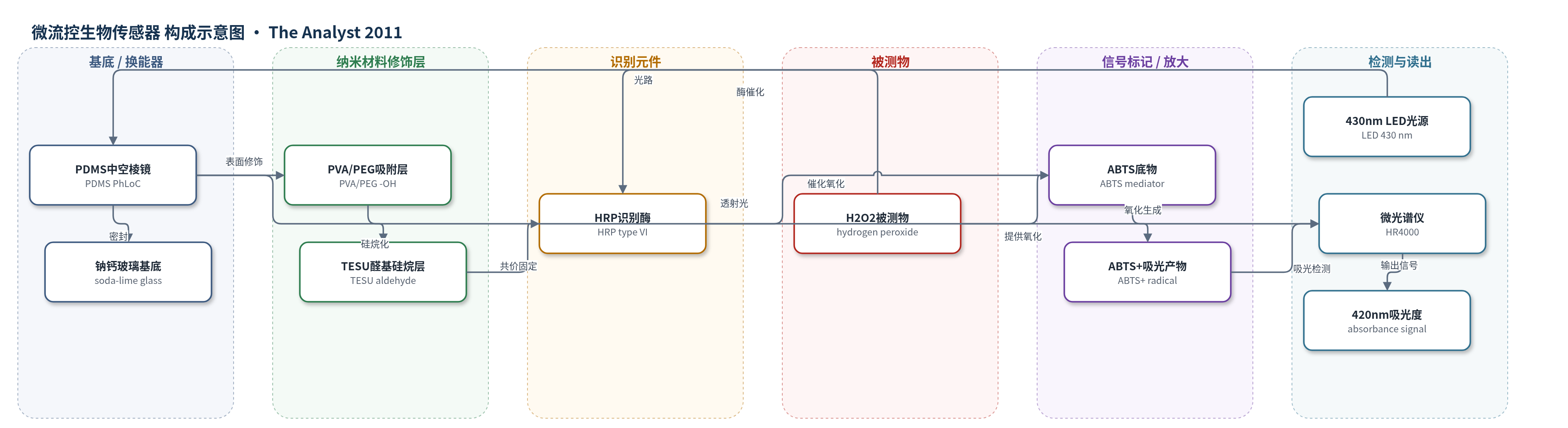
点击图片查看大图 · 依据论文自动绘制
传感器类型
微流控生物传感器
检测对象
过氧化氢(hydrogen peroxide, H2O2);样品基质:醋酸缓冲液溶液(0.1 M acetate buffer pH 5.5,含0.5 mM ABTS)
检测原理
该传感器以共价固定的HRP作为识别/催化元件。当H2O2溶液进入PDMS中空棱镜微流控腔时,HRP催化H2O2氧化ABTS,生成绿色ABTS+自由基阳离子。ABTS+在420 nm处具有特征吸收,其浓度与H2O2浓度在0.1–24.2 mM范围内近似线性相关。检测时,430 nm LED光穿过PDMS棱镜,微光谱仪记录透射光谱,通过420 nm附近吸光度变化定量H2O2。由于酶催化可循环转化底物,单个HRP分子可连续产生多个ABTS+,形成酶促信号放大;表面PVA/TESU共价固定则减少非特异吸附并提高稳定性。
检测灵敏度
LOD: around 0.10 mM (Table 2: 0.10 ± 0.01, 0.12 ± 0.08, 0.14 ± 0.08, 0.28 ± 0.08 mM); 线性范围: 0.1 mM–24.2 mM; 灵敏度: 0.02 a.u. mM−1 (Table 2: 0.017 ± 0.003, 0.019 ± 0.001, 0.019 ± 0.001, 0.021 ± 0.005 a.u. mM−1); R^2: 0.996, 0.990, 0.996, 0.998
效应效果
四种方案的分析性能相近,均在0.1–24.2 mM范围内线性,灵敏度约0.02 a.u. mM−1,LOD约0.1 mM;其中LOD比同类HRP系统低10–100倍,灵敏度较同一PhLoC先前报道提高约150倍。直接吸附和PEG修饰器件在第一周内灵敏度快速下降,氧化修饰器件至少一个月稳定但一个月后下降,PVA修饰器件两个月后仍保留82%初始灵敏度,重现性最好。论文未报告选择性、抗干扰或实际样品加标回收率。作者认为PVA修饰无需特殊仪器,最适合在PDMS光子芯片中快速、可靠地集成生物传感器。
传感器的构成
- 基底/换能器:PDMS中空棱镜微流控芯片(PhLoC),底部钠钙玻璃盖板,提供微流控通道与光学检测棱镜
- 表面吸附层:PEG或PVA线性聚合物,引入羟基并提高亲水性,为硅烷化提供位点
- 硅烷修饰层:11-三乙氧基硅基十一醛(TESU),通过乙氧基水解后与羟基共价结合,提供醛基反应位点
- 识别元件:辣根过氧化物酶(HRP),经赖氨酸伯胺与醛基形成席夫碱,并用NaBH3CN还原为稳定仲胺
- 封闭/清洗液:PBST(0.1 M PBS pH 7.0含0.02% Tween 20),去除非特异性吸附的HRP
- 信号底物:ABTS(2,2'-偶氮双(3-乙基苯并噻唑-6-磺酸)),在HRP催化下被H2O2氧化为ABTS+
- 读出系统:430 nm LED光源与微光谱仪(OceanOptics HR4000),测量ABTS+在420 nm附近的吸光度
中文摘要
本文比较了不同方法在聚二甲基硅氧烷(PDMS)表面选择性固定生物分子,旨在为基于PDMS的光子芯片(PhLoC)生物传感器建立稳健、可靠的简易实施方案。研究采用中空棱镜构型,其内表面先通过直接吸附聚乙二醇(PEG)或聚乙烯醇(PVA)线性聚合物,或进行轻度化学氧化,引入羟基;随后用含醛基的硅烷进行硅烷化。醛基与生物分子伯胺反应,实现选择性共价固定。通过接触角、X射线光电子能谱(XPS)和原子力显微镜(AFM)对修饰PDMS基底进行结构表征。以辣根过氧化物酶(HRP)为模型识别元件,构建了基于各修饰过程的生物传感器,用于检测0.1–100 mM过氧化氢(H2O2)。各方案分析性能相近,线性范围为0.1–24.2 mM,灵敏度约0.02 a.u. mM−1,检出限约0.1 mM;但器件重现性和运行稳定性存在明显差异,PVA修饰方案在两个月内保留82%初始灵敏度,最适合集成于PDMS PhLoC。
英文摘要
A comparative study of different approaches for the selective immobilisation of biomolecules on the surface of poly(dimethylsiloxane) (PDMS) is reported. The motivation of this work is to set a robust and reliable protocol for the easy implementation of a biosensor device in a PDMS-based photonic lab-on-a-chip (PhLoC). A hollow prism configuration, previously reported for the colorimetric detection of analytes was chosen for this study. Here, the inner walls of the hollow prism were initially modified by direct adsorption of either polyethylene glycol (PEG) or polyvinyl alcohol (PVA) linear polymers as well as by carrying out a light chemical oxidation step. All these processes introduced hydroxyl groups on the PDMS surface to a different extent. The hydroxyl groups were further silanised using a silane containing an aldehyde end-group. The interaction between this group and a primary amine moiety enabled the selective covalent attachment of a biomolecule on the PDMS surface. A thorough structural characterisation of the resulting modified-PDMS substrates was carried out by contact angle measurements, X-ray photoelectron spectroscopic (XPS) analysis and atomic force microscopy (AFM) imaging. Using horseradish peroxidase as a model recognition element, different biosensor approaches based on each modification process were developed for the detection of hydrogen peroxide target analyte in a concentration range from 0.1 µM to 100 µM. The analytical performance was similar in all cases, a linear concentration range between 0.1 µM and 24.2 µM, a sensitivity of 0.02 a.u. µM(-1) and a limit of detection around 0.1 µM were achieved. However, important differences were observed in the reproducibility of the devices as well as in their operational stability, which was studied over a period of up to two months. Considering all these studies, the PVA-modified approach appeared to be the most suitable one for the simple fabrication of a biosensor device integrated in a PDMS PhLoC.