组成图示
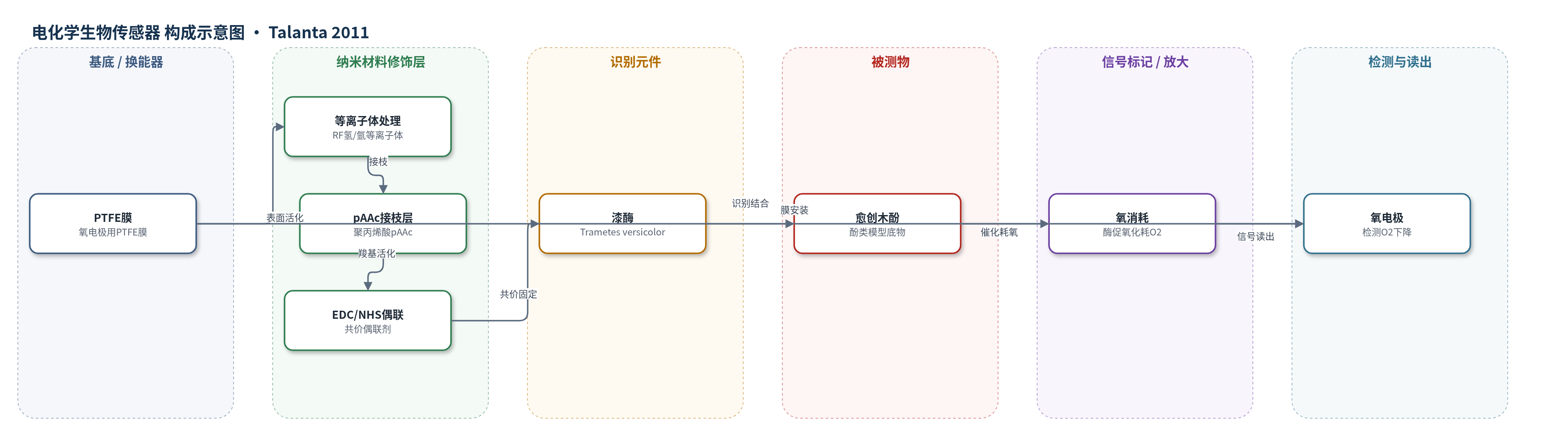
点击图片查看大图 · 依据论文自动绘制
传感器类型
电化学生物传感器
检测对象
愈创木酚(guaiacol,酚类化合物 phenolic compounds 模型底物);样品基质:缓冲液(实验基质),目标基质为环境水样/现场水样
检测原理
该传感器以 PTFE 膜为支撑,经等离子体接枝 pAAc 后,用 EDC/NHS 将漆酶共价固定于膜表面。检测时,愈创木酚等酚类底物扩散进入酶层,被漆酶催化氧化;漆酶以 O2 为电子受体,将酚类氧化为醌类产物,同时 O2 被还原消耗。反应体系中溶解氧浓度随时间下降,Clark 型氧电极实时监测 O2 消耗速率。愈创木酚浓度越高,单位时间内 O2 消耗速率越大,在低浓度范围内信号与底物浓度呈正相关。该体系不依赖荧光、比色或电化学发光标记,信号放大主要依靠酶催化循环,因此适合现场快速监测。
检测灵敏度
LOD: 82.1 μM(gelatin entrapment)、91.3 μM(pAAc-g-PTFE)、125.1 μM(pAAm-g-PTFE)
效应效果
pAAc-g-PTFE 综合最佳:400 μM 愈创木酚下活性 7.4 nmol ml−1 min−1(pAAm 6.4、明胶 12.0);LOD 91.3 μM(pAAm 125.1、明胶 82.1)。pAAc 可重复使用约 50 次(损失 40%),pAAm 约 35 次,明胶 3–4 次;4 °C PBS 储存 20 天损失 60% 活性,pAAm 6 天、明胶 13 天。pAAc 在 pH 4.5–7.0 保持 60% 以上活性,最佳 pH 6、35 °C,信号波动最小。作者称其可装于任意氧电极用于现场酚类监测,可重复使用性优于或可比于文献 CLEC 及双酶传感器;未报告选择性、抗干扰、实际样品回收率和 RSD。
传感器的构成
- 基底/换能器膜:聚四氟乙烯(PTFE)膜,作为氧电极用支撑膜,惰性、透气并承载酶层。
- 表面活化层:射频(RF)氢/氩等离子体处理,提高 PTFE 润湿性并产生接枝反应位点。
- 聚合物接枝层:聚丙烯酰胺(pAAm)或聚丙烯酸(pAAc),提供可偶联官能团(pAAm 含酰胺/氨基,pAAc 含羧基)。
- 共价偶联剂:EDC(N-(3-二甲氨基丙基)-N-乙基碳二亚胺)和 NHS(N-羟基丁二酰亚胺),介导漆酶与接枝层形成酰胺键。
- 识别元件:漆酶(laccase,Trametes versicolor),催化酚类底物氧化并消耗 O2。
- 包埋/交联层(明胶方案):明胶(gelatin)包埋漆酶,戊二醛(glutaraldehyde)交联,提高机械性但稳定性较差。
- 换能/读出:氧电极(oxygen electrode),检测酶促反应中溶解氧下降。
中文摘要
本研究将来自 Trametes versicolor 的漆酶通过两种策略固定在聚四氟乙烯(PTFE)膜上,用于构建酚类化合物生物传感器。第一种为明胶包埋,第二种为表面共价固定。表面固定先采用射频(RF)等离子体处理在 PTFE 表面引入反应性基团,再分别接枝聚丙烯酰胺(pAAm)或聚丙烯酸(pAAc)。pAAm 接枝采用氢等离子体预处理和氩等离子体引发两步聚合;pAAc 接枝采用氩等离子体处理后在 70 °C 热引发 6 h。两种接枝膜均通过优化的碳二亚胺偶联反应将漆酶共价固定。酶活性以愈创木酚为底物,用氧电极测定。三种传感膜在最佳工作条件、储存稳定性和可重复使用性方面进行了比较。结果表明,明胶包埋膜活性较高,但机械稳定性差、储存寿命短,不适合多次使用和现场测量;pAAc-g-PTFE 膜更稳定,可重复使用约 50 次,灵敏度适合现场应用,可作为酚类化合物现场监测的替代工具。
英文摘要
In this study, Trametes versicolor laccase was immobilized on polytetrafluoroethylene (PTFE) membranes using two different techniques, entrapment to gelatin and covalent immobilization to the surface. For surface immobilization, functional groups were formed on PTFE surface by radiofrequency (RF) plasma treatment followed by polymer grafting. Two different polymers, polyacrylamide (pAAm) and polyacrylic acid (pAAc) were tried. For polyacrylamide grafted PTFE, a two-step polymerization process was used. The membranes were first treated with hydrogen plasma and pAAm grafted PTFE (pAAm-g-PTFE) was then formed by argon plasma treatment. To produce pAAc grafted PTFE (pAAc-g-PTFE), the surface was first treated with argon plasma and AAc was then attached to the surface by heat treatment (70°C, 6h). For both cases, an optimized carbodiimide coupling reaction was used for laccase immobilization. Enzyme activity was measured by an oxygen electrode using guaiacol as substrate. All three biosensing membranes were characterized and compared in terms of optimum working conditions, storage stability and reusability. Our study concluded that although a higher activity was obtained by gelatin entrapped laccase, its mechanical instability and poor storage life makes the gelatin biosensor unattractive for multiple usages and for field measurements. pAAc-g-PTFE biosensor was found to be more stable and highly reusable (ca. 50 times) when compared with the other two biosensors. In addition, its sensitivity was suitable for field applications. Therefore, the pAAc-g-PTFE biosensor could be proposed as an alternative on-site detection tool for phenolic compound monitoring.