组成图示
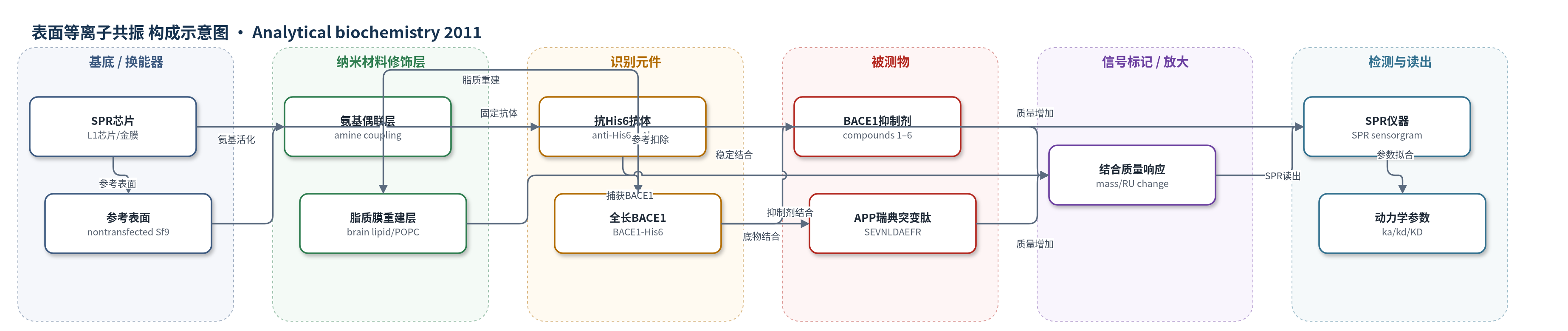
点击图片查看大图 · 依据论文自动绘制
传感器类型
表面等离子共振(SPR)生物传感器
检测对象
BACE1(b-site amyloid precursor protein cleaving enzyme 1,全长膜结合酶);样品基质:Sf9细胞裂解液。同时检测其配体结合:BACE1抑制剂(compounds 1–6)、APP瑞典突变肽(SEVNLDAEFR);缓冲基质:Hepes/NaCl/DMSO或Na-acetate/NaCl/DMSO。
检测原理
全长BACE1在Sf9细胞中表达并带C端His6标签,细胞裂解液直接流过固定有抗His6单克隆抗体的SPR芯片,BACE1被特异性捕获。随后注入脑脂质提取物或POPC脂质混合物,在芯片表面重建脂质双分子层,稳定BACE1跨膜区并形成接近生理的膜环境。当BACE1抑制剂或APP衍生肽流过时,配体与BACE1胞外域结合,使芯片表面质量增加,改变表面等离子体共振条件,产生与结合量成正比的共振单位(RU)响应;解离时响应下降。通过不同浓度配体的传感器图,以1:1结合模型并加入质量传递校正拟合,得到结合速率ka、解离速率kd和亲和力KD。该方法无标记、实时监测,脂质膜重建提高稳定性并增强生理相关性。
检测灵敏度
原文未报告LOD、线性范围、灵敏度斜率或相关系数;表面灵敏度:small molecules (Mr ~ 500 Da) produced a maximum signal of approximately 8 RU。
效应效果
该SPR表面经脑脂质提取物重建后基线稳定,结合能力可维持24 h以上,而仅用POPC的表面12 h后无法结合抑制剂;固定蛋白量为1700–2200 RU,BACE1与脂质总信号3500–4500 RU,参考表面约2300 RU,表观结合能力约45%,Mr≈500 Da小分子最大响应约8 RU。多种BACE1抑制剂验证了表面功能:化合物2–4在pH 4.5和7.4下均可逆结合并可用1:1模型拟合,化合物1、5、6结合缓慢或机制复杂;pH显著影响结合,50 μM Ca2+未显著改变KD或动力学,1 mM Ca2+未显示结合。与截短胞外域BACE1相比,结合速率略慢、解离速率多数无显著差异,说明胞外域可作为模型但全长膜环境更生理。方法可用于BACE1抑制剂发现并推广至其他膜靶点。
传感器的构成
- 基底/换能器:SPR L1传感器芯片(金膜/氨基活化表面),通过氨基偶联固定捕获抗体,提供光学换能表面
- 捕获抗体层:单克隆抗多组氨酸抗体(anti-polyhistidine antibody),固定于芯片,识别并捕获C端His6标签BACE1
- 目标酶/识别元件:全长BACE1(b-site amyloid precursor protein cleaving enzyme 1),C端His6标签,被抗体捕获后作为膜结合酶与抑制剂/底物结合
- 脂质膜重建层:脑脂质提取物(total brain lipid extract)或POPC(1-palmitoyl-2-oleoyl-sn-glycero-3-phosphocholine)脂质混合物,在芯片上形成脂质双分子层,稳定BACE1跨膜区并模拟生理膜环境
- 分析物/配体:BACE1抑制剂(compounds 1–6)或APP瑞典突变衍生肽(SEVNLDAEFR),与BACE1结合引起SPR信号变化
- 信号读出:Biacore 2000 SPR仪器,以共振单位(RU)实时监测结合/解离,生成传感器图
中文摘要
本研究开发了一种基于表面等离子共振(SPR)的生物传感器检测方法,用于在重建脂质膜环境中分析膜嵌入的全长β-淀粉样蛋白前体蛋白切割酶1(BACE1,又称β-分泌酶),该酶是阿尔茨海默病的重要药物靶点。全长BACE1在Sf9细胞中表达,细胞裂解液中的酶通过识别C端His6标签的单克隆抗体直接捕获到SPR芯片表面,随后利用脑脂质提取物在芯片上重建脂质双分子层,使酶的跨膜区稳定于接近生理的脂质环境中。利用多种BACE1抑制剂验证了传感器表面的功能,并与固定截短胞外域BACE1的参考表面进行比较。结果显示,全长BACE1表面的抑制剂结合特性与胞外域BACE1略有差异,但pH对抑制剂结合的影响趋势一致。该策略可在更接近生理的条件下研究BACE1与配体的相互作用,有助于理解BACE1在阿尔茨海默病中的作用并促进BACE1抑制剂发现;通过选择合适捕获抗体和脂质混合物,该方法可推广至其他膜结合药物靶点。
英文摘要
A surface plasmon resonance (SPR) biosensor-based assay for membrane-embedded full-length BACE1 (β-site amyloid precursor protein cleaving enzyme 1), a drug target for Alzheimer's disease, has been developed. It allows the analysis of interactions with the protein in its natural lipid membrane environment. The enzyme was captured via an antibody recognizing a C-terminal His6 tag, after which a lipid membrane was reconstituted on the chip using a brain lipid extract. The interaction between the enzyme and several inhibitors confirmed that the surface was functional. It had slightly different interaction characteristics as compared with a reference surface with immobilized ectodomain BACE1 but had the same inhibitor characteristic pH effect. The possibility of studying interactions with BACE1 under more physiological conditions than assays using truncated enzyme or conditions dictated by high enzyme activity is expected to increase our understanding of the role of BACE1 in Alzheimer's disease and contribute to the discovery of clinically efficient BACE1 inhibitors. The strategy exploited in the current study can be adapted to other membrane-bound drug targets by selecting suitable capture antibodies and lipid mixtures for membrane reconstitution.