组成图示
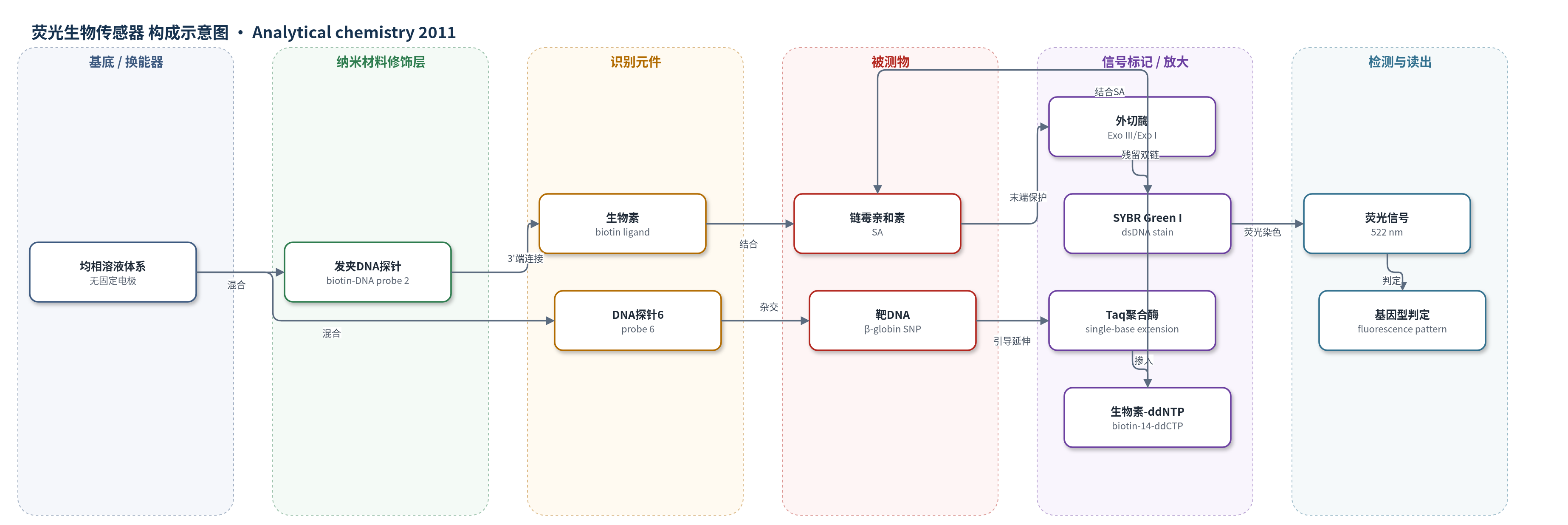
点击图片查看大图 · 依据论文自动绘制
传感器类型
荧光生物传感器
检测对象
链霉亲和素(streptavidin, SA,缓冲液样品)、人β-珠蛋白基因codon 39 SNP(human β-globin gene codon 39 SNP, G>A,PCR扩增产物/人基因组DNA)
检测原理
该策略以小分子-DNA嵌合体为识别探针。生物素连接在发夹DNA探针3'端,无SA时Exo III从3'端逐步降解双链发夹为单链DNA,SYBR Green I不能有效结合,荧光弱;SA与生物素结合后产生空间位阻,保护3'端,双链结构保留,SYBR Green I结合后产生强荧光,荧光强度随SA浓度升高而增加。SNP检测中,DNA探针6与靶DNA杂交,Taq DNA聚合酶仅在SNP位点互补时掺入biotin-ddNTP,形成生物素-DNA;SA结合后保护Exo I/III,保留双链并产生荧光;不匹配时不延伸,DNA被降解而无荧光。信号放大依赖酶促降解/保护转换和双链荧光染色。
检测灵敏度
SA检测:LOD: 0.1 nM;动态范围: 0.5–100 nM;线性范围: 0.5–37.5 nM。SNP基因分型:LOD: 0.02 nM;动态范围: 0.1–200 nM。
效应效果
该策略选择性高,对1 μM BSA、IgG、凝血酶、叶酸受体、刀豆蛋白A及10倍稀释人血清均无明显响应;SA检测信号/背景比约64,SNP检测信号/背景比约20。重现性良好,SA在0.5、5、25、50 nM的RSD为3.0%、1.1%、1.4%、1.2%;SNP在0.1、5、50、200 nM的RSD为1.5%、1.7%、2.4%、3.2%。12例人基因组DNA经PCR扩增后基因型判定与测序一致。作者认为其均相、低成本、易自动化,适合分子诊断、基因组研究和药物筛选。
传感器的构成
- 基底/换能器:无固定电极或纳米修饰层,均相溶液反应体系,荧光分光光度计(F-7000)作为光学换能读出
- 识别探针:生物素修饰发夹DNA探针(biotin-linked hairpin DNA probe 2),3'端连接生物素,自组装双链结构,用于结合SA并抵抗Exo III
- SNP识别探针:DNA探针6(probe 6),5'端发夹、3'端引物,与靶DNA杂交后引导Taq DNA聚合酶单碱基延伸
- 信号标记物:生物素-14-ddNTP(biotin-14-ddATP/ddGTP/ddCTP/ddUTP),互补SNP位点时掺入延伸产物,提供SA结合位点
- 识别/保护元件:链霉亲和素(SA),与生物素高亲和结合,形成空间位阻,保护DNA末端免受外切酶降解
- 酶促换能元件:外切酶III(Exo III)和外切酶I(Exo I),降解未保护DNA,将结合/延伸事件转化为双链DNA残留量
- 荧光报告染料:SYBR Green I,选择性结合双链DNA,产生522 nm荧光信号
- 反应介质:Exo III buffer(10 mM Bis Tris Propane-HCl、10 mM MgCl2、1 mM DTT、pH 7.0)及Taq DNA聚合酶缓冲液,提供酶反应环境
中文摘要
小分子-蛋白相互作用检测对化学遗传学、分子诊断和药物开发具有重要意义。本文报道了广义末端保护新发现:当小分子-DNA嵌合体中的小分子部分与其蛋白靶标结合时,可抵抗多种DNA外切酶降解。该机制将小分子-蛋白相互作用检测转化为对不同结构DNA的检测,为小分子分析提供了有用机制。基于此,作者发展了一种无标记均相荧光生物传感器策略,利用双链DNA荧光染色检测蛋白-小分子相互作用;并提出一种无标记SNP基因分型技术,通过Taq DNA聚合酶延伸单个带小分子标记的核苷酸实现。以生物素/链霉亲和素体系和人β-珠蛋白基因codon 39位点SNP为模型,蛋白-小分子相互作用检测在0.5–100 nM范围内呈动态响应,检出限0.1 nM;SNP基因分型在0.1–200 nM范围内呈动态响应,检出限0.02 nM。该方法还具有高选择性、良好重现性、低成本和操作简便等优点,有望用于分子诊断和基因组研究。
英文摘要
Assays of small molecule-protein interactions are of tremendous importance in chemical genetics, molecular diagnostics, and drug development. This work reports a new finding of generalized terminal protection that small molecule-DNA chimeras are protected from degradation by various DNA exonucleases, when the small molecule moieties are bound to their protein targets. This generalization converts small molecule-protein interaction assays into the detection of DNA of various structures, affording a useful mechanism for the analytics of small molecules. On the basis of this mechanism, a label-free biosensor strategy has been developed for a homogeneous assay of protein-small molecule interactions based on the fluorescence staining detection. Also, a label-free SNP genotyping technique is proposed based on polymerase extension of a single nucleotide with a small molecule label. The developed techniques are demonstrated using a model protein-small molecule system of biotin/streptavidin and a model SNP system of human β-globin gene around the position of codon 39. The results revealed that the protein-small molecule interaction assay strategy shows dynamic responses in the concentration range from 0.5 to 100 nM with a detection limit of 0.1 nM, and the SNP typing technique gives dynamic responses in the concentration range from 0.1 to 200 nM with a detection limit of 0.02 nM. Besides desirable sensitivity, the developed strategies also offer high selectivity, excellent reproducibility, low cost, and simplified operations, implying that these techniques may hold considerable potential for molecular diagnostics and genomic research.