组成图示
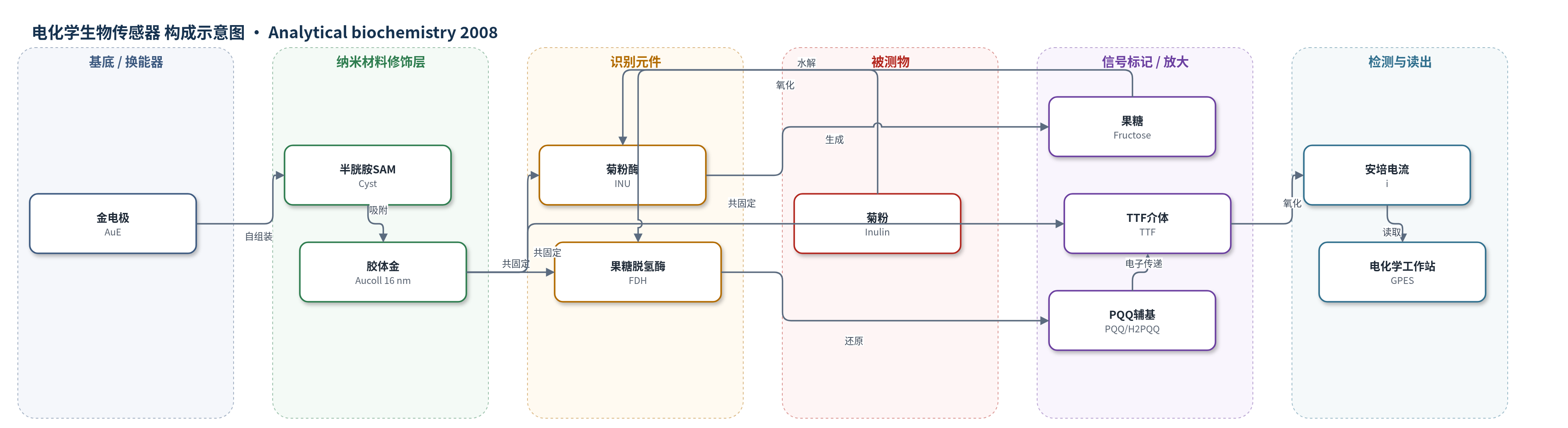
点击图片查看大图 · 依据论文自动绘制
传感器类型
电化学生物传感器
检测对象
菊粉(inulin);样品基质:食品(水溶性菊苣粉、益生元食品),磷酸盐缓冲液(pH 4.5);辅助检测物:果糖(fructose)
检测原理
菊粉在菊粉酶(INU)催化下发生内水解,生成果糖。果糖被果糖脱氢酶(FDH)特异性氧化为5-酮-D-果糖,同时FDH中的吡咯喹啉醌(PQQ)辅基被还原为H2PQQ。氧化态介体四硫富瓦烯(TTF+)将H2PQQ再氧化为PQQ,自身被还原为TTF;TTF随后在金电极表面发生电化学氧化,产生与TTF氧化速率相关的安培电流。由于INU水解速率和FDH氧化速率均受菊粉浓度控制,稳态电流随菊粉浓度增加而增大。金纳米颗粒提供高生物相容性微环境,改善酶固定化取向、电子传递和反应动力学,从而增强灵敏度。
检测灵敏度
菊粉:LOD: 6.6 × 10^-7 mol L^-1(3.3 mg L^-1);线性范围: (5–100) × 10^-6 M;灵敏度斜率: 2.4 ± 0.1 mA M^-1。果糖:LOD: 0.53 μM;线性范围: 0.005–0.1 mM;灵敏度斜率: 3.1 ± 0.2 mA M^-1;r = 0.996。
效应效果
双酶传感器对其它碳水化合物选择性较高;蔗糖因INU弱水解O-糖苷键、抗坏血酸因电化学氧化均造成约10%误差,但实际益生元食品中含量较低。重现性RSD为5.0%(3个传感器斜率),重复性RSD为3.6%(n=10,50 μM菊粉)。单个传感器在首日电流±3s控制限内稳定使用超过5个月,响应时间100 s。实际食品中,菊苣粉测得19.5±0.4%(RSD=2%,n=6),益生元食品Mas Vital测得1.8±0.1%(RSD=5%,n=6),与标签值一致。方法比HPLC-UV/RI/ED等更快速简便,适合食品工业快速检测。
传感器的构成
- 基底/换能器:金电极(AuE),经预处理,提供电子传导与安培检测界面
- 自组装单分子层:半胱胺(Cyst)SAM,0.1 mol L^-1 水溶液浸渍2 h,提供氨基锚定位点
- 纳米材料修饰层:胶体金(Aucoll),粒径16±2 nm,吸附于Cyst-AuE,提供生物相容微环境并改善反应动力学
- 识别/催化元件:菊粉酶(INU)与果糖脱氢酶(FDH)共固定,INU水解菊粉生成果糖,FDH催化果糖氧化
- 信号介体:四硫富瓦烯(TTF),与酶共固定并经戊二醛交联,传递电子并在电极上氧化产生安培信号
- 交联固定剂:戊二醛(glutaraldehyde),25%溶液处理1 h,交联固定FDH、INU和TTF形成三维组装
- 保存介质:0.05 mol L^-1 磷酸盐溶液(pH 4.5),4 ℃保存,维持酶活性与传感器稳定性
中文摘要
本文报道了一种用于食品中菊粉测定的双酶安培生物传感器。该传感器将果糖脱氢酶(FDH)和菊粉酶(INU)共固定于金纳米颗粒-半胱胺自组装单分子层修饰的金电极(Aucoll-Cyst-AuE)上,四硫富瓦烯(TTF)作为介体并通过戊二醛交联共固定。INU催化菊粉水解生成果糖,FDH催化果糖氧化,并通过TTF在生物电极上的电化学氧化实现安培检测。作者优化了单酶FDH传感器和双酶菊粉传感器的制备条件与性能。FDH-Aucoll-Cyst-AuE对果糖响应快速、灵敏,分析性能优于其他FDH电化学传感器,使用寿命达35天。双酶INU/FDH-Aucoll-Cyst-AuE对菊粉的线性范围为(5–100)×10^-6 mol/L,检出限为6.6×10^-7 mol/L。单个双酶传感器在首日电流±3倍标准差控制限内响应超过5个月,并对其他碳水化合物表现出高选择性。通过最小化果糖干扰,该传感器可用于食品中菊粉的快速测定。
英文摘要
A biosensor design involving coimmobilization of fructose dehydrogenase (FDH) and inulinase (INU) on a gold nanoparticle-cysteamine (Cyst) self-assembled monolayer (SAM)-modified gold electrode (Au(coll)-Cyst-AuE), for the determination of the carbohydrate inulin in foodstuffs, is reported. Tetrathiafulvalene (TTF), used as the mediator, was also coimmobilized by crosslinking with glutaraldehyde. INU catalyzes the hydrolysis of inulin, forming fructose that is detected through the fructose dehydrogenase system by the electrochemical oxidation of TTF at the bioelectrode. The variables involved in the preparation and performance of both the single enzyme FDH biosensor and the bienzyme inulin biosensor were optimized. The FDH-Au(coll)-Cyst-AuE biosensor exhibited rapid and sensitive response to fructose, allowing the obtention of improved analytical characteristics for the determination of fructose with respect to other FDH electrochemical biosensors. Moreover, the lifetime of this biosensor was 35 days. The bienzyme INU/FDH-Au(coll)-Cyst-AuE biosensor provided a calibration plot for inulin in the (5-100)x10(-6) M linear range, with a detection limit of 6.6 x 10(-7) mol L(-1). One single bienzyme biosensor responded within the control limits, set at +/-3x the standard deviation of the currents measured on the first day of use, for more than 5 months. Furthermore, the biosensor exhibited high selectivity with respect to other carbohydrates. The usefulness of the biosensor was evaluated by the rapid determination of inulin in food products involving minimization of the fructose interference.