组成图示
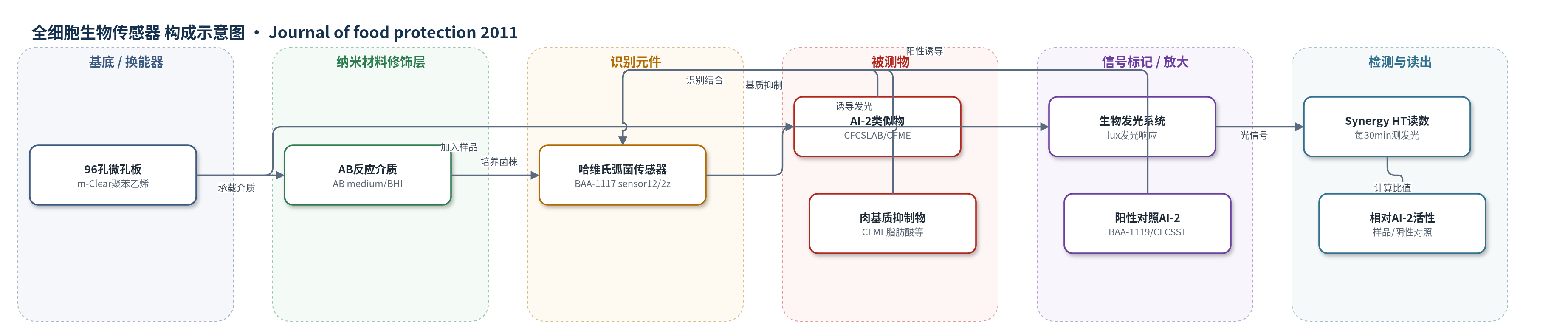
点击图片查看大图 · 依据论文自动绘制
传感器类型
全细胞生物传感器
检测对象
AI-2类似信号分子(autoinducer-2-like molecules, AI-2-like activity);样品基质:乳酸菌无细胞培养上清(CFCSLAB)与无细胞肉提取物(CFME,来自改良气氛包装碎牛肉)
检测原理
该检测基于Vibrio harveyi BAA-1117全细胞生物传感器。样品中的AI-2类似信号分子被菌株的AI-2特异性识别系统(sensor 12/sensor 2z)感知,触发群体感应信号级联,诱导lux相关发光基因表达,使细胞产生生物发光。发光强度随样品中AI-2类似活性增强而升高,但原文指出发光值与AI-2浓度之间无线性关系,因此只能以相对AI-2类似活性(样品发光/阴性对照发光)进行半定量比较。阴性对照为无菌quarter-strength BHI或0 h CFME,阳性对照为V. harveyi BAA-1119 CFCS或Salmonella Typhimurium CFCSST。肉基质中的脂肪酸等成分可抑制菌株发光,造成假阴性,因此需同时测定抑制率。
检测灵敏度
原文未报告LOD、线性范围、灵敏度斜率或相关系数。
效应效果
在89株LAB(15个指纹型)中,76.4%(68株)表现出AI-2类似活性,主要集中于Leuconostoc spp.和L. mesenteroides B 243;Leuconostoc sp. B 233的相对活性为12.41–26.84倍,且相同菌株在不同储存阶段和温度间无显著差异(P>0.05)。L. sakei、W. viridescens等未检测到活性。CFME样品相对AI-2类似活性仅0.47–2.24,但对AI-2检测的抑制率达51.11–91.09%,表明肉基质存在明显干扰。实验以n=3重复,未报告RSD、加标回收率或与ELISA/HPLC/qPCR的对比。作者认为AI-2类似分子可能影响储存期间不同LAB菌株的优势地位,为研究温度对AI-2相关基因表达和菌群多样性的影响提供基础。
传感器的构成
- 全细胞识别/换能元件:Vibrio harveyi BAA-1117 (sensor 12, sensor 2z) 生物传感器菌株,特异性识别AI-2并启动发光
- 反应介质:AB medium(autoinducer bioassay medium)与quarter-strength BHI broth,维持菌株活性并避免葡萄糖抑制
- 反应容器:96-well polystyrene microplate (m-Clear, Greiner Bio-One),承载菌株与样品混合反应
- 待测样品输入:CFCSLAB(乳酸菌无细胞培养上清)或CFME(无细胞肉提取物),提供AI-2类似分子
- 阳性对照信号源:V. harveyi BAA-1119 (luxL::Tn5 AI-1+ AI-2-) CFCS或Salmonella Typhimurium CFCSST,提供AI-2阳性信号
- 信号输出元件:细菌生物发光系统(lux相关基因),AI-2诱导产生光信号
中文摘要
本研究从改良气氛包装碎牛肉在不同温度下储存过程中分离的89株乳酸菌(LAB)中,获得15个指纹型菌株,包括Leuconostoc spp.、Leuconostoc mesenteroides、Weissella viridescens、Leuconostoc citreum和Lactobacillus sakei,并筛选其在特定培养条件下表现自诱导物-2(AI-2)类似活性的能力。同时收集无细胞肉提取物(CFME),检测其中是否存在AI-2类似分子。所有生物测定均采用Vibrio harveyi BAA-1117(sensor 12、sensor 2z)生物传感器菌株进行,并评估肉提取物对生物传感器菌株活性的抑制作用。结果显示,Leuconostoc spp.分离株表现出AI-2类似活性,而L. sakei菌株未检测到活性;该活性主要与Leuconostoc sp. B 233相关,该菌株在10和15℃储存以及0和5℃储存初期和中期占优势。CFME样品AI-2类似活性较低,并抑制AI-2活性。结果表明,肉腐败过程中分离的LAB可产生AI-2类似分子,其优势菌株受储存时间和温度影响,为研究储存温度对AI-2相关基因表达及短暂菌群多样性的影响提供基础。
英文摘要
Fifteen fingerprints (assigned to Leuconostoc spp., Leuconostoc mesenteroides, Weissella viridescens, Leuconostoc citreum, and Lactobacillus sakei) of 89 lactic acid bacteria (LAB) isolated from minced beef stored under modified atmospheres at various temperatures were screened for their ability to exhibit autoinducer-2 (AI-2)-like activity under certain growth conditions. Cellfree meat extracts (CFME) were collected at the same time as the LAB isolates and tested for the presence of AI-2-like molecules. All bioassays were conducted using the Vibrio harveyi BAA-1117 (sensor 1(-), sensor 2(+)) biosensor strain. The possible inhibitory effect of meat extracts on the activity of the biosensor strain was also evaluated. AI-2-like activity was observed for Leuconostoc spp. isolates, but none of the L. sakei strains produced detectable AI-2-like activity. The AI-2-like activity was evident mainly associated with the Leuconostoc sp. B 233 strain, which was the dominant isolate recovered from storage at 10 and 15°C and at the initial and middle stages of storage at chill temperatures (0 and 5°C). The tested CFME samples displayed low AI-2-like activity and inhibited AI-2 activity regardless of the indigenous bacterial populations. The LAB isolated during meat spoilage exhibited AI-2-like activity, whereas the LAB strains retrieved depended on storage time and temperature. The production of AI-2-like molecules may affect the dominance of different bacterial strains during storage. The results provide a basis for further research concerning the effect of storage temperature on the expression of genes encoding AI-2 activity and on the diversity of the ephemeral bacterial population.