组成图示
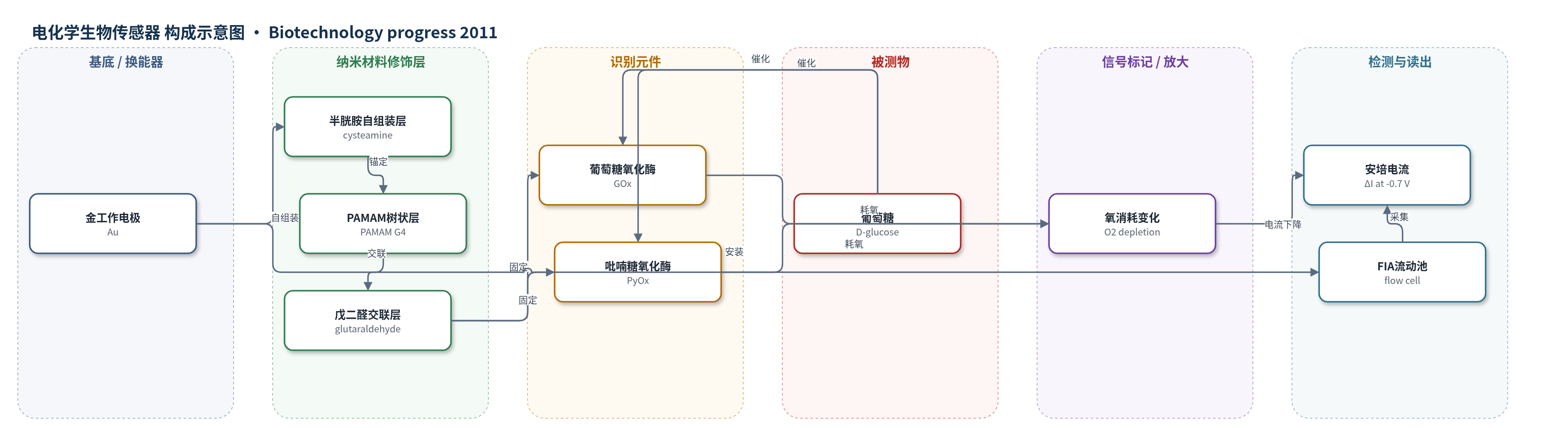
点击图片查看大图 · 依据论文自动绘制
传感器类型
电化学生物传感器
检测对象
葡萄糖(glucose, D-glucose);样品基质:酵母发酵液/Schatzmann培养基、缓冲液标准品
检测原理
该传感器以GOx或PyOx为识别元件,固定于PAMAM/半胱胺修饰的金电极表面。葡萄糖进入生物活性层后,被GOx或PyOx催化氧化,同时消耗O2并生成H2O2及相应糖酸/2-酮糖。在-0.7 V下,金电极上O2还原电流随生物层内O2浓度降低而下降,电流变化ΔI与葡萄糖浓度成正比。PAMAM和戊二醛通过多点共价交联稳定酶的四聚体结构,减少泄漏。FIA模式下样品随载流液进入流动池,稳态电流差被恒电位仪记录,从而离线测定发酵液中葡萄糖。
检测灵敏度
Batch PyOx: LOD: 7.45 μM;线性范围: 0.025–0.5 mM;方程: y = 3.358x + 0.028;R^2 = 0.998。Batch GOx: LOD: 11.84 μM;线性范围: 0.01–1.0 mM;方程: y = 1.539x + 0.181;R^2 = 0.992。FIA PyOx: LOD: 1.27 μM;线性范围: 0.025–1.0 mM;方程: y = 1.346x + 0.0004;R^2 = 0.999。FIA GOx: LOD: 38.97 μM;线性范围: 0.05–2.5 mM;方程: y = 0.075x + 0.007;R^2 = 0.995;表1: y = 0.748x + 0.0069;R^2 = 0.997。
效应效果
在-0.7 V下,抗坏血酸、3-乙酰氨基酚和Schatzmann培养基对信号干扰较小:GOx相对响应分别为84.8%、99.8%、92.9%,PyOx为96.1%、105.1%、99.7%;+0.7 V干扰明显。重复性方面,批量模式RSD为PyOx 4.9%、GOx 4.38%,FIA模式为GOx 1.6%、PyOx 2.8%。批量操作8 h无活性损失;4 ℃储存1个月,PyOx保留72%,GOx无损失。FIA连续3.5 h进样34次,GOx保持100%,PyOx保持91%。用于酵母发酵离线监测时,结果与HPLC良好相关,证明其可用于发酵过程葡萄糖监控。
传感器的构成
- 工作电极基底:金电极(Au),提供电子转导与酶固定基底。
- 自组装修饰层:半胱胺(cysteamine)在金表面形成自组装单分子层,提供氨基锚定位点。
- 树状分子修饰层:聚酰胺胺(PAMAM, G4 C12)树枝状分子,提供密集氨基并承载酶。
- 交联固定层:戊二醛(glutaraldehyde)交联PAMAM与酶表面氨基,实现多点共价固定。
- 识别元件:葡萄糖氧化酶(GOx)或吡喃糖氧化酶(PyOx),催化葡萄糖氧化并消耗O2。
- 参比电极:Ag/AgCl电极,提供稳定参比电位。
- 对电极:铂(Pt)电极,完成安培测量回路。
- 流动注射检测池:交叉流电化学流动池,用于FIA模式样品引入与检测。
中文摘要
本文报道了吡喃糖氧化酶(PyOx)和葡萄糖氧化酶(GOx)在安培型生物传感器设计中的应用,并结合流动注射分析(FIA)用于发酵过程监测。在批量和FIA模式下,于-0.7 V进行安培测量,通过监测酶促反应引起的氧气消耗变化来间接测定葡萄糖。研究了酶用量、pH等优化条件以及线性、重复性、干扰、储存和操作稳定性等分析参数。优化条件下,PyOx传感器在50 mM磷酸缓冲液(pH 7.0)中对葡萄糖在0.025–0.5 mM呈线性,方程y=3.358x+0.028,R^2=0.998;GOx传感器在50 mM柠檬酸缓冲液(pH 4.0)中线性范围为0.01–1.0 mM,方程y=1.539x+0.181,R^2=0.992。随后在常规流动注射系统中评估了传感器构型。批量实验为设计高灵敏、稳定、无干扰的FIA模式传感器提供了依据。在FIA条件下研究了稳定性、动态范围和重复性,并成功证明其可用于发酵液中葡萄糖测定。该FIA联用葡萄糖生物传感器用于酵母发酵离线监测,结果与HPLC测量良好相关。
英文摘要
This article deals with the use of pyranose oxidase (PyOx) and glucose oxidase (GOx) enzymes in amperometric biosensor design and their application in monitoring fermentation processes with the combination of flow injection analysis (FIA). The amperometric studies were carried out at -0.7 V by following the oxygen consumption due to the enzymatic reactions for both batch and FIA modes. Optimization studies (enzyme amounts and pH) and analytical parameters such as linearity, repeatability, effect of interference, storage, and operational stabilities have been studied. Under optimized conditions, for the PyOx-based biosensor, linear graph was obtained from 0.025 to 0.5 mM glucose in phosphate buffer (50 mM) at pH 7.0 with the equation of y = 3.358x + 0.028 and R(2) = 0.998. Linearity was found to be 0.01-1.0 mM in citrate buffer (50 mM and pH 4.0) with the equation of y = 1.539x + 0.181 and R(2) = 0.992 for the GOx biosensor. Finally, these biosensor configurations were further evaluated in a conventional flow injection system. Results from batch experiments provide a guide to design sensitive, stable, and interference-free biosensors for FIA mode. Biosensor stability, dynamic range, and repeatability were also studied in FIA conditions, and the applicability for the determination of glucose in fermentation medium could be successfully demonstrated. The FIA-combined glucose biosensor was used for the offline monitoring of yeast fermentation. The obtained results correlated well with HPLC measurements.