组成图示
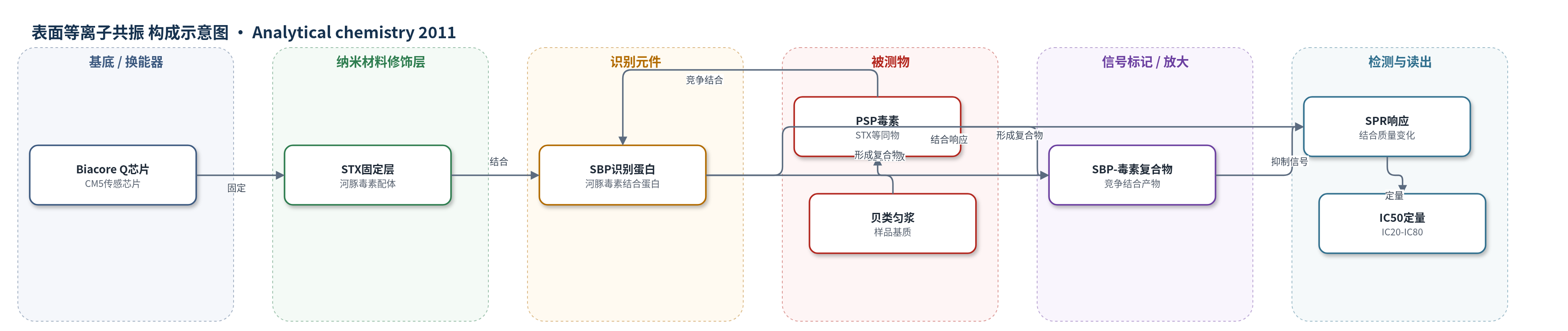
点击图片查看大图 · 依据论文自动绘制
传感器类型
表面等离子共振(SPR)生物传感器
检测对象
麻痹性贝毒(paralytic shellfish poisoning toxins, PSP toxins,含河豚毒素STX、新河豚毒素NEOSTX、去羧基冈田酸毒素2/3 dcGTX2/3、C1/C2等);样品基质:贝类匀浆(扇贝、贻贝、蛤、血蛤)
检测原理
该方法基于SPR竞争抑制原理。CM5芯片表面固定河豚毒素(STX)作为配体,河豚毒素结合蛋白(SBP)作为识别元件。样品或标准品中的PSP毒素先与SBP结合,形成SBP-毒素复合物,从而减少SBP与芯片表面STX的结合。SPR通过监测表面结合质量变化产生光学响应:PSP毒素浓度越高,SBP被占据越多,芯片上SBP结合越少,响应值越低。样品用0.2 M乙酸钠缓冲液(pH 5)提取,经HBS-EP缓冲液稀释后与SBP等体积混合注入芯片。通过STXdiHCl标准曲线(IC50及IC20–IC80动态范围)将响应转换为STXdiHCl等同物浓度。方法无酶或核酸放大,直接光学换能,适用于贝类PSP毒素筛查。
检测灵敏度
LOD: 120 μg STXdiHCl equivalents/kg shellfish tissue;校准标准范围: 0–1200 μg STXdiHCl equivalents/kg(0–10 ng/mL);IC50: 621 ±62 μg STXdiHCl/kg;IC20–IC80: 327 ±38–929 ±54 μg STXdiHCl/kg
效应效果
七个实验室均完成研究,HorRat值均小于1,实验室间精密度可接受。低水平PSP毒素混合物平均回收率94.6±16.8%,高水平STX加标回收率98.6±5.6%;RSDr为1.8%–9.6%,RSDR为2.9%–18.3%。LOD为120 μg STXdiHCl等同物/kg,低于小鼠生物试验约370 μg/kg,可更早发现有害藻华。与AOAC HPLC和小鼠生物试验比较,在800 μg/kg监管限附近多数判定一致;个别差异与TEF、提取条件及抗体交叉反应有关,如C1/C2和GTX5交叉反应分别为217%和1300%,GTX1/4低于1.1%。作者认为该方法可转移至其他SPR仪器,有望作为贝类PSP毒素筛查工具,减少并最终替代小鼠生物试验。
传感器的构成
- 基底/换能器:Biacore Q SPR光学生物传感器,CM5羧甲基葡聚糖(CM5)传感芯片,提供SPR信号读出与表面固定平台
- 表面配体层:固定河豚毒素(STX)于CM5芯片,作为捕获探针与SBP特异性结合
- 识别元件:河豚毒素结合蛋白(SBP),与PSP毒素家族结合,形成竞争抑制识别
- 运行缓冲液:HBS-EP缓冲液(pH 7.4),维持结合反应并稀释样品/标准品
- 样品提取液:0.2 M乙酸钠缓冲液(pH 5),从贝类匀浆中提取PSP毒素
- 再生剂:50 mM盐酸(HCl),洗脱芯片表面结合的SBP以再生表面
- 校准标准:STXdiHCl标准品(0–10 ng/mL,HBS-EP配制),用于建立竞争抑制曲线
中文摘要
本研究开发了一种表面等离子共振(SPR)光学生物传感器方法,用于检测贝类中的麻痹性贝毒(PSP)毒素。该方法以原型试剂盒形式转移至七个实验室,使用Biacore Q SPR仪器进行实验室间评价。每个实验室分析20个贝类样品,包括盲重复;样品含4个未污染样品低水平PSP毒素加标(240 μg STXdiHCl等同物/kg)、1个高水平河豚毒素加标(825 μg STXdiHCl/kg)、2个未污染样品和14个天然污染样品。七个实验室均完成研究,HorRat值均小于1,表明方法性能可接受。以STXdiHCl等同物/kg表示的平均回收率分别为低水平PSP毒素混合物94.6±16.8%和高水平河豚毒素98.6±5.6%。实验室内重复性RSDr为1.8%–9.6%,实验室间重现性RSDR为2.9%–18.3%。这是首次报道的SPR生物传感器实验室间研究,表明该PSP检测方法可作为欧洲减少和替代小鼠生物试验的有力工具。
英文摘要
A surface plasmon resonance (SPR) optical biosensor method was developed for the detection of paralytic shellfish poisoning (PSP) toxins in shellfish. This application was transferred in the form of a prototype kit to seven laboratories using Biacore Q SPR optical biosensor instrumentation for interlaboratory evaluation. Each laboratory received 20 shellfish samples across a range of species including blind duplicates for analysis. The samples consisted of 4 noncontaminated samples spiked in duplicate with a low level of PSP toxins (240 μg STXdiHCl equivalents/kg), a high level of saxitoxin (825 μg STXdiHCl/kg), 2 noncontaminated, and 14 naturally contaminated samples. All 7 participating laboratories completed the study, and HorRat values obtained were <1 demonstrating that the method performance was acceptable. Mean recoveries expressed as STXdiHCl equivalents/kg were 94.6 ± 16.8% for the low level PSP toxin mix and 98.6 ± 5.6% for the high level of saxitoxin. Relative standard deviations for within-laboratory variations (RSD(r): repeatability) and between-laboratory variations (RSD(R) = reproducibility) ranged from 1.8 to 9.6% and 2.9 to 18.3% respectively. This first ever reported SPR biosensor interlaboratory study demonstrated this PSP application to be an empowering tool in the drive toward the reduction and replacement of the mouse bioassay within Europe.