组成图示
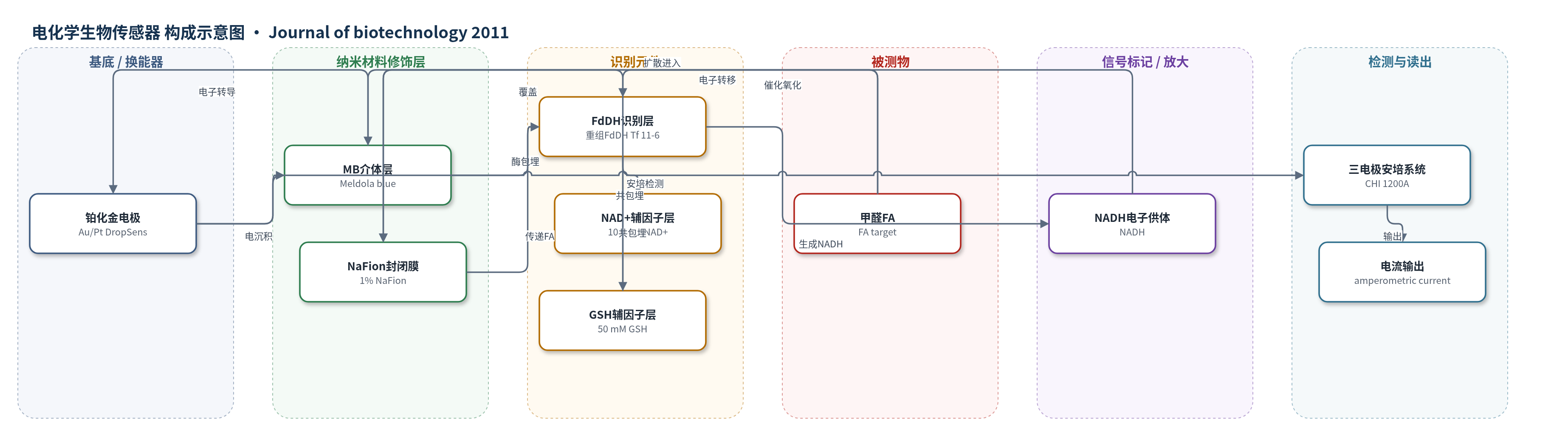
点击图片查看大图 · 依据论文自动绘制
传感器类型
电化学生物传感器
检测对象
甲醛(formaldehyde, FA);样品基质:含 FA 的空气(气相)及 FBBR 出水/磷酸盐缓冲液(液相)
检测原理
甲醛(FA)从样品液相扩散穿过 NaFion 封闭膜进入 FdDH 识别层。在 NAD+ 和 GSH 存在下,FdDH 催化 FA 氧化为 S-甲酰谷胱甘肽,同时 NAD+ 被还原为 NADH。NADH 在 +0 V(vs Ag/AgCl)工作电位下被电沉积的 Meldola blue(MB)介体氧化回 NAD+,电子经 MB 传递至铂化金电极,产生与 FA 浓度成正比的安培电流。低电位运行和负电荷 NaFion 膜限制 NAD+/GSH 泄漏,提高选择性。该传感器无额外信号放大,依靠酶催化与介导电子转移实现检测。
检测灵敏度
未报告 LOD、线性范围、灵敏度斜率或相关系数。
效应效果
固定化 AOX 保留 85–90% 活性,4 ℃ 储存 12 个月不变;FBBR 气相 FA 去除率 93.0–99.9%,0.3 ppm 进气出气 <0.02–0.03 ppm,18.5 ppm 进气出气 <0.03 ppm,低于阈值限值 10 倍。放大反应器出气未检出 FA,液相 3 周后 ≤0.9 mM。FdDH 传感器与 MBTH、chromotropic acid、Formatest 结果一致:无 AOX 柱液相 FA 为 10.2±0.23 mM,AOX 柱为 3.2±0.13 mM。作者认为可用于室内空气 FA 去除与在线监测。
传感器的构成
- 工作电极基底:铂化丝网印刷金电极(DropSens C220AT,Au/Pt),作为电子转导与安培检测界面
- 介体修饰层:电沉积 Meldola blue(MB),介导 NADH/NAD+ 与电极间的电子转移
- 识别元件层:重组甲醛脱氢酶(FdDH,H. polymorpha Tf 11-6)与 NAD+ 包埋于阴极漆 GY 83-0270 0005 聚合物膜,特异性催化 FA
- 辅因子层:还原型谷胱甘肽(GSH)共包埋,作为 FdDH 催化 FA 的必需辅因子
- 封闭限域膜:1% NaFion 膜,限制 NAD+ 和 GSH 泄漏并提高选择性
- 信号转换元件:酶反应生成的 NADH 经 MB 氧化,将 FA 浓度转换为安培电流
中文摘要
室内空气中甲醛(FA)危害健康,需通过通风或催化转化去除。本文从过表达醇氧化酶(AOX)的多形汉森酵母 C-105(gcr1 catX)突变体中分离 AOX,并将其固定于海藻酸钙微球中,用于连续流化床生物反应器(FBBR)中氧化气相 FA。固定化 AOX 比活为 6–8 U mg−1 蛋白,保留 85–90% 初始活性,且催化参数与游离酶相近(kcat/Km 分别为 2.35×10^3 M−1 s−1 和 2.89×10^3 M−1 s−1)。当含 0.3–18.5 ppm FA 的空气通过含 1.3–26.6 U g−1 凝胶的固定化 AOX 时,出口气相 FA 降至 0.02–0.03 ppm 以下,低于阈值限值 10 倍。固定化透化 C-105 细胞的 FBBR 对气相 FA 的去除率超过 90%。过程由基于重组 NAD+ 和谷胱甘肽依赖性甲醛脱氢酶(FdDH)的酶促安培生物传感器监测。
英文摘要
Formaldehyde (FA)-containing indoor air has a negative effect on human health and should be removed by intensive ventilation or by catalytic conversion to non-toxic products. FA can be oxidized by alcohol oxidase (AOX) taking part in methanol metabolism of methylotrophic yeasts. In the present work, AOX isolated from a Hansenula polymorpha C-105 mutant (gcr1 catX) overproducing this enzyme in glucose medium, was tested for its ability to oxidize airborne FA. A continuous fluidized bed bioreactor (FBBR) was designed to enable an effective bioconversion of airborne FA by AOX or by permeabilized mutant H. polymorpha C-105 cells immobilized in calcium alginate beads. The immobilized AOX having a specific activity of 6-8 U mg⁻¹ protein was shown to preserve 85-90% of the initial activity. The catalytic parameters of the immobilized enzyme were practically the same as for the free enzyme (k(cat)/K(m) was 2.35×10³ M⁻¹ s⁻¹ vs 2.89×10³ M⁻¹ s⁻¹, respectively). The results showed that upon bubbling of air containing from 0.3 up to 18.5 ppm FA through immobilized AOX in the range of 1.3-26.6 U g⁻¹ of the gel resulted in essential decrease of FA concentration in the outlet gas phase (less than 0.02-0.03 ppm, i.e. 10-fold less than the threshold limit value). It was also demonstrated that a FBBR with immobilized permeabilized C-105 cells provided more than 90% elimination of airborne FA. The process was monitored by a specially constructed enzymatic amperometric biosensor based on FA oxidation by NAD+ and glutathione-dependent formaldehyde dehydrogenase from the recombinant H. polymorpha Tf 11-6 strain.