组成图示
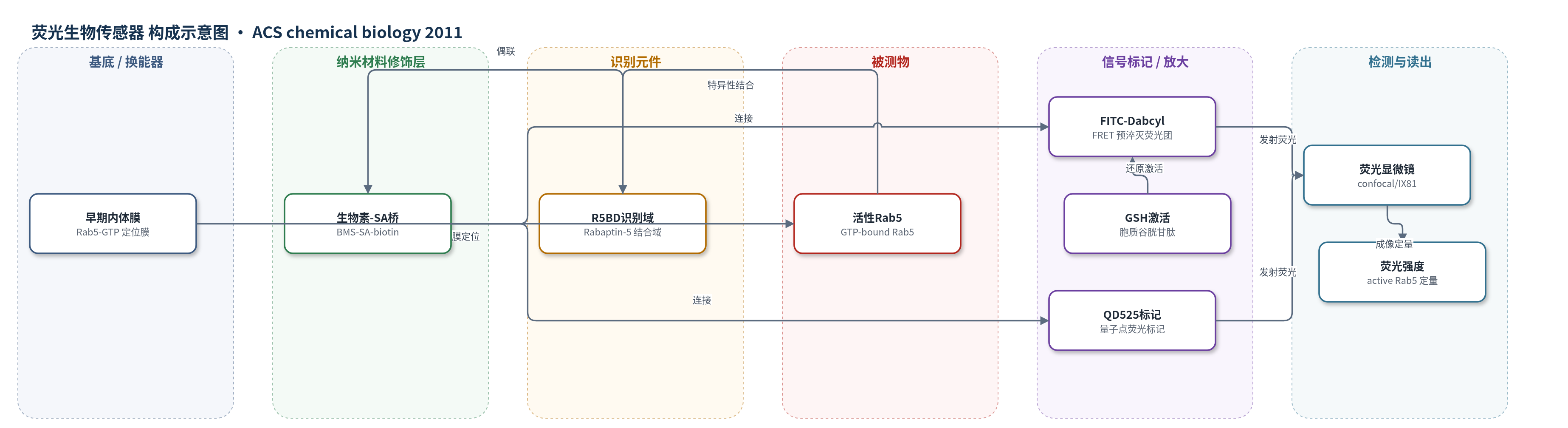
点击图片查看大图 · 依据论文自动绘制
传感器类型
荧光生物传感器
检测对象
活性 Rab5(GTP-bound Rab5, Rab5-GTP);样品基质:活 HeLa 细胞、固定小鼠脑组织切片(Ts65Dn 与 2N 小鼠皮层/海马)
检测原理
RAFB以Rabaptin-5的R5BD为识别元件,特异性结合早期内体膜胞质侧的GTP结合态Rab5。固定组织成像中,QD525标记的RAFB结合活性Rab5后产生荧光,荧光强度随活性Rab5数量增加而增强。活细胞成像中,多精氨酸CPP介导探针内吞进入细胞;FITC-Dabcyl模块通过FRET处于预淬灭状态,进入胞质后谷胱甘肽(GSH)还原二硫键并释放Dabcyl,FITC荧光恢复。随后R5BD结合活性Rab5,使荧光定位于内体膜或内体聚集区。活性Rab5越多,被激活并定位的探针越多,平均荧光密度越高;不结合突变体RAFB-Mut信号显著降低。该策略以预淬灭-激活降低背景,而非酶催化放大。
检测灵敏度
未报告 LOD、线性范围、灵敏度斜率或相关系数。
效应效果
RAFB-QD525在Ts65Dn小鼠脑切片中显示活性Rab5显著升高:皮层较2N对照升高4.68倍,海马升高3.57倍(p<0.001);而总Rab5差异较小,皮层比值1.217±0.024、海马0.882±0.018。活细胞实验中,100 nM预淬灭RAFB在表达组成型活性Rab5Q79L-mC的HeLa细胞中产生强点状荧光,较不结合突变体RAFB-Mut高65倍;表达显性负性Rab5S34N-mC细胞信号较活性突变体低11倍。预淬灭荧光团经GSH激活最高达8.0倍,细胞内最高5.9倍。相比抗体法仅测总Rab5,RAFB可低背景区分活性Rab5,适用于疾病模型与内吞/自噬研究。
传感器的构成
- 识别元件:Rabaptin-5 的 Rab5 结合域(R5BD,124 aa),特异性识别 GTP-bound active Rab5
- 细胞递送元件:N端多精氨酸序列(polyarginine, RRRRRRRRR)/细胞穿透肽(CPP),促进探针进入活细胞
- 连接元件:C端生物素模拟序列(BMS, PCHPQFPRCYA)与链霉亲和素(streptavidin, SA)结合,连接荧光团
- 信号标记物:量子点 QD525 或荧光素异硫氰酸酯(FITC),提供荧光信号
- 预淬灭模块:Dabcyl 淬灭剂经二硫键连接半胱氨酸(Cys),与 FITC 形成 FRET 预淬灭
- 激活元件:胞质还原型谷胱甘肽(GSH)还原二硫键,释放 Dabcyl 并恢复 FITC 荧光
中文摘要
Rab5是受体介导内吞的关键调节因子,参与货物受体内化、内体成熟、内化信号分子的转导与降解以及受体循环。细胞应激可升高Rab5活性,且Rab5活性异常与多种疾病相关。现有抗体成像方法只能检测总Rab5,无法区分活性Rab5,也难以提供Rab5激活幅度和持续时间的动态信息。本文报道一种新型Rab5活性荧光生物传感器(RAFB),其由Rabaptin-5的Rab5结合域、荧光团(量子点或荧光染料)和细胞穿透肽组成,可特异性靶向活细胞及固定小鼠脑组织中与早期内体膜结合的GTP结合态Rab5。量子点偶联RAFB成功成像Ts65Dn小鼠皮层和海马中升高的Rab5活性;基于荧光共振能量转移(FRET)的预淬灭RAFB则可在单个活细胞中实时成像胞质活性Rab5。该方法有望用于研究Rab5活性调控及疾病相关内吞/自噬过程。
英文摘要
A key regulator of receptor-mediated endocytosis, Rab5, plays a pivotal role in cargo receptor internalization, endosomal maturation, and transduction and degradation of internalized signaling molecules and recycling cargo receptor. Stressful conditions within cells lead to increased Rab5 activation, and increasing evidence correlates Rab5 activity abnormalities with certain diseases. Current antibody-based imaging methods cannot distinguish active Rab5 from total Rab5 population and provide dynamic information on magnitude and duration of Rab5 activation in cellular events and pathogenesis. We report here novel molecular imaging probes that specifically target GTP-bound Rab5 associated with the early endosome membrane in live cells and fixed mouse brain tissues. Our Rab5 activity fluorescent biosensor (RAFB) contains the Rab5 binding domain of the Rab5 effector Rabaptin 5, a fluorophore (a quantum dot or fluorescent dye) and a cell-penetrating peptide for live-cell delivery. The quantum dot conjugated RAFB was able to image the elevated Rab5 activity in both the cortex and hippocampi tissues of a Ts65Dn mouse. A prequenched RAFB based on fluorescence resonance energy transfer (FRET) can image cytosolic active Rab5 in single live cells. This novel method should enable imaging of the biological process in which Rab5 activity is regulated in various cellular systems.