组成图示
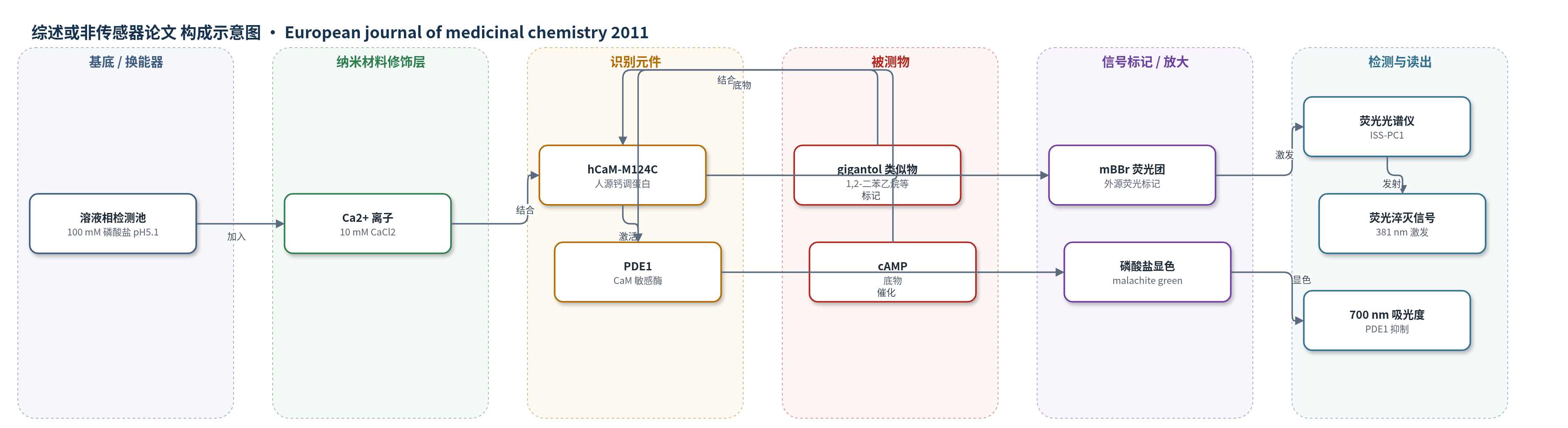
点击图片查看大图 · 依据论文自动绘制
传感器类型
综述或非传感器论文
检测对象
gigantol 类似物(1,2-diphenylethanes、diphenylmethanes、1,3-diphenylpropenones、1,3-diphenylpropanes);样品基质:体外缓冲液(100 mM 磷酸盐 pH 5.1 含 10 mM CaCl2;PDE1 酶学缓冲液)
检测原理
本文采用两种体外检测。荧光法中,人源钙调蛋白 hCaM 的 M124C 突变体经 mBBr 标记形成 hCaM-M124C-mBBr,在 10 mM CaCl2 中形成 Ca2+-CaM 复合物并产生外源荧光。gigantol 类似物与 CaM 结合后引起荧光淬灭,最大荧光变化按 y=(F-F0)/(FN-F0) 和 y=EmaxL^h/(K^h+L^h) 拟合,得到表观亲和力 Km。酶学法中,Ca2+-CaM 激活牛脑 PDE1 水解 cAMP,释放无机磷酸盐;化合物抑制该复合物后磷酸盐减少,malachite green 在 700 nm 的显色降低,据此计算 IC50。
检测灵敏度
原文未报告 LOD、线性范围、灵敏度斜率或 R^2;报告 IC50: 9–146 mM,Km: 3–80 mM。
效应效果
荧光法中,除 11、12、15 外,类似物淬灭 hCaM-M124C-mBBr 荧光,Km 为 3–80 mM;化合物 17 的 Km 为 3.89 mM,优于 gigantol 1(60.82 mM)和 CPZ(5.55 mM)。PDE1 酶学法中,多数化合物抑制 Ca2+-CaM-PDE1,IC50 为 9–146 mM;15 不结合 CaM 但 IC50 为 15.02 mM,提示可能直接作用 PDE1。对接显示 4、13、17、20 与 TFP/CPZ/W-7 结合于 CaM 相同疏水口袋。作者认为其可作为抗 CaM 药物候选及研究工具。
传感器的构成
- 基底/换能器:无固体基底;溶液相稳态荧光检测,ISS-PC1 荧光光谱仪,381 nm 激发、400–550 nm 发射
- 识别元件:人源钙调蛋白 hCaM(M124C 突变体),与 Ca2+ 形成复合物并结合 gigantol 类似物
- 信号标记物:mBBr 荧光团,标记于 hCaM M124C 位点,提供外源荧光并在配体结合后淬灭
- 辅助离子:CaCl2(10 mM),维持 Ca2+-CaM 构象
- 被测物:gigantol 类似物(1,2-diphenylethanes、diphenylmethanes、1,3-diphenylpropenones、1,3-diphenylpropanes)
- 酶学检测元件:PDE1(牛脑来源)、5'-nucleotidase(Crotalus atrox 毒液)、cAMP 底物、malachite green 显色剂
- 缓冲体系:100 mM 磷酸盐 pH 5.1(荧光法);含 Tris-HCl、Mg(OAc)2、imidazole、CaCl2、BSA 的 PDE1 酶学缓冲液
中文摘要
为评估巨花素(gigantol, 1)类似物对 Ca2+-钙调蛋白(CaM)及 Ca2+-CaM-钙调蛋白敏感磷酸二酯酶 1(PDE1)复合物的影响,作者合成了四类结构类似物:1,2-二苯乙烷(2–11)、二苯甲烷(13–15)、1,3-二苯基丙烯酮(16–18)和 1,3-二苯基丙烷(20–22)。体外酶学研究表明,除化合物 11 外,所有化合物均抑制 Ca2+-CaM-PDE1 复合物,IC50 为 9–146 mM。另一方面,除 11、12 和 15 外,所有类似物均在不同程度上淬灭 CaM 荧光生物传感器 hCaM-M124C-mBBr 的外源荧光,表明其与 CaM 具有不同亲和力,表观亲和力常数 Km 为 3–80 mM。分子模拟显示,这些化合物与经典抑制剂三氟哌啶醇(TFP)和氯丙嗪(CPZ)结合于 CaM 的相同位点。部分类似物因对 CaM 亲和力较好且合成简便,可作为开发具有抗 CaM 活性的抗肿瘤、局部麻醉、抗抑郁、抗精神病或平滑肌松弛药物的候选分子,也可作为研究 Ca2+-CaM 功能的工具。
英文摘要
Several analogs of gigantol (1) were synthesized to evaluate their effect on the complexes Ca(2+)-calmodulin (CaM) and Ca(2+)-CaM-CaM sensitive phosphodiesterase 1 (PDE1). The compounds belong to four structural groups including, 1,2-diphenylethanes (2-11), diphenylmethanes (13-15), 1,3-diphenylpropenones (16-18), and 1,3-diphenylpropanes (20-22). In vitro enzymatic studies showed that all compounds except 11 inhibited the complex Ca(2+)-CaM-PDE1 with IC(50) values ranging from 9 to 146 μM. On the other hand, all analogs but 11, 12 and 15 quenched the extrinsic fluorescence of the CaM biosensor hCaM-M124C-mBBr to different extent, then revealing different affinities to CaM; their affinity constants (K(m)) values were in the range of 3-80 μM. Molecular modeling studies indicated that all these compounds bound to CaM at the same site that the classical inhibitors trifluoperazine (TFP) and chlorpromazine (CPZ). Some of these analogs could be worthy candidates for developing new anti-tumor, local anesthetics, antidepressants, antipsychotic, or smooth muscle relaxant drugs, with anti-CaM properties due to their good affinity to CaM and the straightforwardness of their synthesis. In addition they could be valuable tools for the study of Ca(2+)-CaM functions.