组成图示
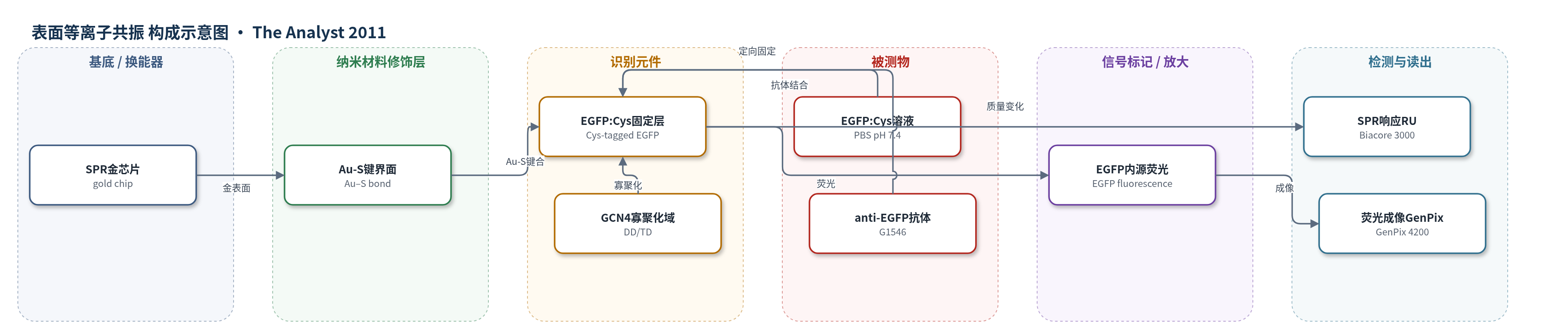
点击图片查看大图 · 依据论文自动绘制
传感器类型
表面等离子共振(SPR)生物传感器
检测对象
EGFP(增强绿色荧光蛋白,EGFP)及其二聚/三聚体;anti-EGFP 单克隆抗体(G1546,结合实验);样品基质:PBS (pH 7.4) 缓冲液。
检测原理
流动相中的 EGFP:Cys 通过 C 端半胱氨酸巯基与裸金表面形成 Au–S 共价键,使蛋白以固定取向吸附在金芯片上;N 端融合的 GCN4 衍生 DD/TD 寡聚化域促使 EGFP 形成二聚或三聚,从而增加单位面积结合的蛋白质量。SPR 检测中,蛋白结合引起金表面附近折射率和质量变化,产生响应单位(RU)信号;寡聚化程度越高,表面密度越大,RU 越高,单体、二聚和三聚分别约为 687、1160 和 2521 RU。荧光成像中,EGFP 内源荧光强度随表面结合蛋白量增加而增强,用于验证 SPR 结果。该策略以寡聚化多价固定作为信号放大/密度增强手段。
检测灵敏度
未报告
效应效果
SPR 结果显示,单体、二聚和三聚 EGFP:Cys 平台响应约 687、1160 和 2521 RU,表面密度约 6.87×10^-10、11.6×10^-10 和 25.2×10^-10 g mm^-2;二聚和三聚结合量为单体的 1.7 和 3.6 倍,三聚覆盖率约 63%。无半胱氨酸 EGFP 有约 590 RU 非特异结合。Tween-20 和 CHAPS 洗涤后响应无明显变化,固定化较稳定。荧光测量中,三聚 EGFP:Cys 在 100 µg ml^-1 饱和,单体 EGFP:Cys 信号约为无半胱氨酸单体的 1.8 倍;二聚和三聚 KD 约 29.5±5.2 和 15.4±1.2 µg ml^-1。作者认为可用于 SPR 生物传感器、疾病诊断、环境监测、食品病原检测和药物筛选。
传感器的构成
- 基底/换能器:SPR 金芯片(gold chip),提供表面等离子共振换能界面。
- 表面预处理:piranha solution(70% H2SO4/30% H2O2)清洗裸金表面,去除污染物。
- 识别/固定化元件:EGFP:Cys(半胱氨酸标记增强绿色荧光蛋白),C端两个半胱氨酸通过 Au–S 键定向结合金表面。
- 寡聚化修饰层:GCN4-derived dimerization domain(DD)或 trimerization domain(TD),融合于 EGFP N端,驱动二聚/三聚以提高表面密度。
- 内源信号标记:EGFP 自身绿色荧光,用于荧光成像验证表面结合。
- 分析物/配体:anti-EGFP monoclonal antibody(G1546),用于 SPR 抗体结合实验。
中文摘要
本文报道了一种在表面等离子共振(SPR)金芯片上固定化蛋白质的有效方法,以增强绿色荧光蛋白(EGFP)为模型蛋白,结合半胱氨酸介导的定向固定与寡聚化域介导的多聚化,实现方向可控的高表面密度堆积。为诱导 EGFP 寡聚化,作者选用源自 GCN4 亮氨酸拉链结构域的二聚化和三聚化构建体,用于组装多聚 EGFP。为实现方向控制,采用 C 端引入半胱氨酸残基的 EGFP,该蛋白此前已被证明可在金芯片上呈现良好取向。作者通过基因工程构建 EGFP 寡聚化域融合蛋白,纯化后加载到金芯片上,并用 SPR 分析。结果显示,金芯片上固定化的 EGFP 密度随蛋白寡聚化状态增加,二聚和三聚 EGFP 的吸附能力分别优于单体和二聚形式。荧光测量结果与 SPR 结果一致。总体而言,半胱氨酸与寡聚化域联合介导的蛋白固定化可用于 SPR 生物传感器应用,同时实现优良取向和高表面密度。
英文摘要
Here we report an effective method for protein immobilization on a surface plasmon resonance (SPR) gold chip, describing the combination of cysteine- and oligomerization domain-mediated immobilization of enhanced green fluorescent protein (EGFP) as a model protein for the purpose of orientation-controlled surface density packing. In order to facilitate the oligomerization of EGFP, the dimeric and trimeric constructs derived from GCN4- leucine zipper domain were chosen for multimeric EGFP assembly. For orientation-controlled immobilization of the protein, EGFP modified with cysteine residues showing excellent orientation on a gold chip was used as a starting protein, as previously reported in our earlier study (Anal. Chem., 2007, 79, 2680-2687). Constructs of EGFP with oligomerization domains were genetically engineered, and corresponding fusion proteins were purified, applied to a gold chip, and then analyzed under SPR. The immobilized EGFP density on a gold chip increased according to the states of protein oligomerization, as dimeric and trimeric EGFPs displayed better adsorption capability than monomeric and dimeric forms, respectively. Fluorescence measurement corroborated the SPR results. Taken together, our findings indicated that the combination of cysteine- and oligomerization domain-mediated immobilization of protein could be used in SPR biosensor applications, allowing for an excellent orientation and high surface density simultaneously.