组成图示
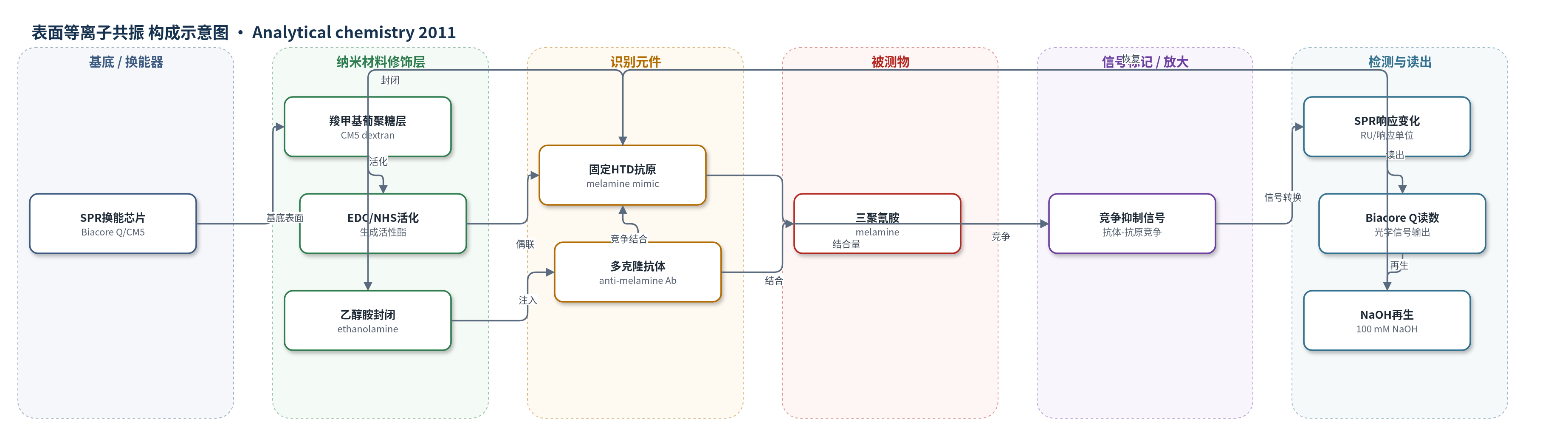
点击图片查看大图 · 依据论文自动绘制
传感器类型
表面等离子共振(SPR)生物传感器
检测对象
三聚氰胺(melamine);样品基质:婴儿配方奶粉(infant formula)、婴儿液态奶(infant liquid milk)、奶粉(milk powder)
检测原理
本方法采用竞争抑制免疫分析。HTD 作为三聚氰胺结构类似物,经 EDC/NHS 活化后共价偶联到 CM5 芯片表面,形成固定抗原层;样品中的三聚氰胺与兔多克隆抗体结合后,会减少抗体与芯片表面 HTD 的结合。随着三聚氰胺浓度升高,芯片表面抗体结合量下降,导致 SPR 响应降低。Biacore Q 通过监测界面折射率变化获得响应信号,以 IC50 表征灵敏度。该过程无需酶标或荧光标记,直接以质量结合变化产生光学信号,适合批量筛查。
检测灵敏度
IC50: 67.9 ng mL^-1;LOD: <0.5 μg mL^-1;校准浓度: 0, 0.125, 0.25, 0.5, 1, 5, 10 μg mL^-1
效应效果
该抗体对三聚氰胺生产副产物 ammeline、ammelide 和 cyanuric acid 无交叉反应,但对杀虫剂 cyromazine 有显著交叉反应,缓冲液中为 243%,婴儿配方奶粉基质中为 224%,因此阳性样品需经理化方法确认。方法在 0.5 和 1.0 μg/mL 加标水平下批内变异系数分别为 3.6% 和 3.8%,批间变异系数分别为 4.6% 和 10.0%。对 10±0.6 mg/kg 污染奶粉的测定结果为 10.45、10.82 和 9.85 mg/kg,与能力验证结果一致。其检出能力低于欧盟食品检测要求约 5 倍,适合大批量样品自动化筛查。
传感器的构成
- SPR换能基底:Biacore Q 光学生物传感器与 CM5 传感器芯片,提供表面等离子共振检测平台和羧甲基葡聚糖表面
- 活化层:EDC/NHS 混合液活化 CM5 表面羧基,生成可与 HTD 反应的活性酯位点
- 固定抗原层:HTD(6-hydrazino-1,3,5-triazine-2,4-diamine)作为三聚氰胺结构类似物,偶联于芯片表面用于竞争结合
- 封闭层:1 M 乙醇胺(ethanolamine, pH 8.5)封闭未反应位点,降低非特异结合
- 识别元件:兔多克隆抗体(anti-melamine polyclonal antibody),由 HTD-SFB-BTG 免疫原免疫制备,用于结合三聚氰胺或芯片 HTD
- 免疫原体系:BTG(bovine thyroglobulin)载体蛋白与 SFB(succinimidyl 4-formylbenzoate)交联剂,将 HTD 偶联至蛋白用于免疫
- 运行与再生:HBS-EP/biosensor buffer 作为运行缓冲,100 mM NaOH 用于芯片表面再生
中文摘要
2008年中国非法向牛奶中掺入三聚氰胺,导致数十万儿童出现肾脏和泌尿系统不良反应,并报告6例死亡。牛奶被故意掺假以提高表观蛋白含量,随后在许多出口乳制品中检出三聚氰胺,促使多国禁止进口用于儿童营养的牛奶及乳制品,并建立含乳产品检测方法。本研究开发了一种基于光学生物传感器的抑制免疫分析方法,用于快速、稳健地检测婴儿配方奶粉和婴儿液态奶样品。采用与三聚氰胺化学结构相似的化合物作为半抗原,免疫制备多克隆抗体,并将其固定于生物传感器芯片表面作为抗原。该分析在缓冲液中的灵敏度以IC50表示为67.9 ng/mL。抗体与三聚氰胺生产副产物无交叉反应,但与三聚氰胺代谢来源的杀虫剂西维因(cyromazine)存在显著交叉反应。在样品基质中,婴儿配方奶粉和婴儿液态奶的检出限均低于0.5 μg/mL。本文报道了该免疫分析方法的建立、三聚氰胺检测验证数据以及对三聚氰胺污染奶粉的分析结果。
英文摘要
The illegal adulteration of milk with melamine in 2008 in China led to adverse kidney and urinary tract effects in hundreds of thousands of children and the reported deaths of six. The milk had been deliberately adulterated to elevate the apparent protein content, and subsequently melamine was detected in many milk-related products which had been exported. This led to the banning of imports of milk and milk products from China intended for the nutritional use of children and to the implementation of analytical methods to test products containing milk products. An optical biosensor inhibition immunoassay has been developed as a rapid and robust method for the analysis of infant formula and infant liquid milk samples. A compound with a chemical structure similar to that of melamine was employed as a hapten to raise a polyclonal antibody and as the immobilized antigen on the surface of a biosensor chip. The sensitivity of the assay, given as an IC(50), was calculated to be 67.9 ng mL(-1) in buffer. The antibody did not cross-react with any of the byproducts of melamine manufacture; however, significant cross-reactivity was observed with the insecticide cyromazine of which melamine is a metabolite. When sample matrix was applied to the assay, a limit of detection of <0.5 μg mL(-1) was determined in both infant formula and infant liquid milk. The development of the immunoassay and validation data for the detection of melamine is presented together with the results obtained following the analysis of melamine-contaminated milk powder.