组成图示
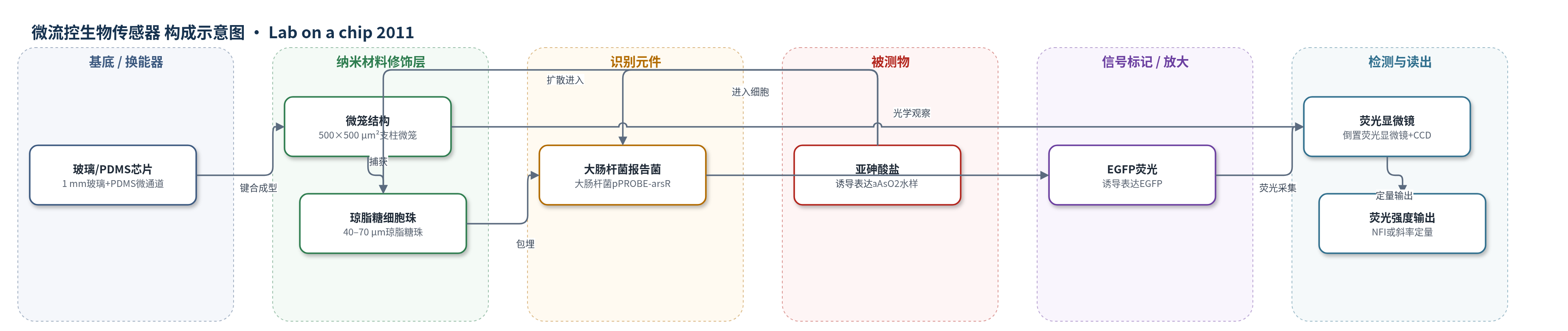
点击图片查看大图 · 依据论文自动绘制
传感器类型
微流控生物传感器
检测对象
亚砷酸盐(arsenite, As(III)),并可响应砷酸盐(arsenate, As(V));样品基质:含砷水样/MOPS模拟水样(饮用水/环境水样)
检测原理
该传感器以工程化大肠杆菌为识别与信号元件。菌株携带arsR启动子-EGFP转录融合和ArsR阻遏蛋白。无砷时,ArsR结合启动子操作子,egfp仅低水平表达;亚砷酸盐进入细胞后与ArsR结合,使其构象改变并从操作子解离,arsR和egfp去抑制表达,EGFP随时间积累。微流控微笼将大量琼脂糖细胞珠聚集在固定区域,使荧光信号在空间上集中并放大。样品中的砷浓度越高,EGFP表达速率和累积荧光越强。倒置荧光显微镜周期性采集GFP荧光图像,经背景与初始信号校正得到归一化荧光强度(NFI);也可对半对数信号拟合斜率,该斜率在0–50 mg As/L范围内与砷浓度线性相关,从而实现定量检测。
检测灵敏度
检出限(MDL): 1.6 mg As per L;线性范围: 0–50 mg As per L;R^2: r2 = 0.9997;另报道 r2 = 0.9674、r2 = 0.9576;MDL: 1–1.6 mg As per L
效应效果
该装置在0–100 mg As/L范围内可区分砷浓度,10和50 mg/L样品可重复与空白区分。-20°C预填充芯片保存至少28天仍保持诱导性,4°C保存9天后10 mg/L难以与空白区分,-80°C保存可维持至14天。重现性方面,-20°C芯片内细胞珠在180 min后RSD为4–6%,4°C细胞珠RSD约10%以上,-80°C细胞珠RSD约15%以上;单批-80°C细胞珠平均偏差约15%,批间NFI偏差约20%。与既往稳态荧光或单细胞显微方法(MDL约5–8 mg As/L)相比,本微笼方法将MDL降至1–1.6 mg As/L,并简化液体处理,适合现场水样检测。未报告实际水样加标回收率。
传感器的构成
- 基底/微流控芯片:1 mm厚玻璃载玻片与PDMS(Sylgard 184)氧等离子体键合,形成微通道和微笼,作为样品流动与光学观察基底。
- 微笼结构:PDMS中干法蚀刻形成的500×500 μm²微笼,由间隔5 μm的支柱组成,用于捕获并固定琼脂糖细胞珠。
- 包埋基质:2.5% (w/v)琼脂糖(Agarose D1 low EEO)微珠,直径40–70 μm,包埋报告细胞并允许砷和营养物扩散。
- 识别元件:工程化大肠杆菌DH5a 1598 (pPROBE-arsR-ABS)全细胞生物报告菌,携带arsR启动子-EGFP融合和ArsR阻遏蛋白,识别亚砷酸盐/砷酸盐。
- 信号标记物:增强绿色荧光蛋白(EGFP),在砷诱导下表达,作为可光学读出的荧光报告分子。
- 保存/诱导介质:MOPS培养基(10% MOPS buffer、2 mM MgCl2、0.1 mM CaCl2、2 g/L葡萄糖),用于细胞悬浮、诱导和保存;-20°C保存时加15%甘油。
- 样品引入与读出:注射泵经PTFE管输送含亚砷酸钠(NaAsO2)水样;倒置荧光显微镜(Leica DMI6000B)配CCD相机(DFC320)和GFP滤光片(BP470/40)采集荧光。
中文摘要
砷污染在工业化和发展中国家均常见,许多饮用水砷浓度超过允许限值(欧洲和美国多为10 mg As/L,其他地区50 mg As/L)。传统仪器昂贵且难以在发展中国家普及。基于基因工程细菌的生物测定可作为替代,但需更好标准化并直接集成到传感装置中。本研究开发并测试了可嵌入、暴露和检测细菌生物报告信号的大肠杆菌微流控装置,作为完整微型化细菌生物传感器的进一步步骤。传感信号元件为非致病大肠杆菌实验室菌株,接触亚砷酸盐和砷酸盐后产生绿色荧光蛋白变体。大肠杆菌报告细胞被包埋在琼脂糖珠中,并置于微流控芯片的500×500 μm²微笼内,暴露于含砷水样。-20°C冷冻保存于芯片中的细胞珠可保持诱导性长达一个月,10或50 mg/L砷样品可重复与空白区分。在0–50 mg/L范围内,暴露200 min时信号增加速率与砷浓度线性相关;可靠检测50 mg/L需75–120 min,10 mg/L需120–180 min。
英文摘要
Contamination with arsenic is a recurring problem in both industrialized and developing countries. Drinking water supplies for large populations can have concentrations much higher than the permissible levels (for most European countries and the United States, 10 μg As per L; elsewhere, 50 μg As per L). Arsenic analysis requires high-end instruments, which are largely unavailable in developing countries. Bioassays based on genetically engineered bacteria have been proposed as suitable alternatives but such tests would profit from better standardization and direct incorporation into sensing devices. The goal of this work was to develop and test microfluidic devices in which bacterial bioreporters could be embedded, exposed and reporter signals detected, as a further step towards a complete miniaturized bacterial biosensor. The signal element in the biosensor is a nonpathogenic laboratory strain of Escherichia coli, which produces a variant of the green fluorescent protein after contact to arsenite and arsenate. E. coli bioreporter cells were encapsulated in agarose beads and incorporated into a microfluidic device where they were captured in 500 × 500 μm(2) cages and exposed to aqueous samples containing arsenic. Cell-beads frozen at -20 °C in the microfluidic chip retained inducibility for up to a month and arsenic samples with 10 or 50 μg L(-1) could be reproducibly discriminated from the blank. In the 0-50 μg L(-1) range and with an exposure time of 200 minutes, the rate of signal increase was linearly proportional to the arsenic concentration. The time needed to reliably and reproducibly detect a concentration of 50 μg L(-1) was 75-120 minutes, and 120-180 minutes for a concentration of 10 μg L(-1).