组成图示
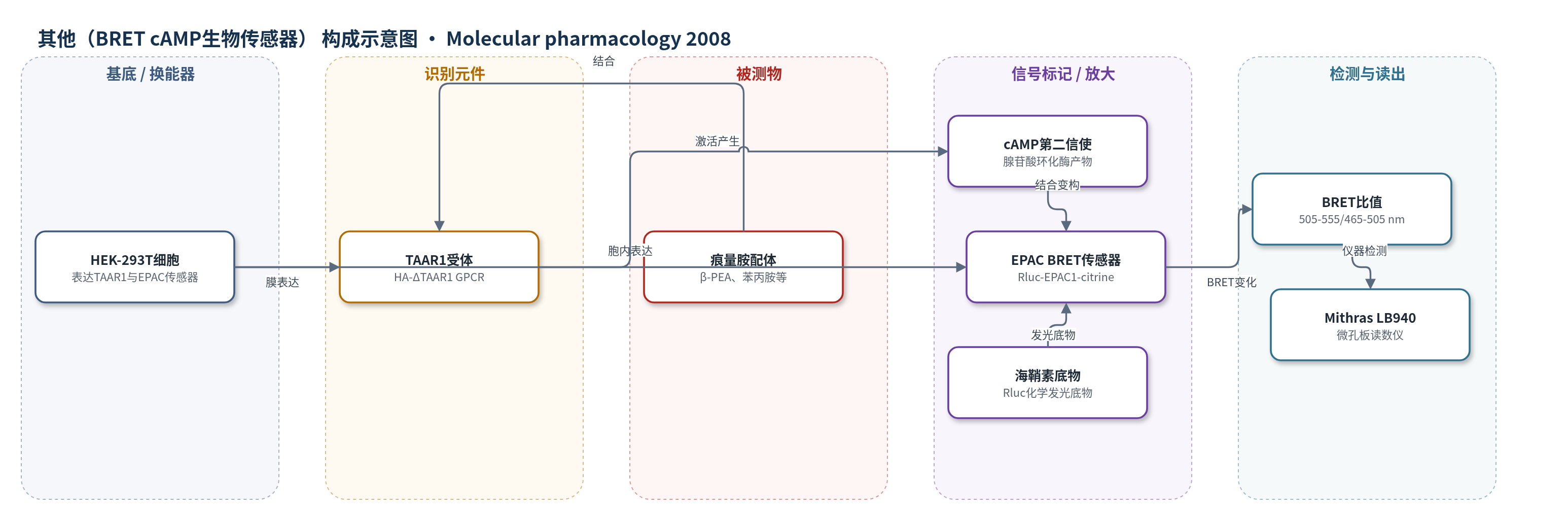
点击图片查看大图 · 依据论文自动绘制
传感器类型
其他(BRET cAMP生物传感器)
检测对象
cAMP(cyclic AMP,细胞内第二信使);TAAR1配体(β-苯乙胺 β-PEA、苯丙胺 amphetamine、MDMA 等),样品基质:HEK-293T细胞培养体系(活细胞内cAMP)
检测原理
TAAR1结合痕量胺配体后激活Gs蛋白和腺苷酸环化酶,使细胞内cAMP浓度升高。cAMP结合Rluc-EPAC1-citrine传感器中的EPAC1结构域,引起构象变化,增大N端Rluc供体与C端citrine受体之间的距离,从而降低生物发光共振能量转移效率。Rluc催化coelenterazine氧化发光,其发射光通过非辐射能量转移激发citrine荧光;仪器分别采集465–505 nm发光与505–555 nm荧光,BRET比值随cAMP浓度升高而下降。加入IBMX抑制磷酸二酯酶,减少cAMP降解,可放大信号并维持稳定响应。
检测灵敏度
原文未报告 LOD、线性范围、灵敏度斜率或 R^2;报告 EC50(BRET):β-PEA 1.08 ± 0.29 × 10^-7 M,d-苯丙胺 1.36 ± 0.14 × 10^-7 M;筛选 Z-score 0.6。
效应效果
该BRET法与柱层析cAMP法结果定性一致,但BRET的EC50左移3–4倍。未转染TAAR1的mock细胞对β-PEA无显著响应,而isoproterenol响应相同,说明选择性良好。β-PEA诱导的BRET信号幅度在cAMP诱导后至少稳定20 min;共转染β-arrestin2后约5 min出现脱敏。筛选约40个化合物,未检出拮抗剂,但确认l-苯丙胺(效能127.9±4.1%)、d-甲基苯丙胺(107.7±5.1%)、β-PEA、MDMA(89.6±6.3%)等为激动剂,Z-score为0.6。作者认为该法适合实时、高通量筛选TAAR1及其他低表达GPCR配体。
传感器的构成
- 细胞基底/表达系统:HEK-293T细胞,永久表达EPAC BRET传感器并瞬时表达HA-ΔTAAR1,提供膜受体与胞内信号环境
- 识别元件:人TAAR1(HA-ΔTAAR1,N端插入α2-AR前9氨基酸以增强N-糖基化和膜表达),结合痕量胺配体并激活Gs/腺苷酸环化酶
- 第二信使/被测物:cAMP,由腺苷酸环化酶产生,结合EPAC传感器引起构象变化
- 传感器融合蛋白:Rluc-EPAC1-citrine(人化海肾荧光素酶Rluc连接N端截短EPAC1与citrine黄荧光蛋白),作为BRET供体-受体对
- 发光底物:coelenterazine(海鞘素),Rluc化学发光底物,激发BRET
- 信号增强剂:IBMX(3-异丁基-1-甲基黄嘌呤),磷酸二酯酶抑制剂,减少cAMP降解并增强BRET变化
- 读出装置:Mithras LB940微孔板读数仪,分别检测465–505 nm发光与505–555 nm荧光并计算BRET比值
中文摘要
痕量胺是一类神经递质,近年发现其可结合中枢神经系统中广泛表达的新型G蛋白偶联受体(GPCR)家族——痕量胺相关受体(TAAR)。人TAAR1在模型细胞中膜表达极差,严重限制其药理学表征。本研究显示,在人TAAR1 N端插入人α2-肾上腺素受体前9个氨基酸所形成的天冬酰胺糖基化位点,足以使其在HEK-293细胞质膜上表达,从而可用新型基于cAMP EPAC(cAMP直接激活的交换蛋白)蛋白的生物发光共振能量转移(BRET)生物传感器进行药理学研究。作者将该cAMP BRET传感器用于评估潜在TAAR1配体,首次系统表征了膜表达人TAAR1的药理学。该策略可为研究痕量胺在体内的功能及表征其他低表达GPCR提供基础。
英文摘要
Trace amines are neurotransmitters whose role in regulating invertebrate physiology has been appreciated for many decades. Recent studies indicate that trace amines may also play a role in mammalian physiology by binding to a novel family of G protein-coupled receptors (GPCRs) that are found throughout the central nervous system. A major obstacle impeding the careful pharmacological characterization of trace amine associated receptors (TAARs) is their extremely poor membrane expression in model cell systems, and a molecular basis for this phenomenon has not been determined. In the present study, we show that the addition of an asparagine-linked glycosylation site to the N terminus of the human trace amine associated receptor 1 (TAAR1) is sufficient to enable its plasma membrane expression, and thus its pharmacological characterization with a novel cAMP EPAC (exchange protein directly activated by cAMP) protein based bioluminescence resonance energy transfer (BRET) biosensor. We applied this novel cAMP BRET biosensor to evaluate the activity of putative TAAR1 ligands. This study represents the first comprehensive investigation of the membrane-expressed human TAAR1 pharmacology. Our strategy to express TAARs and to identify their ligands using a cAMP BRET assay could provide a foundation for characterizing the functional role of trace amines in vivo and suggests a strategy to apply to groups of poorly expressing GPCRs that have remained difficult to investigate in model systems.