组成图示
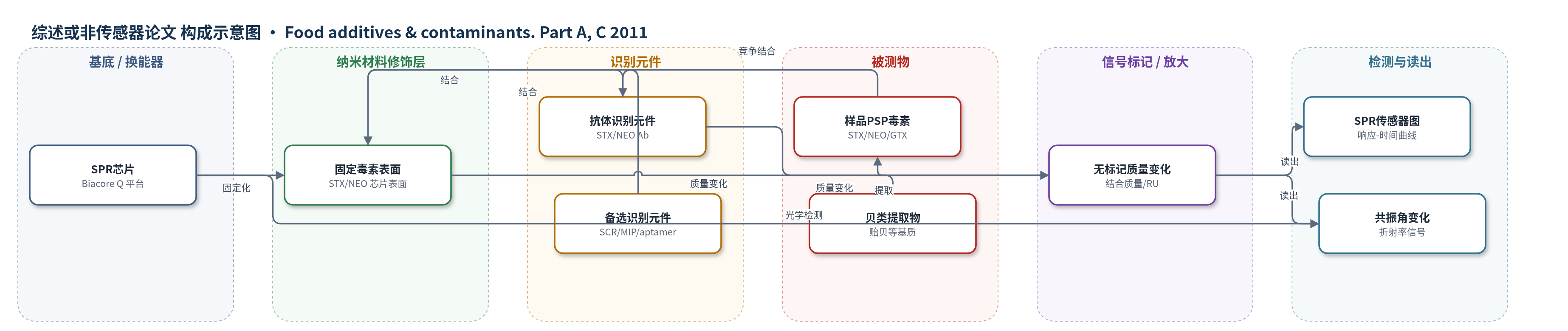
点击图片查看大图 · 依据论文自动绘制
传感器类型
综述或非传感器论文
检测对象
麻痹性贝类毒素(PSP toxins,包括 STX、NEO、GTX 等类似物);样品基质:贝类肉/贻贝等贝类提取物
检测原理
SPR 光学生物传感器采用竞争抑制格式:将 PSP 毒素类似物固定于传感器芯片表面形成 STX 或 NEO 表面;样品中的抗体或受体等识别元件先与样品内 PSP 毒素结合,再注入芯片。若样品无毒素,识别元件结合固定毒素,表面质量增加,SPR 响应升高;若样品含毒素,识别元件被毒素占据,表面结合减少,响应降低,响应与毒素浓度成反比。SPR 通过结合质量改变界面折射率与共振角,实现无标记实时检测。针对单一抗体交叉反应谱与毒性因子不一致的问题,可将 STX 与 NEO 抗体按 20%/80% 混合并在通用 NEO 表面使用,合并交叉反应谱,使结果更接近 STX 当量总毒性。
检测灵敏度
原文未报告 LOD、线性范围、灵敏度斜率或 R^2;仅报告 IC50 与动态范围:STX 抗体 IC50 4.8 ng ml^-1,NEO 抗体 IC50 2.4 ng ml^-1;动态范围 IC20–IC80 分别为 2.7–8.1 ng ml^-1 和 1.1–5.5 ng ml^-1。
效应效果
综述指出抗体交叉反应谱主要取决于免疫原结构,而不一定与毒性一致:单克隆 GT-13A 对羟基化毒素 NEO/GTX1/4 响应低,可能低估总毒性,但对 C1/C2、GTX5 响应高,可能高估;多克隆 R895 交叉反应更宽,但羟基化毒素仍需改进。88 个自然贝类样品与 AOAC HPLC 比较显示多克隆抗体相关性更好;使用贻贝提取校准曲线可减轻基质效应,若用缓冲曲线会高估约 50%。Garthwaite 乙醇提取法 STX 回收率约 50%。SPR 芯片可再生超过 1000 次,方法简单、快速,作为筛查工具可避免超过 80% 样品进入小鼠生物测定;双抗体混合可改善总毒性估算。
传感器的构成
- 换能器/基底:Biacore Q SPR 光学生物传感器芯片:提供表面等离子共振检测界面,通过折射率/共振角变化读出结合质量
- 固定化靶标层:PSP 毒素芯片表面(STX 或 NEO 表面):将 PSP 毒素类似物固定于芯片,作为竞争结合位点,可再生超过 1000 次
- 识别元件:抗体(多克隆 STX 抗体 R895/BC67、多克隆 NEO 抗体、单克隆 GT-13A):与样品中 PSP 毒素特异性结合,形成竞争抑制
- 备选识别元件:钠通道受体(SCR)、saxiphilin 受体、冠醚/杯[4]芳烃化学传感器、分子印迹聚合物(MIP)、核酸适配体:作为未来非抗体识别元件
- 样品基质:贝类/贻贝提取物(乙醇、乙酸或 pH 5 醋酸钠缓冲液提取):提供待测 PSP 毒素
- 流动相:HBS-EP 缓冲液:输送样品与识别元件,维持结合反应
- 信号读出:SPR 传感器图/响应单位(RU):无标记检测表面结合质量变化,响应与样品毒素浓度成反比
中文摘要
本文综述了基于表面等离子共振(SPR)的光学生物传感器技术用于检测麻痹性贝类毒素(PSP)的研究进展。SPR 通过监测传感器芯片表面生物分子相互作用引起的折射率/共振角变化,实现无标记、实时定量。文中评估了受体、单克隆/多克隆抗体、化学传感器、分子印迹聚合物和适配体等识别元件,重点讨论低分子量 PSP 类似物在四个取代位点结构差异导致单一识别元件难以覆盖全谱的问题,以及各毒素相对河豚毒素(STX)的毒性因子与抗体交叉反应谱不一致带来的总毒性估算困难。综述指出,将 STX 与 NEO 两种抗体按 20%/80% 混合并在通用 NEO 芯片表面使用,可合并交叉反应谱,使结果更接近小鼠生物测定的毒性当量;多通道/多重 SPR 平台及非抗体识别元件有望发展快速、低动物使用的筛查方法。
英文摘要
This review examines the developments in optical biosensor technology, which uses the phenomenon of surface plasmon resonance, for the detection of paralytic shellfish poisoning (PSP) toxins. Optical biosensor technology measures the competitive biomolecular interaction of a specific biological recognition element or binder with a target toxin immobilised onto a sensor chip surface against toxin in a sample. Different binders such as receptors and antibodies previously employed in functional and immunological assays have been assessed. Highlighted are the difficulties in detecting this range of low molecular weight toxins, with analogues differing at four chemical substitution sites, using a single binder. The complications that arise with the toxicity factors of each toxin relative to the parent compound, saxitoxin, for the measurement of total toxicity relative to the mouse bioassay are also considered. For antibodies, the cross-reactivity profile does not always correlate to toxic potency, but rather to the toxin structure to which it was produced. Restrictions and availability of the toxins makes alternative chemical strategies for the synthesis of protein conjugate derivatives for antibody production a difficult task. However, when two antibodies with different cross-reactivity profiles are employed, with a toxin chip surface generic to both antibodies, it was demonstrated that the cross-reactivity profile of each could be combined into a single-assay format. Difficulties with receptors for optical biosensor analysis of low molecular weight compounds are discussed, as are the potential of alternative non-antibody-based binders for future assay development in this area.