组成图示
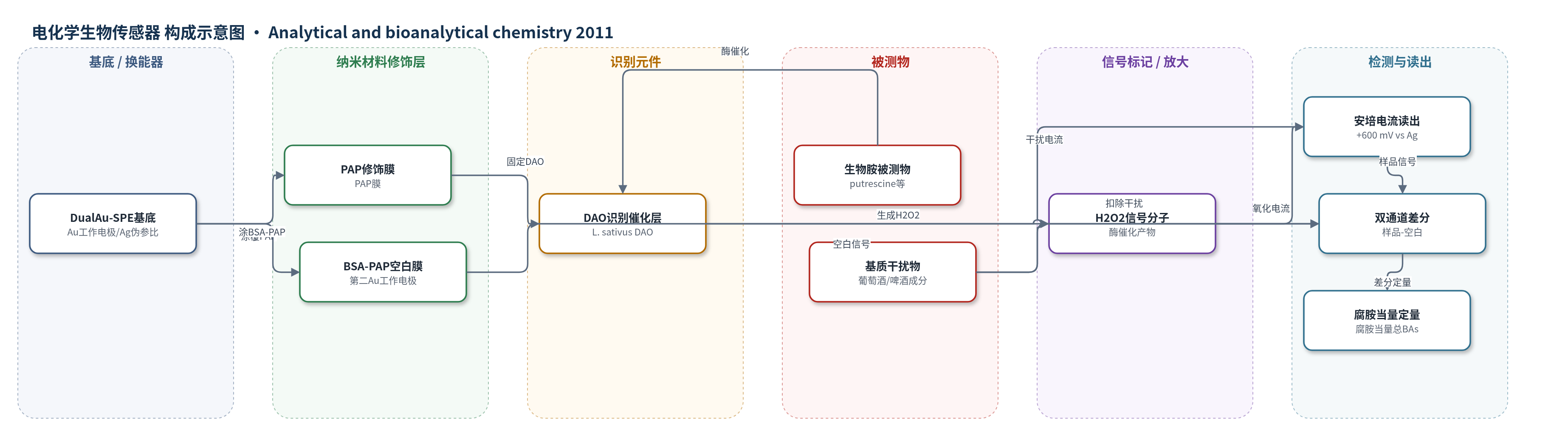
点击图片查看大图 · 依据论文自动绘制
传感器类型
电化学生物传感器
检测对象
生物胺(biogenic amines, BAs),包括腐胺(putrescine)、尸胺(cadaverine)、组胺(histamine)、精胺(spermine)、亚精胺(spermidine)、酪胺(tyramine)、苯乙胺(phenylethylamine);样品基质:葡萄酒(红葡萄酒、白葡萄酒)和啤酒(淡色啤酒)。
检测原理
DAO 催化双胺氧化,以 O2 为电子受体,将腐胺、尸胺等生物胺氧化为醛、NH3 和 H2O2。生成的 H2O2 在 DualAu-SPE 的金工作电极上于 +600 mV(对 Ag 伪参比)发生电化学氧化,产生与 H2O2 浓度相关的安培电流。实际样品分析采用双通道差分:一个 Au 工作电极固定 DAO-PAP,另一个固定 BSA-PAP 作为空白,流动注射同时记录样品通道和空白通道电流,扣除基质干扰后,以腐胺标准曲线将净电流换算为总生物胺(腐胺当量)。由于 DAO 对不同胺的催化效率不同,结果以腐胺当量表达,可能引入系统偏差。
检测灵敏度
LOD: 0.2 mg l-1;线性范围: 0.7–20.0 mg l-1;灵敏度: 11.2±0.4 nA mg-1 l
效应效果
与 GC-MS 参考方法比较,传感器在葡萄酒中表现良好:白葡萄酒1 15.0±0.8 对 12.6±0.5 mg/L,白葡萄酒2 6.6±0.7 对 6.0±0.4 mg/L,红葡萄酒1 26.5±6.5 对 21.8±1.6 mg/L,红葡萄酒2 43.0±5.4 对 44.9±3.1 mg/L。啤酒中低估约50%:淡色啤酒1 7.8±2.2 对 15.1±0.9 mg/L,淡色啤酒2 3.8±0.1 对 8.1±0.8 mg/L,可能因酶对不同胺选择性及基质抑制。连续10次校准,前5次无明显性能损失,重现性良好。作者认为其快速、样品处理少、灵敏度较高,可用于酿酒厂或生产厂快速估计总生物胺含量。
传感器的构成
- 基底/换能器:DualAu-SPE,含两个 Au 工作电极、Au 对电极和 Ag 伪参比,提供双通道安培检测与差分扣除。
- 修饰层:PAP(polyazetidine prepolymer)膜,包埋并固定 DAO 或 BSA,保持酶活性。
- 识别/催化元件:DAO(Lathyrus sativus diamine oxidase, EC 1.4.3.22),催化双胺氧化生成 H2O2。
- 空白对照层:BSA(bovine serum albumin)+PAP,涂于第二 Au 工作电极,提供基质干扰空白信号。
- 信号分子:H2O2,DAO 催化产物,在 Au 电极 +600 mV 下氧化产生电流。
- 流动系统:flow injection system,0.1 M phosphate buffer pH 7.4 载流,250 μL 进样,实现快速检测。
中文摘要
本研究表征了来自 Lathyrus sativus 的二胺氧化酶(DAO),并首次将其作为电化学生物传感器的生物催化组分,用于葡萄酒和啤酒样品中生物胺指数(BAs index)的测定。首先利用铂电极对溶液中游离 DAO 进行电化学动力学表征,随后将其通过聚氮丙啶预聚物(PAP)固定在由两个金工作电极构成的丝网印刷电极表面。在 0.1 mol/L、pH 7.4 磷酸盐缓冲液中,采用流动系统于 +600 mV(对内置银伪参比)进行安培测量。葡萄酒和啤酒样品分析在流动注射系统中进行,双通道换能器同时检测样品和空白信号,扣除空白后的信号以腐胺(putrescine)标准曲线定量。结果与经改进的气相色谱-质谱(GC-MS)参考方法比较。意大利葡萄酒分析表明,该 DAO 生物传感器适合以腐胺当量表达的红葡萄酒和白葡萄酒生物胺指数测定;在啤酒样品中效率较低,低估约 50% 的生物胺含量。
英文摘要
In this work, we have characterized a diamine oxidase (DAO) from Lathyrus sativus and evaluated its use, for the first time, as biocatalytic component of an electrochemical biosensor for the determination of biogenic amines index in wine and beer samples. Firstly, DAO was electrokinetically characterized free in solution by means of a platinum electrode and then immobilized by using polyazetidine prepolimer on the surface of screen-printed electrodes constituted of two gold working electrodes. The amperometric measurements were carried out by using a flow system at a fixed potential of +600 mV vs the internal silver pseudo reference in phosphate buffer solution (0.1 mol l(-1), pH = 7.4). The analysis of wine and beer samples were performed in flow injection system using the dual channel transducer providing simultaneous detection of sample and blank signal, and the resulting signal (after subtraction of the blank signal) was referred to that of putrescine. The results were compared with those obtained using a modified reference method based on gas chromatography-mass spectrometry analysis on the same samples. The results obtained in the analysis of Italian wines shows the better suitability of DAO-based biosensor in the determination of the biogenic amines (BAs) index expressed as putrescine equivalent in both red and white wines, being less efficient in beer samples where it underestimates by about 50% the BAs content.