组成图示
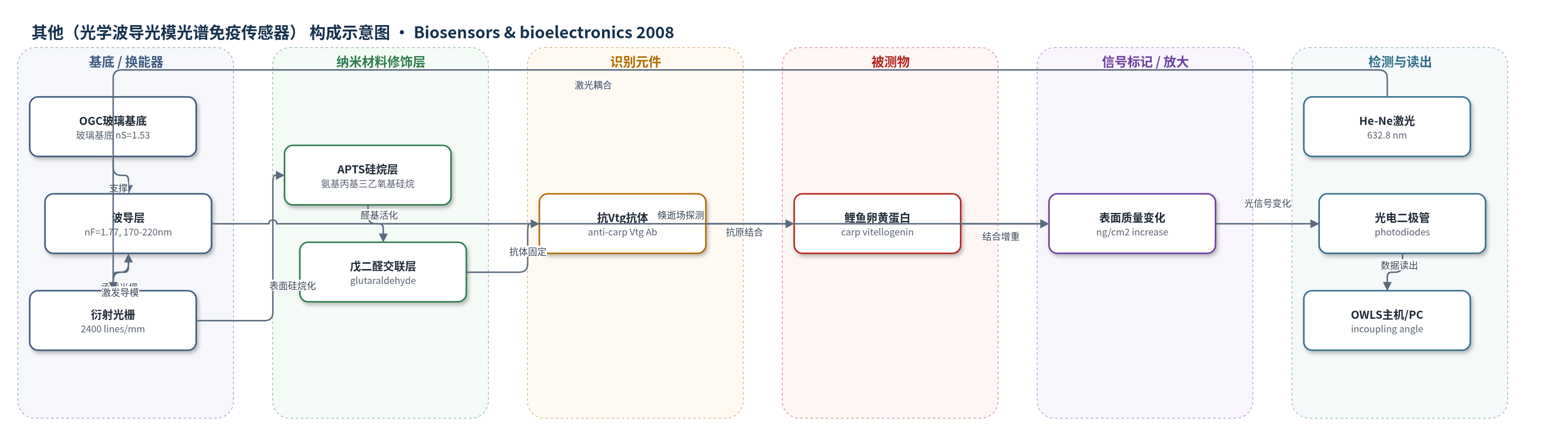
点击图片查看大图 · 依据论文自动绘制
传感器类型
其他(光学波导光模光谱免疫传感器)
检测对象
鲤鱼卵黄蛋白(carp vitellogenin, Vtg);样品基质:鲤鱼血清(含10倍稀释无Vtg鲤鱼血清加标样品及2000倍稀释雌/雄鲤鱼血清)
检测原理
该传感器为无标记直接结合免疫传感器。OGC芯片表面经APTS硅烷化和戊二醛活化后固定抗鲤鱼Vtg抗体。样品中的鲤鱼Vtg与表面抗体特异性结合,使界面质量/折射率增加。He-Ne激光(632.8 nm)经衍射光栅耦合进入波导层,激发导模并产生穿透液相的倏逝场;结合事件改变倏逝场边界条件,导致入射角(TE/TM模式)发生偏移。OWLS主机通过光电二极管实时监测入射角变化,并由软件换算为表面覆盖质量(ng/cm2)。信号随Vtg浓度增加而增大,在双对数坐标下呈线性;未使用酶、纳米材料或核酸扩增等信号放大策略。
检测灵敏度
LOD: 0.00675 nM;线性范围: 0.00675–67.5 nM(双对数坐标);斜率: 0.3327;r = 0.9904
效应效果
特异性良好:6.75 nM Vtg下,仅APTS芯片响应4.48±0.76 ng/cm2,APTS+戊二醛5.63±0.43,抗体芯片51.47±0.54,高9.14–11.49倍;BSA芯片2.88±0.18,抗体芯片48.47±0.54。10 mM HCl再生后9次重复平均44.21±2.66 ng/cm2,为首次95.61%,CV 6.02%。9.45 nM Vtg加入10倍稀释无Vtg鲤鱼血清的模型样品响应为纯化Vtg的96.70%;ELISA相对比134.60%。2000倍稀释诱导雌/雄鲤鱼血清响应58.70±1.90和45.00±1.10 ng/cm2,高于对照15.20–17.50。作者认为可用于养殖场内分泌干扰物暴露现场初筛。
传感器的构成
- 基底/换能器:OGC传感器芯片玻璃基底(glass substrate,nS=1.53,48×16×0.55 mm),承载波导与光栅
- 波导层:折射率nF=1.77、厚度170–220 nm的波导层,形成导模与倏逝场
- 光栅层:衍射光栅(2400 lines/mm,表面浮雕深度约20 nm,2×16 mm),耦合He-Ne激光进入波导
- 硅烷化修饰层:3-氨基丙基三乙氧基硅烷(APTS)处理,提供氨基反应位点
- 交联活化层:戊二醛(glutaraldehyde)活化氨基,用于抗体共价固定
- 识别元件:抗鲤鱼卵黄蛋白抗体(anti-carp vitellogenin antibody,兔抗血清1:10稀释)
- 被测物:鲤鱼卵黄蛋白(carp vitellogenin, Vtg)
- 读出系统:OWLS 110主机、He-Ne激光(632.8 nm)、光电二极管、流通池和PC,监测入射角/表面质量变化
中文摘要
本研究报道了一种无标记鲤鱼卵黄蛋白(carp vitellogenin, Vtg)光学波导光模光谱(OWLS)免疫传感器,用于现场监测食用鱼可能受内分泌干扰物污染的综合参数。传感器采用直接结合模式,将抗鲤鱼Vtg抗体固定于光学光栅耦合器(OGC)芯片表面。根据逐步抗体固定过程,Vtg在传感器表面特异性结合;固定牛血清白蛋白(BSA)时响应可忽略。在0.00675–67.5 nM范围内,双对数坐标下Vtg浓度与传感器响应呈线性关系,检出限为0.00675 nM。经10 mM HCl再生后,9次重复测量变异系数为6.02%,重复性良好。将纯化Vtg加入10倍稀释无Vtg鲤鱼血清至9.45 nM的模型样品,其响应为纯化Vtg的96.70%。对17β-雌二醇诱导的雌、雄鲤鱼血清进行分析,2000倍稀释后仍可识别Vtg诱导。
英文摘要
A label-free carp vitellogenin sensor has a strong potential for on-site monitoring on the possible contamination of edible fish with endocrine disruptors as a sum parameter in an inland carp farm. In this study, we performed a sensitive detection for carp vitellogenin with a direct-binding optical waveguide lightmode spectroscopy-based immunosensor. Carp vitellogenin bound over the sensor surface quite specifically, judging from the sensor responses according to stepwise antibody immobilization. This was also supported by a negligible sensor response found at bovine serum albumin immobilization. When plotted in double-logarithmic scale for carp vitellogenin concentrations of 0.00675-67.5 nM, a linear relationship was found between analyte concentration and sensor response, together with the limit of detection of 0.00675 nM. The reusability of the immunosensor after the regeneration with 10mM HCl was reasonably good, as presumed from the coefficient of variability of 6.02% for nine repetitive measurements. The model sample prepared by spiking a purified carp vitellogenin into a 10-fold diluted vitellogenin-free carp serum in 9.45 nM showed the response ratio of 96.70% against 9.45 nM of the purified carp vitellogenin. When a female and male carp sera induced with 17beta-estradiol injection were analyzed, biomarker induction was even identifiable at 2000-fold serum dilution.