组成图示
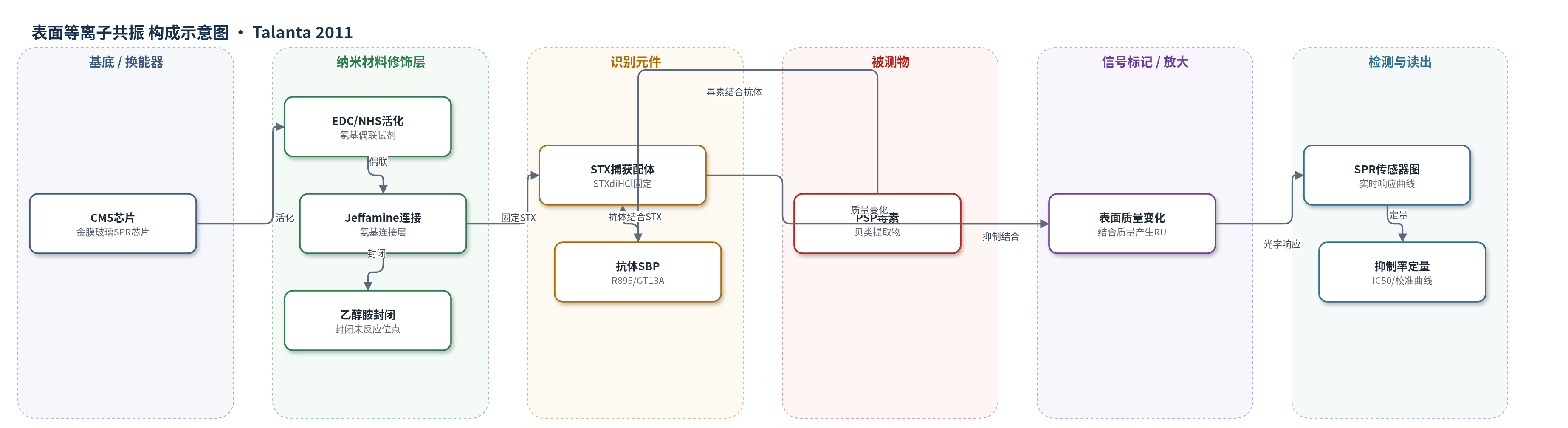
点击图片查看大图 · 依据论文自动绘制
传感器类型
表面等离子共振(SPR)生物传感器
检测对象
麻痹性贝类毒素(PSP toxins,含河豚毒素STX、gonyautoxins GTX、neosaxitoxin NEO等类似物);样品基质:贝类肉匀浆/提取物(贻贝、鸟蛤、蛤、牡蛎、扇贝)
检测原理
该SPR生物传感器采用竞争抑制法。CM5芯片表面经EDC/NHS活化、Jeffamine偶联和乙醇胺封闭后,用甲醛将STXdiHCl共价固定为捕获配体。检测时,样品提取物与已知浓度抗体R895或GT13A预混后注入芯片。若样品不含PSP毒素,抗体可结合芯片上的STX,表面结合质量增加,SPR响应升高;若样品含PSP毒素,毒素与抗体结合并竞争占据抗体结合位点,使抗体与芯片STX的结合减少,响应降低。响应抑制程度与PSP毒素浓度相关,通过STXdiHCl校准曲线或IC50进行半定量/定性判断。整个过程无需标记,实时监测金膜表面折射率变化,并用50 mM HCl再生芯片。
检测灵敏度
动态范围(IC20–IC80): R895/Biacore T100 2.02–6.40 ng/mL (242–768 μg STXdiHCl/kg);R895/Biacore Q 2.24–7.51 ng/mL (269–901 μg STXdiHCl/kg);GT13A/Biacore T100 5.72–30.5 ng/mL (686–3663 μg STXdiHCl/kg);GT13A/Biacore Q 2.80–18.93 ng/mL (335–2271 μg STXdiHCl/kg)。IC50: R895/Biacore T100 3.95 ng/mL (473 μg STXdiHCl/kg);R895/Biacore Q 4.96 ng/mL (563 μg STXdiHCl/kg);GT13A/Biacore T100 13.63 ng/mL (1635 μg STXdiHCl/kg);GT13A/Biacore Q 7.51 ng/mL (901 μg STXdiHCl/kg)。
效应效果
研究对60个贝类样品(贻贝、鸟蛤、蛤、牡蛎、扇贝)实际检测,并与AOAC HPLC和MBA比较。R895下Q与T100一致性91.7%,Q与HPLC 85.0%,Q与MBA 94.4%,T100与HPLC 86.7%,T100与MBA 90.7%;GT13A下Q与T100一致性100%,与HPLC 78.3%,与MBA 77.8%。GT13A对GTX2/3、C1/C2、dcGTX2/3、GTX5交叉反应较高(163%、175%、216%、137%),R895与毒性相关性更好。未报告RSD、回收率。方法提取简单、分析快速,可跨实验室和SPR平台转移,适合作为PSP毒素快速筛查,并与HPLC确证联用以减少MBA使用。
传感器的构成
- 基底/换能器:CM5传感器芯片(金膜玻璃,SPR光学换能)
- 活化层:EDC/NHS氨基偶联试剂,活化芯片表面羧基
- 连接层:Jeffamine(2,2-(ethylenedioxy)bis-(ethylamine)),提供氨基用于固定STX
- 封闭层:ethanolamine(1 M,pH 8.5),封闭未反应氨基
- 捕获配体:STXdiHCl(河豚毒素二盐酸盐),经甲醛氨基-氨基偶联固定,捕获抗体
- 识别元件:R895多克隆抗体或GT13A单克隆抗体(SBP),与STX/PSP毒素结合
- 运行缓冲液:HBS-EP或HBS-EP+,用于抗体/样品稀释和流动相
- 再生液:50 mM HCl,洗脱结合抗体并恢复芯片表面
中文摘要
麻痹性贝类中毒(PSP)毒素由某些海洋甲藻产生,可经滤食在双壳贝类中富集。小鼠生物试验(MBA)是国际公认参考方法,但存在技术困难并因伦理问题日益受到质疑,因此需要替代方法。本研究开发了一种快速表面等离子共振(SPR)生物传感器抑制法,用于检测贝类中的PSP毒素,采用河豚毒素(STX)多克隆抗体R895。该检测体系先在Biacore Q SPR系统上开发并验证,随后利用原型PSP毒素试剂盒和推荐参数转移至另一实验室的高通量Biacore T100系统,并评估单克隆抗体GT13A。尽管两种仪器均基于SPR原理,但在集成流体芯片、自动进样和芯片兼容性等方面差异较大。60个贝类样品经简单快速提取后在两个平台分析,并与AOAC高效液相色谱(HPLC)和MBA结果比较。基于2×2统计比较表,R895各方法总体一致性为85%–94.4%,GT13A为77.8%–100%。结果表明,具有高灵敏度和较广特异性的抗体SPR检测可应用于不同生物传感器平台。
英文摘要
Paralytic shellfish poisoning (PSP) toxins are produced by certain marine dinoflagellates and may accumulate in bivalve molluscs through filter feeding. The Mouse Bioassay (MBA) is the internationally recognised reference method of analysis, but it is prone to technical difficulties and regarded with increasing disapproval due to ethical reasons. As such, alternative methods are required. A rapid surface plasmon resonance (SPR) biosensor inhibition assay was developed to detect PSP toxins in shellfish by employing a saxitoxin polyclonal antibody (R895). Using an assay developed for and validated on the Biacore Q biosensor system, this project focused on transferring the assay to a high-throughput, Biacore T100 biosensor in another laboratory. This was achieved using a prototype PSP toxin kit and recommended assay parameters based on the Biacore Q method. A monoclonal antibody (GT13A) was also assessed. Even though these two instruments are based on SPR principles, they vary widely in their mode of operation including differences in the integrated μ-fluidic cartridges, autosampler system, and sensor chip compatibilities. Shellfish samples (n=60), extracted using a simple, rapid procedure, were analysed using each platform, and results were compared to AOAC high performance liquid chromatography (HPLC) and MBA methods. The overall agreement, based on statistical 2×2 comparison tables, between each method ranged from 85% to 94.4% using R895 and 77.8% to 100% using GT13A. The results demonstrated that the antibody based assays with high sensitivity and broad specificity to PSP toxins can be applied to different biosensor platforms.