组成图示
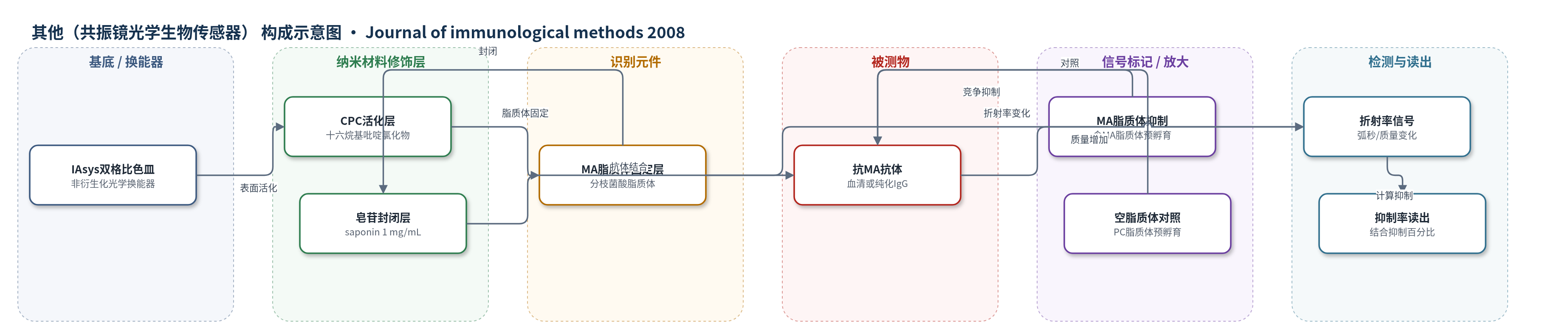
点击图片查看大图 · 依据论文自动绘制
传感器类型
其他(共振镜光学生物传感器)
检测对象
抗分枝菌酸抗体(anti-mycolic acid antibodies, anti-MA IgG);样品基质:患者血清(结核阳性/阴性、HIV阳性/阴性)
检测原理
IAsys共振镜生物传感器为无标记光学换能系统,通过实时监测固定层附近折射率变化来量化结合事件,折射率变化与界面累积质量成正比。非衍生化双格比色皿先用十六烷基吡啶氯化物(CPC)活化,再固定分枝菌酸脂质体(MA liposomes),并以皂苷封闭非特异位点。患者血清中的抗MA IgG与固定MA结合后,界面质量增加,产生结合信号。为降低血清非特异结合干扰,血清先与含MA脂质体或空磷脂酰胆碱(PC)脂质体预孵育;含MA脂质体可竞争性结合血清中的抗MA抗体,使其无法再结合传感器表面,从而降低信号。抑制率越高,提示血清中特异性抗MA抗体越多。TB阳性血清经MA脂质体预孵育后结合被显著抑制,阴性对照抑制较低。蛋白A纯化IgG实验进一步确认被抑制的结合组分是IgG。
检测灵敏度
原文未报告LOD、线性范围、灵敏度斜率或相关系数。
效应效果
研究分析61例患者血清。总体敏感性86.7%(26/30),特异性48.4%(15/31),准确率81.8%;排除18例TB-HIV+后,准确率83.7%(36/43),敏感性86.7%(26/30),特异性76.9%(10/13)。TB+HIV+亚组敏感性91.3%(21/23),TB+HIV-为71.4%(5/7);TB-HIV+特异性27.8%(5/18),TB-HIV-为76.9%(10/13)。与ELISA相比,该方法可实时检测低亲和力抗体,避免洗脱丢失弱结合抗体,并以抑制终点减少非特异干扰,部分ELISA假阴/假阳样本被正确判断。作者认为其在HIV高流行人群有潜力,但操作较难,尚不适合大规模筛查。
传感器的构成
- 基底/换能器:非衍生化双格生物传感器比色皿(IAsys resonant mirror cuvette),提供光学换能并监测界面折射率变化
- 表面活化层:十六烷基吡啶氯化物(CPC, 0.02 mg/mL in PBS/AE),活化比色皿表面以固定脂质体
- 识别/抗原层:分枝菌酸脂质体(mycolic acid liposomes, MA liposomes;含磷脂酰胆碱 phosphatidylcholine, PC),固定MA作为识别抗原
- 封闭层:皂苷(saponin, 1 mg/mL in PBS/AE),封闭非特异结合位点
- 样品/识别事件:患者血清或蛋白A纯化IgG(anti-MA IgG),与固定MA结合;预孵育MA脂质体或空PC脂质体用于抑制
- 再生层:PBS/AE洗涤、12.5 M KOH和96%乙醇,去除结合物并恢复表面
- 信号读出:IAsys共振镜光学系统,实时输出弧秒(arc seconds)折射率/质量变化信号
中文摘要
结核因HIV共感染和耐药菌株出现而重新成为全球健康问题。HIV共感染使基于痰检的结核诊断低估约30%,因此需要快速、可靠的血清学诊断方法辅助HIV高负担人群中的结核管理。分枝菌酸(MA)在结构上具有菌种特异性,且可经济提取和纯化,但ELISA检测抗MA抗体时假阳性和假阴性较多。本文报道一种改进的生物传感器方法,用于检测患者血清中抗MA抗体,作为活动性结核的替代标志物。将MA脂质体固定于非衍生化双格生物传感器比色皿,并用皂苷封闭。先用高稀释血清校准两个传感格的结合信号,再加入较低稀释但预先与含MA脂质体或空脂质体孵育的患者血清。痰检阳性结核患者血清或其蛋白A纯化IgG可被含MA脂质体预孵育后抑制与传感器表面MA的结合。若排除不能以阴性痰检作为参考标准的HIV阳性患者,抑制试验准确率为84%。若该技术适合高通量筛查,有望解决HIV背景下结核血清诊断难题。
英文摘要
Tuberculosis has re-emerged as a global health problem due to co-infection with HIV and the emergence of drug-resistant strains of Mycobacterium tuberculosis. HIV co-infection introduced a 30% underestimation in TB diagnosis based on sputum analysis, calling for a reliable and fast serodiagnostic assay to assist in the management of TB in HIV-burdened populations. Serodiagnosis with mycobacterial lipid cell wall antigens gave promising results, in particular with LAM and cord factor. Free mycolic acids have also been considered because they are unique in structure to each species of Mycobacterium and can be economically extracted and purified. In a standard immunoassay such as ELISA, however, an unacceptable number of false positive and false negative test results were obtained. Here we report a much improved biosensor method to detect antibodies to mycolic acids in patient serum as surrogate markers of active tuberculosis. Mycolic acid (MA) liposomes were immobilized on a non-derivatized twin-celled biosensor cuvette and blocked with saponin. A high dilution of serum was used to calibrate the binding signal of the two cells, followed by contact with patient serum at a lesser dilution, but pre-incubated with either antigen-carrying, or empty liposomes. The serum, or the protein A purified IgG thereof, from sputum-positive tuberculosis patients could be inhibited from binding to the MA in the biosensor by prior incubation with MA-containing liposomes. The accuracy of the inhibition test was 84% if HIV-positive patients for whom a negative TB sputum analyses could not be relied upon to serve as a reference standard were excluded. If biosensor technology could be made suitable for high throughput screening, then it may provide the solution to the serodiagnosis of tuberculosis against a background of HIV.