组成图示
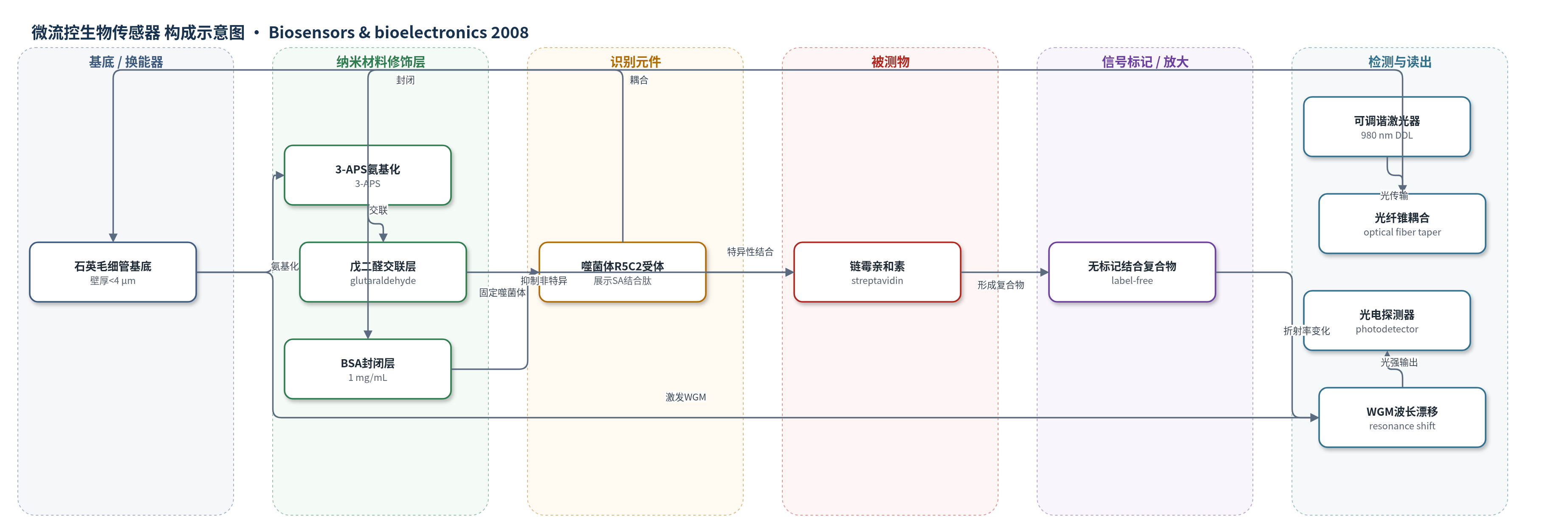
点击图片查看大图 · 依据论文自动绘制
传感器类型
微流控生物传感器
检测对象
链霉亲和素(streptavidin, SA);样品基质:PBS缓冲液
检测原理
OFRR以壁厚小于4 μm的石英毛细管作为微流控环谐振器,980 nm激光经光纤锥耦合后在毛细管内壁激发回音壁模式(WGM)。WGM的倏逝场向芯部延伸约100 nm,使表面附近分析物无需标记即可被检测。石英内壁经3-APS氨基化和戊二醛交联后,共价固定展示链霉亲和素结合肽的噬菌体R5C2,并用BSA封闭。当链霉亲和素与噬菌体受体结合时,表面分子密度增加,改变谐振器有效折射率neff,导致共振波长漂移Δλ。由于OFRR的Q因子约10^7,光子多次循环增强倏逝场与表面结合物的相互作用。结合量随分析物浓度增加而增加,在0.9 nM至3.6 μM范围内呈对数线性响应。
检测灵敏度
LOD: approximately 100 pM;理论 LOD: about 5 pM;线性范围: 0.9 nM–3.6 μM;BRIS: 20 nm per RIU;R = 0.94
效应效果
特异性方面,阴性对照噬菌体RAP 5对链霉亲和素无可观察响应,竞争结合实验显示游离R5C2浓度升高时归一化覆盖度下降,证实结合高度特异。Hill图拟合得Kd(apparent)=25 pM,n=0.4494±0.02472,R=0.99。再生实验表明,含KSCN 0.46 M、MgCl2 1.83 M、urea 0.92 M、guanidine-HCl 1.83 M和EDTA 20 mM的剥离液可去除链霉亲和素,PBS冲洗后信号回到基线,重复进样响应接近首次;若用稀HF完全再生,可重复4–5次。与SPR约1 pM、QCM约3 pM相比,本实验LOD约100 pM,理论约5 pM,作者认为可再提高一个数量级,适合低成本通用检测。
传感器的构成
- 基底/换能器:微尺寸石英毛细管(quartz capillary,壁厚<4 μm),形成OFRR环谐振器,支持WGM,倏逝场进入芯部约100 nm
- 氨基化修饰层:3-aminopropyltrimethoxysilane(3-APS,1%水溶液),在石英内壁引入氨基
- 交联固定层:glutaraldehyde(GA,5%水溶液),双功能交联剂,连接氨基表面与噬菌体胺基
- 识别元件:丝状噬菌体R5C2(filamentous phage R5C2),展示链霉亲和素结合肽,共价固定于表面
- 封闭层:bovine serum albumin(BSA,1 mg/mL),封闭未占据表面位点
- 光学读出:980 nm可调谐二极管激光器、光纤锥、光电探测器,记录WGM共振波长漂移
中文摘要
本文报道了一种基于噬菌体受体的无标记光流体环谐振器(OFRR)生物传感器,用于生物分子检测。与抗体相比,噬菌体受体具有明显优势:可从大规模随机肽库中通过亲和选择获得针对多种分析物的高特异性、高灵敏度受体;噬菌体生产流程更简单、成本更低;且能耐受高温、极端pH和变性剂等恶劣环境,从而降低环境限制并允许传感表面再生。作者以展示链霉亲和素结合肽的丝状噬菌体R5C2为模型受体,验证了噬菌体OFRR传感器的可行性。实验检测限约为100 pM链霉亲和素,表观解离常数Kd(apparent)为25 pM。以非特异性噬菌体RAP 5作为阴性对照验证了检测特异性。表面再生实验表明,噬菌体在再生后仍保持结合功能,显著提高了传感器可重复使用性。该平台有望成为高灵敏度、低成本、可重复使用的通用生物分子检测工具。
英文摘要
We have developed a sensitive and inexpensive opto-fluidic ring resonator (OFRR) biosensor using phage as a receptor for analyte detection. Phages have distinct advantages over antibodies as biosensor receptors. First, affinity selection from large libraries of random peptides displayed on phage provides a generic method of discovering receptors for detecting a wide range of analytes with high specificity and sensitivity. Second, phage production can be less complicated and less expensive than antibody production. Third, phages withstand harsh environments, reducing the environmental limitations and enabling regeneration of the biosensor surface. In this work, filamentous phage R5C2, displaying peptides that bind streptavidin specifically, was employed as a model receptor to demonstrate the feasibility of a phage-based OFRR biosensor. The experimental detection limit was approximately 100pM streptavidin and the K(d(apparent)) is 25pM. Specificity was verified using the RAP 5 phage, which is not specific to streptavidin, as the negative control. Sensing surface regeneration results show that the phage maintained functionality after surface regeneration, which greatly improves the sensors' reusability. The phage-based OFRR biosensor will become a promising platform for universal biomolecule detection with high sensitivity, low cost, and good reusability.