组成图示
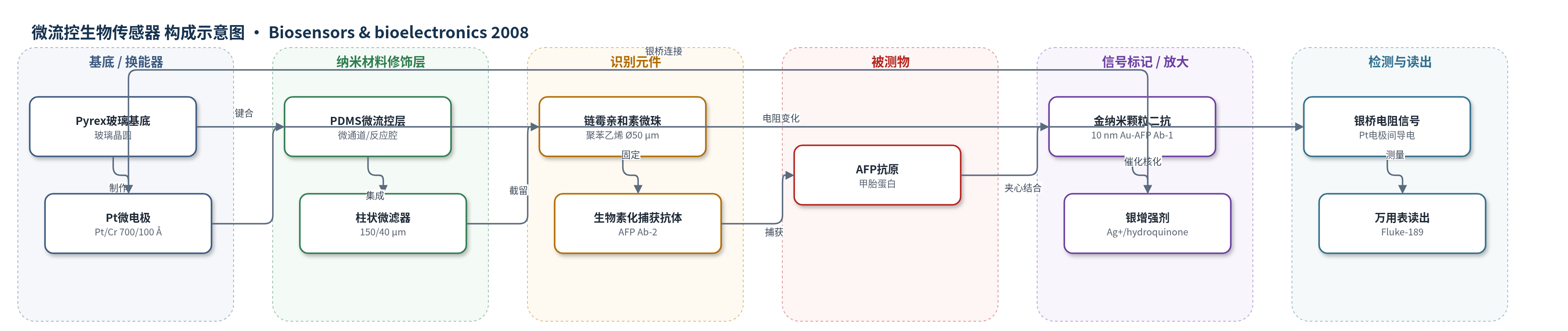
点击图片查看大图 · 依据论文自动绘制
传感器类型
微流控生物传感器
检测对象
甲胎蛋白(alpha-fetoprotein, AFP);样品基质:AFP标准溶液(临床应用指向血清)
检测原理
该传感器采用微珠-微滤器固相夹心免疫与免疫金银染色(IGSS)电检测。链霉亲和素微珠经生物素化捕获抗体固定后,被柱状微滤器截留在Pt微电极前;样品中AFP与捕获抗体结合,再加入金纳米颗粒偶联第二抗体形成夹心复合物。洗涤后,金颗粒作为核化位点,在银增强剂(Ag+和hydroquinone)作用下原位还原Ag+,生成银颗粒并进一步形成连接两Pt电极的导电银桥。AFP浓度越高,结合的金颗粒越多,银桥越完整,Pt电极间电阻越低;无AFP时仅少量非特异结合,银桥弱或无,电阻高。最终用万用表读取电阻变化实现定量。
检测灵敏度
LOD: 1 ng/mL;线性范围: 1–10^3 ng/mL;R^2 = 0.9746
效应效果
在优化条件下,完整检测约50–60 min,较传统免疫检测缩短约1 h;AFP检测范围为1–10^3 ng/mL,LOD为1 ng/mL,校准曲线相关系数R^2=0.9746。银增强前电阻约8–10 MΩ,增强后降至1–10 kΩ;洗涤后特异性结合与非特异性结合电阻差异约5000倍,表明选择性良好。银增强时间7 min可避免自核化背景;流速30/50 μL/min、孵育15 min为优化条件。作者认为该微流控电检测芯片可用于POCT和临床诊断,并可扩展至CEA、CA125、PSA等标志物。
传感器的构成
- 基底/换能器电极:Pyrex玻璃基底上制作Pt/Cr微电极(Pt 700 Å/Cr 100 Å),用于形成和检测银桥电阻信号
- 微流控结构层:PDMS(Sylgard 184)层,含入口/出口微通道、反应腔和柱状微滤器(孔径/间距150/40 μm),用于引导液体并截留微珠
- 固相载体:链霉亲和素包被聚苯乙烯微珠(Ø50 μm),作为抗体固定载体并被微滤器截留
- 识别元件:生物素化AFP捕获抗体(biotinylated AFP Ab-2,兔多克隆抗体),通过亲和素-生物素结合固定于微珠表面,捕获AFP
- 信号标记物:10 nm金纳米颗粒偶联AFP第二抗体(gold nanoparticle conjugated AFP Ab-1,鼠单克隆抗体),与AFP形成夹心复合物,金颗粒作为银还原核化位点
- 信号放大/换能材料:银增强剂(silver enhancer,Ag+ + hydroquinone还原剂),在金颗粒表面原位还原Ag+形成银颗粒/银桥
- 封闭剂:0.2% BSA磷酸盐缓冲液,用于减少微通道和微珠表面非特异性结合
- 流体驱动与读出:注射泵驱动微流控进样/洗涤,万用表(Fluke-189)测量Pt电极间电阻
中文摘要
传统免疫检测操作繁琐、成本高、耗时长,且需要大型检测设备。为此,作者开发并表征了一种由微珠和微生物芯片组成的新型免疫检测方法。该方法利用微珠过滤并固定抗体,并采用免疫金银染色(IGSS)方法放大与结合抗体相对应的电信号。芯片由覆盖在含铂(Pt)微电极的Pyrex玻璃基底上的廉价、生物相容性聚二甲基硅氧烷(PDMS)层构成;Pt微电极用于检测电信号,PDMS层中形成微通道和柱状微滤器。系统采用夹心免疫法检测癌症标志物甲胎蛋白(AFP)。结果表明,使用该系统可将完整检测时间缩短约1 h,检测限低至1 ng/mL,说明类似基于微珠的电检测系统可用于多种癌症的诊断。
英文摘要
Conventional immunoassays are labor intensive, expensive and time consuming and require large pieces of equipment for detection. Therefore, we have developed and characterized a novel immunoassay methodology comprised of microbeads and microbiochips. In this method, microbeads are used to filter and immobilize antibodies and an immuno-gold silver staining (IGSS) method is then used to amplify electrical signals that correspond to the bound antibodies. The chip used for this system is composed of an inexpensive and biocompatible polydimethylsiloxane (PDMS) layer over a Pyrex glass substrate that contains a platinum (Pt) microelectrode, which is used to detect the electrical signal in this system, the microelectrode is fabricated on the substrate and a microchannel and pillar-type microfilter is formed in the PDMS layer. A sandwich immunoassay approach was applied to detect alpha-fetoprotein (AFP), a cancer biomarker, using this system. The results of this study showed that the time required for a complete assay was reduced by 1h and a detection limit as low as 1 ng/mL was attained when this system used, which indicates that similar bead-based electrical detection systems could be used for the diagnosis of many forms of cancer.